
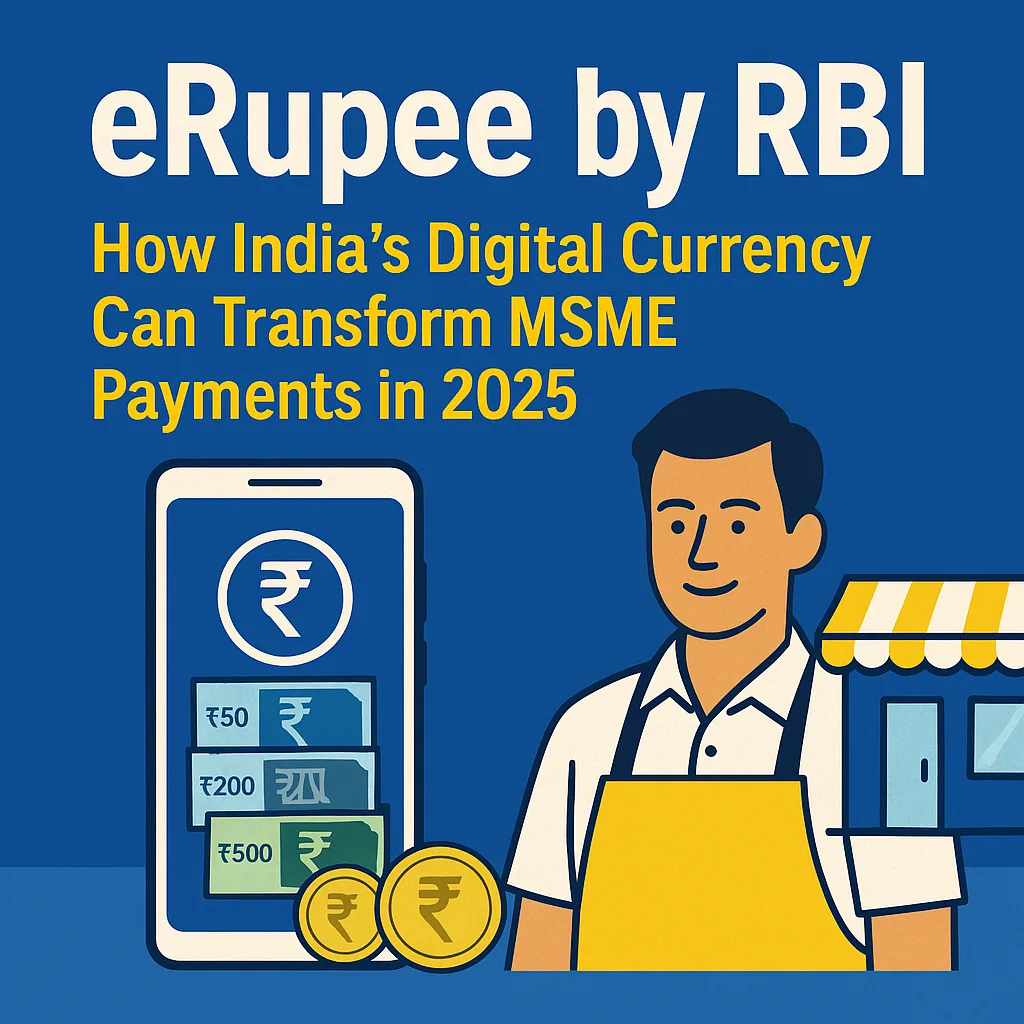
If you run a small business in India, you’ve already seen how digital payments changed your world after UPI became mainstream. But just like UPI took time to be accepted — and then grew exponentially during the COVID era — another quiet revolution is unfolding.
It’s called the eRupees, India’s RBI digital currency, officially launched and showcased at the Mumbai Fintech 2025 event.
And this time, it’s not just about going cashless — it’s about giving digital cash the feel of real cash.
You may also like to read: This Simple Financing Tool Is Helping MSMEs Grow Without Loans
What Is eRupees
The eRupee (e₹) is India’s official digital version of the rupee, issued by the Reserve Bank of India (RBI).
Unlike UPI, which moves money between bank accounts, the eRupees is itself money — just like the notes and coins in your wallet, but in digital form.
The eRupee is:
- Legal tender, issued by RBI
- Held in digital wallets operated by participating banks
- Transferred instantly between users or merchants
- Designed to work offline, even without the internet (in future versions)
In short, it’s digital cash, not just a balance in your account.
Which Banks Are Launching eRupee Apps
RBI began the retail eRupees pilot with selected banks. As of now, the following banks have officially launched or are piloting eRupees wallets:
- State Bank of India (SBI)
- ICICI Bank
- YES Bank
- IDFC First Bank
- HDFC Bank
- Kotak Mahindra Bank
- Bank of Baroda
- Union Bank of India
- Axis Bank
- Canara Bank
- Indian Bank
- IndusInd Bank
- Punjab National Bank (PNB)
Each bank has its own eRupees app, where users can hold, send, and receive eRupee in the form of digital notes and coins — just like real cash denominations.
For example:
In HDFC Bank’s app, you can open your Digital Rupees Wallet, see ₹100, ₹500, ₹2000 “notes” on your screen, and transfer them directly to another wallet — even if it’s with a different bank.
How Is eRupees Different from UPI
| Feature | UPI | eRupees |
|---|---|---|
| Issuer | Commercial banks | RBI directly |
| Nature | Payment system | Digital currency |
| Settlement | Between accounts | Token transfer (like cash) |
| Internet Needed | Yes | Optional (offline capable) |
| Transaction Fee | May apply (for businesses) | Expected to be minimal |
| User Experience | Transfer | Exchange of digital notes |
Think of UPI as a payment bridge, and eRupees as the digital money itself.
UPI needs both sender and receiver accounts; eRupee only needs wallets — just like handing someone cash.
How MSMEs Can Benefit from eRupees
For India’s MSME sector, eRupees is not just a fancy fintech product — it’s a practical game changer.
1. Faster Payments, No Bank Delays
Transactions settle instantly — directly from customer wallet to merchant wallet.
2. Offline Transactions
RBI is testing offline mode, so eRupees will work even in low-connectivity rural areas, helping local kirana stores and small traders.
3. Reduced Payment Costs
Since it’s issued by RBI, it eliminates multiple intermediaries — potentially reducing transaction charges for small businesses.
4. Ease of Use
With bank apps showing notes and coins visually, MSME owners feel like they’re still handling “cash,” just in digital form.
5. Fewer Cash Risks
No risk of theft, fake notes, or cash-handling errors — yet all the flexibility of cash payments.
6. Faster Reconciliation and Record Keeping
Digital receipts and clear transaction trails simplify accounting for GST and tax purposes.
Why eRupee Could Be the Next UPI Moment
Remember how UPI was slow to take off before COVID — and then suddenly exploded into daily use?
The eRupees could follow the same path:
- Government initiatives will boost awareness
- Banks are developing user-friendly apps
- Offline capability will expand rural access
- Businesses adopting early may attract digitally savvy customers
RBI is also exploring programmable eRupees — for example, a digital rupee token that can only be used for a specific subsidy or purpose. That’s huge for supply chains and MSME grants.
How MSMEs Can Get Ready Now
Even though eRupees is still expanding, small business owners can prepare early:
- Check if your bank supports eRupees or is in the pilot.
- Download your bank’s Digital Rupee Wallet app when available.
- Educate your staff and customers about how to use it.
- Start displaying “eRupees Accepted Here” at your shop or invoice.
- Keep monitoring updates from RBI and your bank.
Challenges to Watch Out For
Like any new system, eRupees adoption will face challenges:
- Limited availability during pilot phase
- Need for smartphones and basic digital literacy
- Awareness gap among small merchants
- Integration with accounting and ERP tools
But once these hurdles pass, the ecosystem effect could be huge — especially when fintech players like CRED, Amazon, and Google join the RBI’s eRupee project.
The Future: eRupee and MSME Empowerment
The eRupees is not just another payment app — it’s the foundation for India’s next digital economy layer.
For MSMEs, it means:
- Real-time settlements
- Lower payment friction
- Access to digital infrastructure even in offline zones
- Potential new credit and factoring products built on verified wallet transactions
Just as UPI revolutionized payments, eRupees may revolutionize money itself.
Frequently Asked Questions (FAQ)
Q1. What is eRupees?
The eRupees (e₹) is India’s RBI-issued digital currency — a legal tender in electronic form that can be stored in wallets and used just like cash.
Q2. Is eRupees different from UPI?
Yes. UPI transfers money between bank accounts. eRupee is the money itself, issued digitally by the RBI and stored in wallets.
Q3. Which banks have launched eRupee wallets?
Banks like SBI, ICICI, HDFC, YES Bank, IDFC First, Kotak, Bank of Baroda, and others have launched or are piloting eRupee wallet apps.
Q4. Can I use eRupees without internet?
Offline transactions are being tested by RBI. In the future, eRupee will work even in areas with no internet connectivity.
Q5. How can small businesses accept eRupee?
By downloading their bank’s eRupee app, setting up a merchant wallet, and displaying an eRupee QR code for customers.
Q6. Is eRupee safe?
Yes. Since it’s backed by RBI, it carries sovereign guarantee — just like physical cash.
Q7. How is eRupee useful for MSMEs?
It enables instant payments, reduces transaction costs, improves transparency, and can work offline — making it ideal for small traders and local businesses.
Final Thought
India’s eRupee is not just another fintech trend — it’s the next level of our digital payment infrastructure after UPI.
For MSMEs, it’s a chance to be part of India’s digital-cash revolution early.
Because just like UPI once did, eRupee will soon become the default way to pay and get paid.