
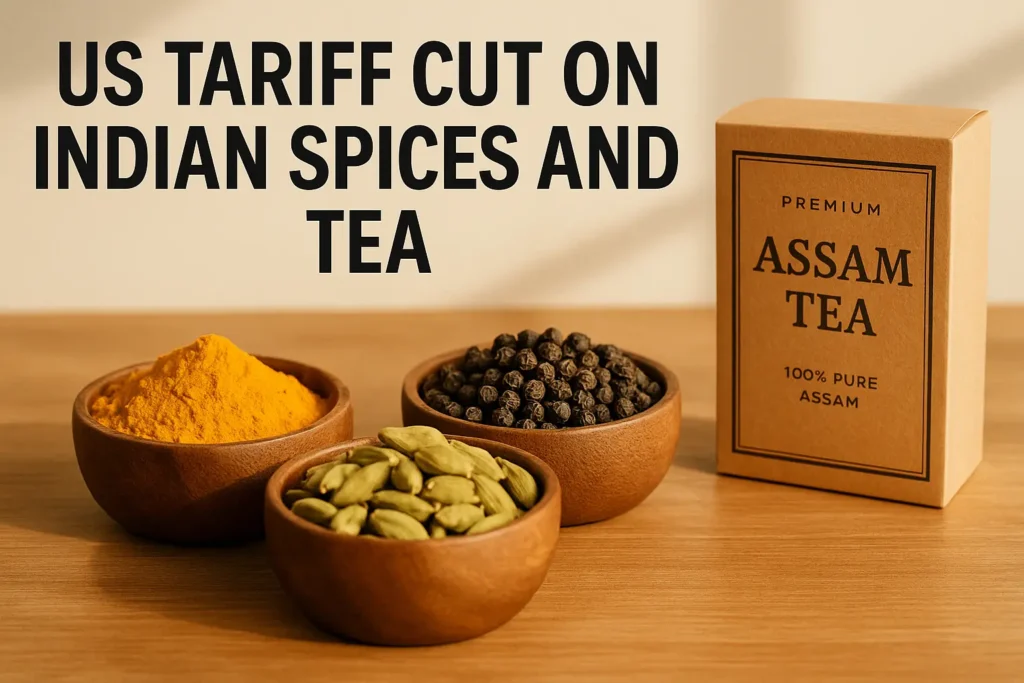
Why “US Tariff Cut on Indian Spices and Tea” Is Big News
The recent US tariff cut on Indian spices and tea is not just an international policy update — it is a real opportunity for India’s MSME exporters. As someone running a tea business, I felt genuine happiness when this news broke. After months of high import duties and cautious U.S. buyers, this move finally opens the door for better pricing, increased demand, and stronger market access.
Multiple credible outlets — Reuters, Financial Times, Associated Press, Times of India, Economic Times — have confirmed that the United States has removed or reduced tariffs on over 200 agricultural and food items, including tea, coffee and major spices like black pepper, cardamom, turmeric, and cumin.
This is likely to reshape the export landscape for Indian MSMEs in the tea and spice sectors.
You may also like to read: How MSMEs Can Use Import Export Data to Unlock High-Profit Products for Global Market
1. What the US Tariff Cut on Indian Spices and Tea Actually Means (Policy Breakdown)
✔ Immediate rollback of tariffs on 200+ products
According to Financial Times and Reuters, the U.S. has revised import duties on:
- Tea
- Coffee
- Major Indian spices
- Certain nuts (including cashews)
- Tropical fruits
- Processed food categories
This change took effect immediately, giving exporters a fast-track benefit.
✔ A reversal of earlier high tariffs
For more than a year, Indian exporters faced high reciprocal duties. This rollback signals a strategic shift focusing on supply-chain stability and grocery price control in the U.S.
2. The Numbers: Why This Tariff Cut Matters for India
✔ Spices: Over USD 500 million in U.S. imports from India
India exported more than US$500 million worth of spices to the U.S. in 2024.
✔ Massive opportunity for tea exporters
Assam black tea , and instant black tea have rising demand in U.S. niche markets like wellness stores and organic green tea in organic retailers.
✔ Overall export benefit: US$1–3 billion
LiveMint estimates that 1–3 billion USD worth of Indian agricultural products fall within the new reduced-tariff categories.
✔ Cashews & processed foods gain too
India supplies ~20% of U.S. cashew imports — now made cheaper due to the tariff cut.
3. Why I’m Personally Happy as a Tea Entrepreneur
When tariffs were high, many U.S. buyers avoided signing long-term contracts. Every conversation ended with:
“Let’s wait till the tariff situation becomes clear.”
Now, with the US tariff cut on Indian spices and tea, here’s what changes:
- Buyers are more confident in placing larger orders.
- MSMEs can offer competitive pricing.
- Margins can finally improve instead of being squeezed.
- Market entry becomes easier for new exporters.
For small and medium tea businesses like mine, this is a big motivational boost and a real business opportunity.
4. How the US Tariff Cut on Indian Spices and Tea Supports MSME Exporters
A) Boosts price competitiveness
Lower duties = lower landed cost for U.S. buyers → better sales potential for MSMEs.
B) Makes buyers more willing to source from India
Retailers and wholesalers prefer predictable tariffs. The rollback reduces their risk.
C) Encourages value-added products
Indian MSMEs can now push products like:
- Tea blends
- Turmeric latte mixes
- Masala spice kits
- Ginger-turmeric wellness powders
- Premium orthodox teas
D) Improves long-term contract feasibility
Reduced tariff uncertainty encourages U.S. importers to sign year-long agreements.
E) Short-term demand spike expected
Buyers who held back orders due to high tariffs may now re-enter the market.
5. Practical 7-Step Action Plan for MSME Exporters
1. Confirm products covered under the tariff cut
Use your HS codes to verify eligibility.
2. Update compliance documentation immediately
FDA, USDA, FSSAI, organic certificates, lab tests — U.S. customs is strict.
3. Rework your pricing strategy
Prepare two versions of quotation:
- Price reduction (to gain market share)
- Margin protection (to enhance profits)
4. Contact existing buyers first
Send them a message like:
“Due to the recent US tariff cut on Indian spices and tea, we can now offer revised pricing. Happy to reopen discussions.”
5. Pitch new U.S. buyers
- Consultants
- Specialty tea stores
- Ethnic grocery chains
- E-commerce wholesalers
- Wellness brands
6. Secure logistics early
Freight routes may tighten once demand rises.
7. Develop at least one new value-added product
Innovation increases chances of shelf-space in the U.S.
6. Risks to Watch Before Scaling Up
1. Policy volatility
The tariff cut is an executive action; it can change with political cycles.
2. Competition from other countries
Vietnam, Indonesia and Latin American spice exporters are also eyeing the U.S. market.
3. Strict non-tariff barriers
Residue limits, labeling laws, and certification processes remain unchanged.
7. What Comes Next? (Market Outlook)
- U.S.–India trade dialogues may expand.
- Some more food items may be added to the relief list.
- Retail prices in the U.S. could fall, increasing consumption.
- Indian MSMEs entering early will get first-mover advantage.
8. Conclusion: Why This Tariff Cut Is a Turning Point for MSMEs
The US tariff cut on Indian spices and tea is a high-impact development for India’s MSME exporters. It unlocks new market opportunities, improves margins, encourages product innovation, and restores confidence among U.S. buyers.
For small tea and spice entrepreneurs like me, this is not just good news — it’s a strategic inflection point.
The opportunity is open, but only those who move fast, upgrade quality, and refine pricing will fully benefit.
The next 3–6 months will be crucial.
Take action now.
Frequently Asked Questions (FAQ)
1. What exactly does the US tariff cut on Indian spices and tea include?
It covers tea, coffee, black pepper, turmeric, cardamom, cumin, ginger, cloves, cashews, tropical fruits, and many processed foods.
2. Will this increase MSME export orders immediately?
Buyers may increase orders, but exporters must improve compliance, pricing and logistics to fully benefit.
3. Can the tariff reductions be reversed?
Yes, future political decisions or trade disputes could reverse or modify them.
4. Are logistics still a concern for exporters?
Yes. Freight delays and costs remain a challenge.
5. Should MSMEs focus on value-added products now?
Absolutely. Value-added teas and spice mixes fetch higher margins and respond better to tariff advantages.
About the Author
Tabrez Khan — Tea entrepreneur,exporter, digital creator and business strategist. He writes about MSMEs, exports, online business and global trade insights to help young entrepreneurs grow through BusinessZindagi.com.
🔗 Authentic Sources & References
- Reuters: US tariff rollback gives relief to Indian agri exporters
- Financial Times: Trump cuts tariffs on key food & farm ite
- Economic Times: US lowers duties on Indian spices & tea
- Hindustan Times: How US tariff cuts impact Indian export
- Moneycontrol: Relief for Indian spice and tea exporters
- The Federal: Trump tariff cut boosts Indian agri exports