
If you run a small business, startup, or MSME in India and handle customer or employee data, there’s a new rulebook you cannot ignore — the Digital Personal Data Protection (DPDP) Rules, 2025. These rules are now law and spell out how personal data must be collected, used, stored, protected and eventually deleted. Wikipedia
But here’s the twist: most MSMEs still haven’t realised this reality yet. That’s not opinion — that’s what Tally Solutions Managing Director Tejas Goenka said in a recent Moneycontrol interview.
“There’s a lot of effort that’s going to be needed. I don’t think people are even aware… DPDP is not even a subject in many conversations. There’s a lot that government, industry bodies and agencies will have to do to spread this knowledge.” — Tejas Goenka, MD, Tally Solutions Moneycontrol
This tells you one thing: DPDP Rules compliance isn’t an abstract legal concept anymore — it’s a real business challenge and opportunity.
In this post, we explain DPDP Rules in plain language, why they matter, what MSMEs should worry about, practical compliance steps, real penalties, and the tools you can adopt right now.
related post: DPDP Act vs DPDP Rules Difference — A Practical Guide for MSMEs & Startups
What Exactly Are DPDP Rules 2025?
The DPDP Rules, 2025 were notified by the Government of India on November 14, 2025 under the Digital Personal Data Protection Act. Wikipedia
They add detail to how businesses must:
- collect customer and employee data
- secure and store it properly
- limit data use
- respond to data access or deletion requests
- report breaches or leaks
- manage cross-border data flows
Think of the DPDP Rules as the operational playbook for data privacy in India — especially for digital businesses.
Why This Matters for MSMEs & Startups
Even if your business is small, if you:
✔ collect customer phone numbers or emails
✔ save data in CRMs, Excel, WhatsApp
✔ use cloud tools or third-party apps
✔ have employee records
…then DPDP Rules apply to you.
Yet, as Tally MD Tejas Goenka warned:
“Most MSMEs aren’t even aware of DPDP compliance yet.” Moneycontrol
This poses two big risks:
- Compliance failure
- Financial & reputation damage
So the early birds who act now will avoid costly mistakes later.
DPDP Rules — Reality Check for Small Businesses
Myth vs. Reality
Myth: “Data protection laws only hit big tech and MNCs.”
Reality: Any business handling digital personal data needs to follow DPDP Rules.
Myth: “Penalties are unlikely.”
Reality: Penalties exist if negligence or breach occurs — especially if you ignore consent rules or data security. Moneycontrol
related post: How MSMEs Can Collect Customer Data Legally Under the DPDP Act — A Practical Guide for Small Businesses
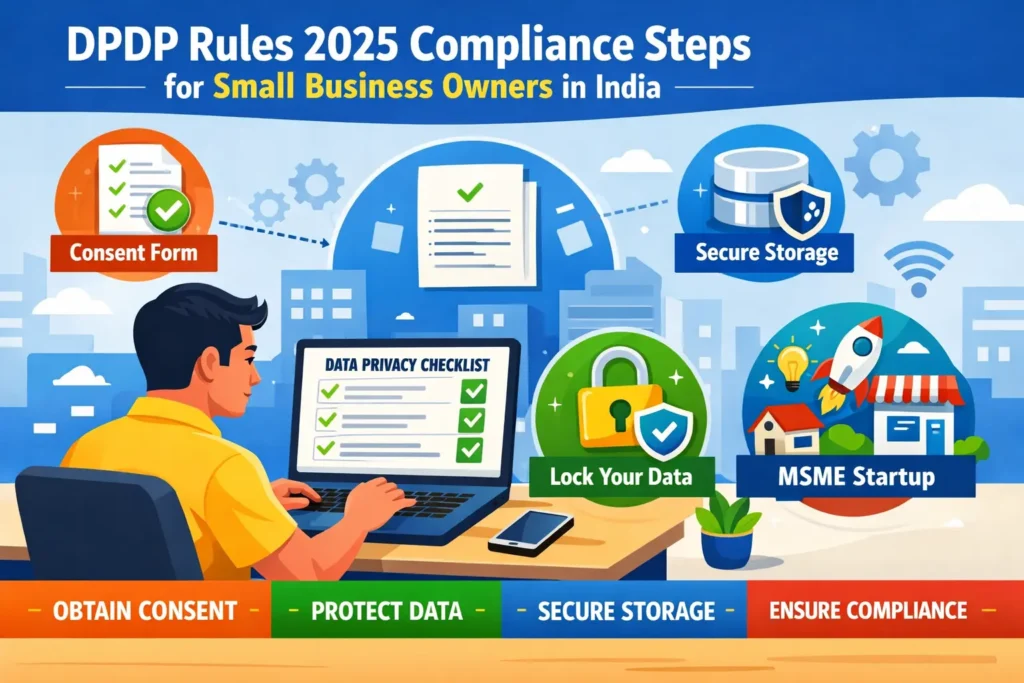
DPDP Compliance Checklist Every MSME Should Follow
Here’s a practical checklist you can start with today:
✔ 1. Honest Data Collection Notices
Tell users:
- why you collect data
- what you’ll use it for
- how long you’ll keep it
Example language:
“We collect your phone number to send invoices and delivery updates only.”
✔ 2. Consent That Really Counts
Verifiable and informed consent — not hidden pre-ticks.
If you use customer numbers for marketing, get explicit opt-in.
✔ 3. Secure Data Storage
Avoid:
❌ shared public spreadsheets
❌ storing unsecured files on phones
Use secure cloud services with access restrictions.
✔ 4. Respond to Consumer Rights
If a customer wants:
- their data deleted
- a copy of their data
- corrections
You must respond within a reasonable time.
✔ 5. Phase Out Old or Unnecessary Info
Older or irrelevant data?
Delete it.
Records should only be kept as long as needed.
How MSMEs Can Start Today — 5 Quick Wins
- Add a privacy notice on your website or WhatsApp business greeting
- Set up a simple consent form for leads
- Review where your data is stored
- Train the team on secure practices
- Document what data is collected and why
Small steps = big compliance impact.
Common DPDP Mistakes to Avoid
❌ Sending marketing texts without consent
❌ Sharing customer lists with external agencies
❌ Storing sensitive data in open files
❌ Ignoring employee data safety
These can draw enforcement attention faster than you think.
❓ Frequently Asked Questions (FAQs)
Q1. Do DPDP Rules apply to freelancers and consultants?
Yes — if you handle personal data digitally, you must follow the basic principles.
Q2. Does WhatsApp Business data count?
Yes — DPDP Rules cover all digital personal data collection and use.
Q3. Are MSMEs seriously fined?
Penalties generally target repeated negligence or harmful misuse, but showing good-faith compliance matters.
Q4. What if I only use customer numbers for delivery updates?
You still need transparent purpose notices and basic consent.
Final Words — Turn Compliance Into Competitive Advantage
DPDP Rules aren’t designed to kill business growth. They are a framework to:
✔ protect customer trust
✔ formalise responsible data handling
✔ align Indian businesses with global data privacy norms
And the fact that leading software providers like Tally Solutions are sounding the alarm means it’s time to pay attention and act. Moneycontrol
📎 Authentic sources and References Links
- 📘 DPDP Rules 2025 — Wikipedia summary: https://en.wikipedia.org/wiki/Digital_Personal_Data_Protection_Rules%2C_2025 Wikipedia
- 📰 Tally MD Tejas Goenka on MSME awareness gap: https://www.moneycontrol.com/news/business/information-technology/most-msmes-aren-t-aware-of-dpdp-rules-compliance-yet-says-tally-solutions-md-tejas-goenka-13737369.html Moneycontrol
About the Author
Tabrez is a first-generation entrepreneur, tea trader, exporter and business writer from Assam. Through BusinessZindagi.com, he shares practical insights, ground-reality perspectives and entrepreneurial lessons for MSMEs, exporters, startup founders and small business owners in India.
⚠️ Disclaimer
This article explains DPDP Rules from a business and awareness perspective. It is not a legal opinion. For case-specific compliance interpretation, consult a qualified legal or data privacy professional.