
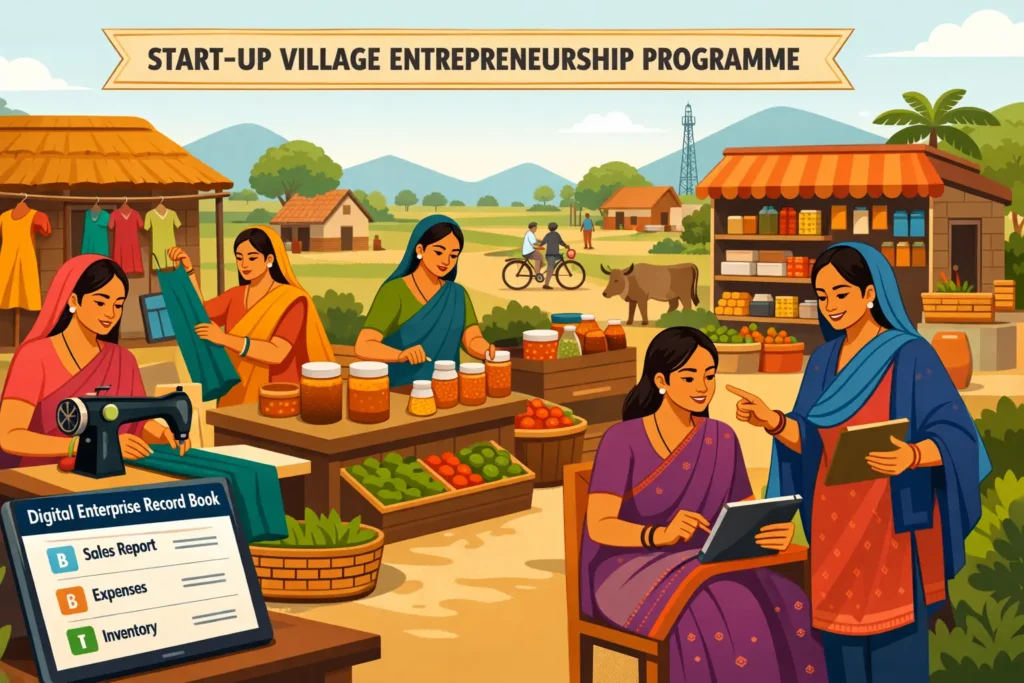
In a small village in Uttar Pradesh, Meena Devi once depended entirely on seasonal farm labour.
Today, she runs a small tailoring unit employing three local women. Her husband helps with order delivery. Their children now attend school regularly.
Her transformation wasn’t accidental.
It was made possible through the Start-Up Village Entrepreneurship Programme (SVEP) — a quiet but powerful rural entrepreneurship movement that is turning thousands of villagers into self-reliant micro-entrepreneurs.
And what makes SVEP different is this:
👉 It doesn’t just give loans.
👉 It builds confidence, capacity, market linkages — and an ecosystem around entrepreneurs.
Let’s explore how.
you may also like to read: Shishu, Kishor, and Tarun: Which MUDRA Loan Category Fits Your MSME?
What Is the Start-Up Village Entrepreneurship Programme?
The Start-Up Village Entrepreneurship Programme (SVEP) is a flagship sub-scheme under the
Deendayal Antyodaya Yojana – National Rural Livelihoods Mission (DAY-NRLM)
implemented by the Ministry of Rural Development.
Its mission is simple — yet transformational:
To help rural poor — especially SHG women & youth — start and sustain non-farm micro-enterprises
through finance, mentoring, training and community-based enterprise support.
Instead of one-time assistance, SVEP offers end-to-end enterprise development support, including:
- business planning & feasibility assessment
- training & soft-skills
- access to credit through Community Enterprise Fund (CEF)
- mentoring by local CRP-Enterprise Promoters
- market linkage support
- continuous hand-holding until business stabilisation
In short…
👉 SVEP doesn’t just help people start businesses — it helps them succeed in business.
Reference: Ministry of Rural Development – SVEP Portal
https://svep.nrlm.gov.in/
Scale, Coverage & Impact — Numbers That Tell the Story
SVEP has steadily grown from a pilot initiative into a nationwide rural entrepreneurship model.
🌍 Programme Scale (As per PIB Reports)
- Implemented in 429 blocks across 31 States & UTs
- More than 3,13,000+ micro-enterprises supported
Source: Press Information Bureau
https://pib.gov.in/PressReleasePage.aspx?PRID=2081567
Strong Women & SHG Participation
In Uttar Pradesh:
- ~1.7 crore women across 16 lakh SHGs have been mobilised under livelihood & enterprise programmes
- SVEP has enabled thousands of village-level micro-businesses
Source: Times of India policy update
https://timesofindia.indiatimes.com/city/lucknow/govt-boosts-rural-entrepreneurshipscheme-with-fresh-budget-allocation/articleshow/126166142.cms
SVEP strengthens:
- rural household income
- dignity
- decision-making power of women
- community entrepreneurship culture
Long-Term Vision
Over time, the programme is expected to enable:
- 1 crore+ village enterprises
- 2 crore+ livelihood opportunities
(Reference — State implementation framework & programme concept notes)
What Is the Financial Assistance Under SVEP?
SVEP does not provide direct cash subsidy.
Instead, it supports entrepreneurs through the
Community Enterprise Fund (CEF) — a revolving loan facility managed at community level.
💵 Financial Assistance Structure
- CEF Corpus per Block: ~ ₹1 crore (indicative, varies by project)
- Typical Enterprise Loan Range
- Individual enterprise — up to ~₹2.5 lakh
- Group enterprise — up to ~₹5 lakh
- Interest rate & tenure — linked to cash-flow viability
Loans are:
✔ repayable
✔ community-managed
✔ reinvested to help more entrepreneurs
Guideline references:
https://cdnbbsr.s3waas.gov.in/…/Community-Enterprise-Fund-Guidelines.pdf
https://www.scribd.com/document/734289649/OSF-guideline-DAY-NRLM
This makes SVEP a financially sustainable entrepreneurship model — not a grant-driven one.
How the Programme Works — The SVEP Support Ecosystem
SVEP is built on three strong pillars:
1️⃣ Finance Support
- Community Enterprise Fund (CEF)
- bank credit facilitation where required
2️⃣ Capacity Building
- business training
- enterprise planning tools
- digital record-keeping support
3️⃣ Local Mentoring Ecosystem
- Community Resource Persons – Enterprise Promotion (CRP-EPs)
- Block Resource Centres (BRCs)
- SHG federations
This creates:
✔ local entrepreneurship leadership
✔ peer support networks
✔ community-owned development
Unlike external consultant-led schemes,
SVEP develops entrepreneurs from within the village ecosystem.
How SVEP Is Different from Other Self-Employment Schemes
Many schemes focus mainly on:
- loans (like MUDRA / PMEGP), or
- training (skill missions)
SVEP is different because it integrates:
| Support Area | SVEP | Loan Schemes | Skill Schemes |
|---|---|---|---|
| Credit support | ✔ Yes | ✔ Yes | ✘ No |
| Training & capacity building | ✔ Strong | ✘ Limited | ✔ Strong |
| Hand-holding & mentoring | ✔ Continuous | ✘ Rare | ✘ None |
| Community-based ecosystem | ✔ Yes | ✘ No | ✘ No |
| Focus | Rural non-farm micro-enterprises | Capital financing | Wage employment |
👉 Other schemes create borrowers & trainees.
SVEP creates entrepreneurs.
Real Impact on Rural Livelihoods
Independent studies & field evaluations highlight:
- significant decline in distress migration
- improvement in household income stability
- increase in food security & consumption
- rise in women-led entrepreneurship
Research reference
https://ijmds.in/index.php/ijmds/article/view/485
Micro-enterprises supported include:
- tailoring & grocery units
- dairy & food processing
- mobile repair & service shops
- handicrafts & local trades
These become anchors of local village economies.
Latest Policy Developments
- Recent budgets have allocated additional funds to strengthen SVEP expansion
- Focus on capacity building & scaling successful enterprises
- Strong results reported in Uttar Pradesh & several states
Policy update reference
https://timesofindia.indiatimes.com/city/lucknow/govt-boosts-rural-entrepreneurshipscheme-with-fresh-budget-allocation/articleshow/126166142.cms
Why the Start-Up Village Entrepreneurship Programme Matters
SVEP is much more than a scheme.
It represents a shift from:
❌ dependency-based welfare
to
✅ community-owned entrepreneurship
It helps villages generate:
- local employment
- diversified income
- social empowerment
- economic resilience
And most importantly…
👉 it gives first-generation entrepreneurs
the confidence to believe:
“Business can happen in villages too — not just in cities.”
🔗 Useful Official & Authentic References
Here are the direct sources behind the figures above:
📑 CEF Funding and Loan Scale Guideline Details
(block level corpus & enterprise loan figures) https://www.scribd.com/document/734289649/OSF-guideline-DAY-NRLM Scribd
📘 SVEP Official Portal – Programme overview & objectives
https://svep.nrlm.gov.in/ SVEP-NRETP
📊 PIB Report on SVEP Implementation & Financial Releases
https://www.pib.gov.in/PressReleasePage.aspx?PRID=2081567 Press Information Bureau
✍️ About the Author
Tabrez is an entrepreneur and MSME enthusiast who writes about small business growth, government schemes, rural entrepreneurship and export trade. He focuses on simplifying policy information and turning it into practical insights for entrepreneurs and self-starters.
⚖️ Disclaimer
This article on the Start-Up Village Entrepreneurship Programme (SVEP) has been prepared for educational, informational and general awareness purposes only. The content is based on publicly available government documents, official portals, press releases, research papers, policy reports, and credible news sources.
While every effort has been made to ensure accuracy, scheme guidelines, financial limits, coverage and eligibility conditions may change over time. Readers are strongly advised to verify details from official government websites, departments, or authorised programme authorities before making any financial or business decisions.
This article also uses ChatGPT / AI-assisted research and drafting tools to help in:
- organising information
- improving readability
- structuring content
- compiling references
All facts and key programme details have been cross-checked with authentic sources as far as possible, but neither the author nor the publisher shall be held responsible for any errors, omissions, policy changes or misinterpretation of information.
Official sources and documents should always be treated as the final reference.