
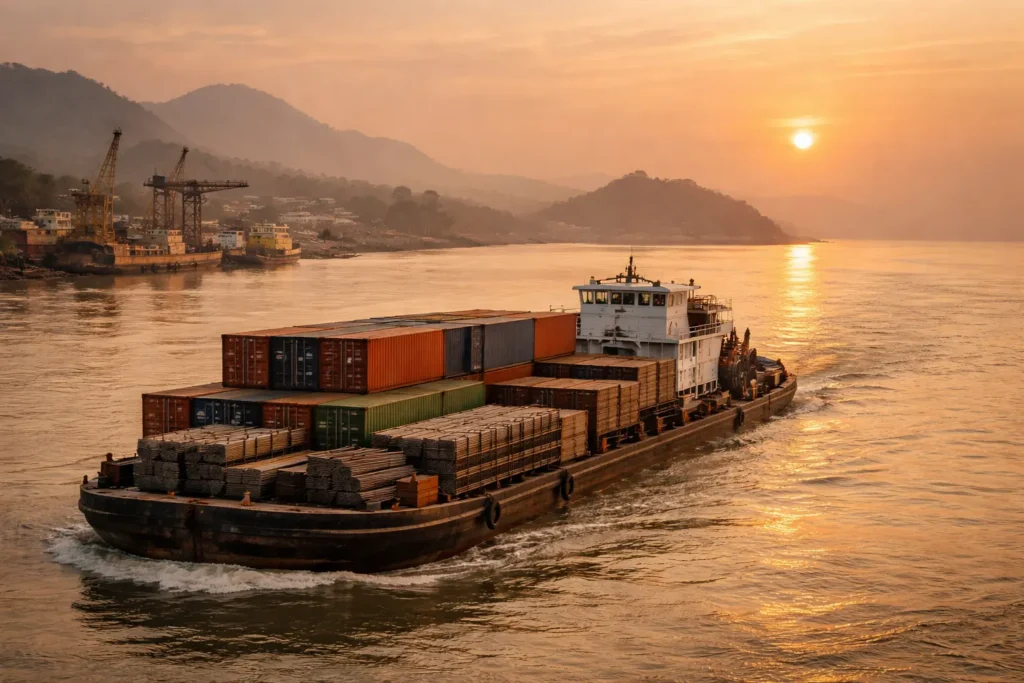
A Shipment That Signals a Bigger Shift
A recent cargo movement by Tata Steel Ltd—carrying slag and TMT bars to Assam via river routes—might look like a routine logistics update.
But if you read between the lines, it reveals something much bigger:
👉 A shift towards inland waterways that could redefine business economics in Northeast India.
At a time when fuel prices are unpredictable and transport costs are rising globally, this shift is not just useful—it’s necessary.
What Are Inland Waterways (And Why Should You Care?)
Think of inland waterways as highways made of rivers.
Instead of trucks burning expensive fuel, goods move through:
- The Brahmaputra River
- Ganga river systems
- Cross-border river routes via Bangladesh
💡 The result?
- Lower cost
- Higher efficiency
- Less dependency on fuel
👉 In simple terms: more goods moved at less cost
related article:Transportation Cost Crisis: How Rising Logistics Expenses Are Hurting Small Businesses
The Game-Changer: Indo-Bangladesh Protocol Route Logistics
The Indo-Bangladesh Protocol Route is the real backbone behind this transformation.
It allows Indian cargo to:
- Travel through Bangladesh rivers
- Reach Assam faster
- Avoid long and costly land routes
Why this matters for business:
- No dependency on the narrow Siliguri corridor
- Shorter routes = lower fuel usage
- Faster delivery cycles
👉 This is not just a trade agreement—it’s a cost-saving corridor for the entire Northeast.
Rising Fuel Prices Are Changing the Game
Let’s connect this to the current global situation.
When fuel prices rise:
- Truck transport becomes expensive
- Logistics costs shoot up
- Profit margins shrink—especially for MSMEs
Now here’s the turning point:
👉 Waterways use far less fuel per tonne of cargo
That means:
- The higher fuel prices go
- The more attractive inland waterways become
💡 This is why smart businesses are should consider shifting to river transport
⛽ Fuel Prices Rising? Calculate Your Business Impact
Even a small increase in petrol or diesel prices can quietly increase your transportation, delivery and operating costs.
💰 Use our free calculator to instantly find out your monthly cost increase, annual fuel impact and possible effect on your business profits.
🚚 Fuel Price Impact Calculator for Businesses
Calculate how changes in petrol, diesel, CNG or other fuel prices affect your business costs, deliveries and profit.
⛽ Fuel Price Change
How Northeast Industries Benefit (Direct Impact)
1. Cheaper Raw Materials = Better Margins
Industries in Assam and nearby regions depend heavily on incoming raw materials like:
- Cement inputs
- Steel
- Fertilizers
With inland waterways:
👉 Bulk cargo arrives at significantly lower cost
This directly improves:
- Production cost
- Pricing competitiveness
- Profit margins
2. MSMEs Get a Survival Advantage
Let’s focus on the key opportunity:
👉 inland water transport India MSME benefits
For small businesses:
- Even a small reduction in logistics cost matters
- Lower freight = higher survival chances
Waterways help MSMEs:
- Compete with bigger players
- Expand distribution
- Maintain stable pricing despite fuel hikes
3. Faster Access to Bigger Markets
Earlier, geography was a disadvantage for Northeast businesses.
Now:
- River routes connect Assam to ports faster
- Export becomes easier
Industries like:
- Tea 🍃
- Handicrafts
- Agro products
can now reach national and global markets more efficiently
4. New Business Ecosystems Around River Ports
Pandu Port is no longer just a docking point—it’s becoming a business hub.
Around such ports, we are seeing:
- Warehousing growth
- Logistics startups
- Industrial clusters
👉 This creates:
- Jobs
- Investment opportunities
- Local economic growth
5. Reduced Risk from Fuel Price Volatility
This is a hidden but powerful benefit.
When your business depends on trucks:
- Fuel price shocks = immediate cost increase
But with waterways:
- Fuel consumption is lower
- Cost impact is reduced
👉 This gives businesses cost stability in uncertain times
🌱 The Bigger Picture (Indirect Benefits)
✔ Cleaner and Sustainable Growth
Waterways produce significantly lower emissions compared to road transport.
✔ Less Traffic, Faster Movement
Heavy cargo shifting to rivers reduces:
- Highway congestion
- Delivery delays
✔ Stronger Regional Trade
Better connectivity with Bangladesh improves:
- Cross-border trade
- Regional economic integration
BusinessZindagi Insight
Here’s the real takeaway:
👉 This is not just about one shipment.
👉 This is about who adapts first.
Businesses that:
- Understand inland waterways early
- Align their logistics strategy
- Reduce dependence on road transport
will gain a long-term cost advantage
❓ FAQ
Q1. Why are inland waterways becoming popular now?
Because rising fuel prices are making road transport expensive, pushing businesses to cheaper alternatives.
Q2. Is this relevant only for large companies?
No. MSMEs benefit even more because logistics cost directly affects their survival and margins.
Q3. Which sectors will grow the most?
Steel, cement, agriculture, tea, FMCG, and logistics services.
Q4. Is the Indo-Bangladesh route reliable?
Yes, it is a long-standing agreement and is now being actively used for cargo movement.
🔗 Authentic Sources & References (Clickable)
- https://www.pib.gov.in/PressReleasePage.aspx?PRID=2155481
- https://www.pib.gov.in/PressReleasePage.aspx?PRID=1907994
- https://www.drishtiias.com/sambhav-daily-answer-writing-practice/papers/sambhav-2025/inland-waterways-transform-indias-logistics-and-transportation-sector-in-terms-of-economic-growth/print
- https://www.icimod.org/article/opinion-how-the-india-bangladesh-waterway-builds-cooperation/
✍️ About Author
Tabrez Khan writes for BusinessZindagi, simplifying complex business trends into actionable insights for MSMEs and emerging entrepreneurs.
⚠️ AI Disclaimer
This article is generated with AI assistance using publicly available data and verified sources. Readers should verify critical information before making business decisions.