
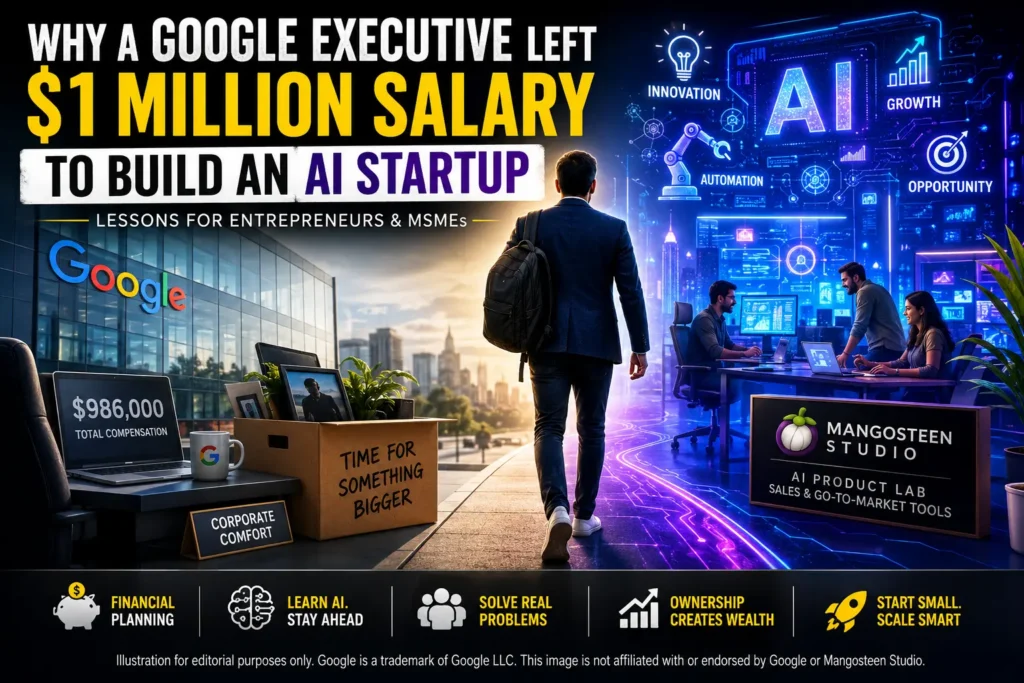
Would you leave a job paying nearly $1 million (around ₹9.5 crore) a year to start a new business?
For most people, the answer would be a firm “No.” But for Yousuf Imran, the answer was different. Despite working at Google and earning an exceptionally high compensation package, he resigned to launch his own AI startup, believing that the biggest opportunities in the coming decade lie in artificial intelligence rather than corporate employment.
His decision has sparked discussions across the startup ecosystem. Was it a reckless gamble or a carefully calculated entrepreneurial move?
In this article, we explore the Yousuf Imran AI startup story, the reasons behind his decision, and, most importantly, the practical lessons that Indian entrepreneurs, startups, and MSMEs can learn from it.
Who Is Yousuf Imran?
Yousuf Imran is a former Google account executive with over 15 years of experience in enterprise sales and technology.
According to recent reports, his annual compensation approached $1 million, yet he decided to leave Google to establish Mangosteen Studio, an AI-focused startup. His decision was not driven by dissatisfaction with his job but by his conviction that artificial intelligence is fundamentally reshaping how businesses are built and how value will be created in the future.
This makes the Yousuf Imran AI startup story especially relevant for entrepreneurs considering whether to build with AI rather than simply use AI.
Yousuf Imran Google AI Departure: Why Leaving Google Was a Strategic Decision
Many readers are searching for Yousuf Imran Google AI departure to understand why someone earning nearly $1 million annually at Google would voluntarily resign.
The answer goes far beyond salary. According to Yousuf Imran, his decision was driven by a combination of factors:
1. AI FOMO (Fear of Missing Out)
One of the most interesting aspects of the story is that Imran openly admitted experiencing “AI FOMO.”
Instead of fearing AI would replace his job, he feared missing one of the biggest technological shifts of this generation.
As generative AI continues to transform industries, he believed entrepreneurs who start early may benefit more than those who wait until the market becomes crowded.
2. Ownership Can Be More Valuable Than Salary
A salary provides financial security.
Ownership creates long-term wealth.
This is perhaps the biggest takeaway from the Google executive AI startup story.
Even an annual compensation nearing $1 million has limits. A successful startup, on the other hand, offers equity that can appreciate significantly if the company grows.
Many of today’s leading technology founders accepted years of uncertainty in exchange for building businesses they owned.
That doesn’t mean everyone should quit their jobs—but it highlights the difference between earning income and creating an asset.
3. He Didn’t Take a Blind Risk
One detail that often gets overlooked is that Yousuf Imran reportedly built a financial cushion before resigning.
Reports suggest he accumulated substantial personal savings and allocated part of those funds to launch his startup while keeping the remainder for living expenses.
This is a hallmark of smart entrepreneurship.
Many successful founders don’t leap without preparation. Instead, they:
- Build emergency savings.
- Develop relevant skills.
- Validate their business idea.
- Understand the market before launching.
This approach reduces unnecessary financial stress during the early stages of a startup.
5 AI Startup Lessons Every Entrepreneur Should Learn from Yousuf Imran AI Startup story.
Lesson 1: Learn Before You Launch
One of the strongest AI startup lessons from Yousuf Imran’s journey is that he reportedly spent considerable time experimenting with AI tools before starting his business.
Today’s entrepreneurs have access to powerful AI platforms that require little or no coding.
Instead of waiting for the “perfect” opportunity, invest time in learning:
- AI-powered content creation
- AI-assisted customer support
- Sales automation
- Marketing automation
- Workflow optimization
Knowledge is often a bigger competitive advantage than capital.
Lesson 2: Build Skills That AI Cannot Easily Replace
Artificial intelligence is changing the workplace rapidly.
However, AI still relies on human creativity, decision-making, leadership, negotiation, relationship building, and strategic thinking.
Entrepreneurs who combine these skills with AI tools are likely to remain more competitive than those who ignore the technology.
Rather than competing against AI, learn to build with AI.
Lesson 3: AI Entrepreneurship Is No Longer Limited to Tech Companies
One common misconception is that AI startups require advanced software engineering expertise.
In reality, many successful founders are building businesses by combining existing AI models with industry-specific knowledge.
For Indian entrepreneurs, opportunities include:
- AI-powered digital marketing agencies
- Customer support automation
- AI consulting for SMEs
- AI-based HR services
- AI-assisted accounting solutions
- AI-powered export documentation
- AI-enabled business advisory services
This makes AI entrepreneurship accessible even to founders without a computer science background.
Lesson 4: Start Small, Scale Smart
One of the biggest myths about startups is that you need millions of rupees in funding before you can begin.
The Yousuf Imran AI startup story shows a different approach. Instead of immediately raising venture capital, reports suggest he first relied on his own savings to build and validate his idea. This allowed him to focus on creating value before seeking external funding.
For most Indian entrepreneurs, especially MSMEs, bootstrapping can be a practical way to start. It helps you maintain control over your business while learning what customers actually need.
Practical Tip: Before investing heavily, try to get your first paying customer. Revenue is often a stronger validation than a polished business plan.
Lesson 5: Solve a Real Business Problem
Artificial intelligence is exciting, but customers don’t pay for “AI.” They pay for solutions.
Successful AI startups usually address problems such as:
- Reducing business costs
- Saving time
- Increasing sales
- Improving customer support
- Automating repetitive work
- Enhancing decision-making
If your product solves one of these challenges, AI becomes a valuable tool rather than just a marketing buzzword.
Lesson 6: Keep Learning as AI Evolves
The AI landscape changes almost every month. New models, features, and tools appear regularly.
Instead of trying to master everything, focus on continuous learning.
Set aside a little time each week to:
- Explore new AI tools.
- Read AI industry news.
- Watch product demonstrations.
- Experiment with workflows relevant to your business.
Founders who adapt quickly often gain an advantage over competitors who resist change.
Lesson 7: Entrepreneurship Always Involves Risk
Leaving a secure job—even a highly paid one—is not the right decision for everyone.
It’s important to remember that stories like Yousuf Imran’s are inspiring, but they don’t guarantee success. Every startup faces uncertainty.
Before making a major career move, consider:
- Do you have sufficient financial reserves?
- Have you validated your business idea?
- Is there genuine customer demand?
- Can you sustain yourself if revenue takes time to grow?
Calculated risk is very different from blind risk.
How Indian MSMEs Can Benefit from AI Today.
Many small business owners believe AI is only for large technology companies. In reality, AI is becoming increasingly affordable and accessible.
Here are some practical ways AI for MSMEs can create value:
1. Customer Support
AI chatbots can answer common customer questions around the clock, improving response times while reducing manual effort.
2. Marketing Content
AI can help generate blog outlines, product descriptions, email drafts, and social media captions. Human review is still essential to ensure accuracy and maintain your brand voice.
3. Sales and Lead Generation
AI can assist in identifying prospects, drafting personalized emails, and organizing customer relationship data, allowing sales teams to focus on closing deals.
4. Business Documentation
AI tools can help prepare invoices, quotations, meeting summaries, and draft business proposals, saving valuable administrative time.
5. Export Documentation
For exporters, AI can assist in drafting commercial invoices, product descriptions, email communications, and shipping document checklists. However, all export documents should always be verified manually to ensure compliance with applicable regulations.
AI Business Ideas for Indian Entrepreneurs
If you’re inspired by the Yousuf Imran AI startup story, here are some business ideas that don’t necessarily require advanced programming skills:
AI Consulting for Small Businesses
Help local businesses adopt AI tools for marketing, customer service, and operations.
AI Content Services
Provide AI-assisted content creation while adding human editing and quality assurance.
AI Automation Agency
Build automated workflows using no-code platforms for small businesses.
AI Training for MSMEs
Many business owners want to use AI but don’t know where to begin. Training and implementation services can meet this growing demand.
Industry-Specific AI Solutions
Develop AI-powered services tailored to sectors such as retail, healthcare, education, logistics, agriculture, or exports.
The most successful AI businesses often focus on solving a specific industry’s challenges rather than trying to serve everyone.
Best AI Tools for Small Business
Choosing the right AI tools for small business depends on your needs. Here are some popular categories:
| Business Need | AI Tool Category |
|---|---|
| Writing & brainstorming | AI writing assistants |
| Customer support | AI chatbot platforms |
| Graphic design | AI image generation tools |
| Meeting notes | AI transcription tools |
| Email drafting | AI email assistants |
| Productivity | AI workflow automation |
Remember, AI tools are meant to enhance human work—not replace critical thinking or professional judgment.
Common Mistakes New AI Entrepreneurs Should Avoid
Many founders become excited by AI and overlook the fundamentals of building a sustainable business.
Avoid these common mistakes:
- Starting with technology instead of a customer problem.
- Assuming AI alone guarantees success.
- Ignoring market research.
- Overestimating demand without validation.
- Spending heavily before generating revenue.
- Neglecting customer feedback.
- Failing to understand legal, privacy, and compliance requirements.
The businesses that thrive are usually those that combine AI with a deep understanding of customer.
The biggest lesson from the Google executive AI startup story is not that everyone should quit their jobs.
Rather, it’s a reminder that the business landscape is evolving rapidly. Entrepreneurs who continuously learn, adapt, and solve real problems are better positioned to benefit from new technologies.
Whether you’re running a tea business, a manufacturing unit, an export company, or a local service business, AI can become a valuable assistant—but only if you use it thoughtfully.
Frequently Asked Questions (FAQs)
Is the Yousuf Imran AI startup story true?
Yes. Multiple reputable media outlets have reported that former Google executive Yousuf Imran left his high-paying role to launch Mangosteen Studio, an AI-focused startup. However, like any recent news, new details may emerge over time. Always refer to reliable sources for the latest updates.
Why did Yousuf Imran leave Google?
According to media reports, Yousuf Imran believed artificial intelligence represents one of the biggest technological shifts of this decade. He chose to pursue entrepreneurship, build products around AI, and create long-term value through business ownership rather than continue in a highly paid corporate role.
Should I quit my job to start an AI startup?
Not necessarily.
Every entrepreneur has different financial responsibilities, risk tolerance, and business opportunities. Before leaving a stable job, consider:
- Having at least 6–12 months of living expenses saved.
- Validating your business idea with real customers.
- Building relevant AI skills.
- Creating a clear business plan.
The lesson from the Yousuf Imran AI startup story is about calculated entrepreneurship, not impulsive decision-making.
Can Indian MSMEs benefit from AI?
Absolutely.
AI is no longer limited to large corporations. Small businesses can use AI to:
- Improve customer support.
- Create marketing content.
- Automate repetitive tasks.
- Analyze business data.
- Draft emails and proposals.
- Increase productivity while reducing manual work.
Do I need coding skills to start an AI business?
Not always.
Many modern AI tools offer no-code or low-code solutions. Entrepreneurs with expertise in marketing, sales, consulting, finance, exports, healthcare, education, or manufacturing can combine domain knowledge with AI tools to create valuable businesses.
Final Thoughts: The Real Lesson Behind the Yousuf Imran AI Startup Story
The headlines focus on one fact: a Google executive walked away from a nearly $1 million compensation package.
But the real story goes much deeper.
Yousuf Imran didn’t simply chase a trend. He recognized a technological shift, invested time in learning, prepared financially, and then took a calculated entrepreneurial risk.
That’s a lesson every entrepreneur can appreciate.
You don’t need to leave your job tomorrow. You don’t need millions in funding. And you certainly don’t need to build the next global AI company overnight.
What you do need is curiosity, continuous learning, disciplined planning, and a willingness to solve real problems.
Whether you’re running a startup, an MSME, or even a traditional family business, AI is becoming a practical business tool—not a distant concept.
The entrepreneurs who learn to work with AI today may be better prepared for the opportunities of tomorrow.
Key Takeaways
- AI is creating new opportunities for entrepreneurs and MSMEs.
- Ownership can create long-term value, but it also comes with risk.
- Financial planning is essential before starting a business.
- AI should be used to solve real customer problems, not just follow trends.
- Indian entrepreneurs can adopt AI incrementally without massive investment.
📚 Suggested Articles
- Collateral-Free Loan for MSMEs in India: Complete Guide (2026)
- LLP vs Private Limited Company: Which Business Structure Should You Choose?
- How I Started tea Export Business Without Big Investment
- WhatsApp Usernames Explained: Build a Professional Business Identity
- Cloud Kitchen Business: Complete Guide for Beginners
Authentic Sources & References
Sources used in this article:
- Business Insider – I left Google after making nearly $1M in a year. Fears about layoffs and missing out on the AI boom gave me the push. (First-person account by Yousuf Imran)
- The Economic Times – ‘AI FOMO’: Why this Google techie left the tech giant even after getting ₹9.5 crore salary
- Moneycontrol – Former Google employee quits ₹9.3 crore job, says AI is giving people more opportunities
Note: This article is based on publicly available reports and Yousuf Imran’s own published statements. Figures and business details are subject to future updates as more information becomes available.
About the Author
About the Author
Tabrez khan is the founder of BusinessZindagi, where he shares practical insights on entrepreneurship, MSMEs, exports, startups, government schemes, and digital business. As a first-generation entrepreneur with hands-on experience in building an export business and an MSME, he focuses on creating actionable, experience-driven content rather than theory. His mission is to simplify business concepts and help aspiring entrepreneurs make informed decisions through practical guidance and real-world examples.
AI Disclosure
This article includes AI-assisted drafting for improved clarity and structure. It has been reviewed, edited, and fact-checked by the BusinessZindagi editorial team using publicly available information from reliable sources.
Affiliate Disclosure
Some articles on BusinessZindagi may include affiliate links to business software or productivity tools. If you purchase through these links, we may earn a small commission at no extra cost to you. This helps us continue creating free, practical content for entrepreneurs and MSMEs.