Inspiring Quotes by Sonam Wangchuk
“Real education should help us solve real-life problems.”
“Innovation begins when we question conventional thinking.”
“Local solutions can create global impact.”
These ideas encourage entrepreneurs to focus on meaningful innovation rather than simply following trends.
What Entrepreneurs Can Learn from Sonam Wangchuk
Every successful entrepreneur has one thing in common—they solve real problems. While many business owners look up to global entrepreneurs such as Steve Jobs or Elon Musk, India has its own innovation icon whose journey offers equally valuable lessons.
Sonam Wangchuk, an engineer, innovator, education reformer, and environmentalist from Ladakh, has demonstrated that meaningful innovation is not about having unlimited resources. It is about understanding people’s problems and creating practical, affordable, and sustainable solutions.
Whether you are starting your first business, running an MSME, or building a startup, Sonam Wangchuk’s journey offers timeless lessons that can help you become a better entrepreneur.
Who Is Sonam Wangchuk?
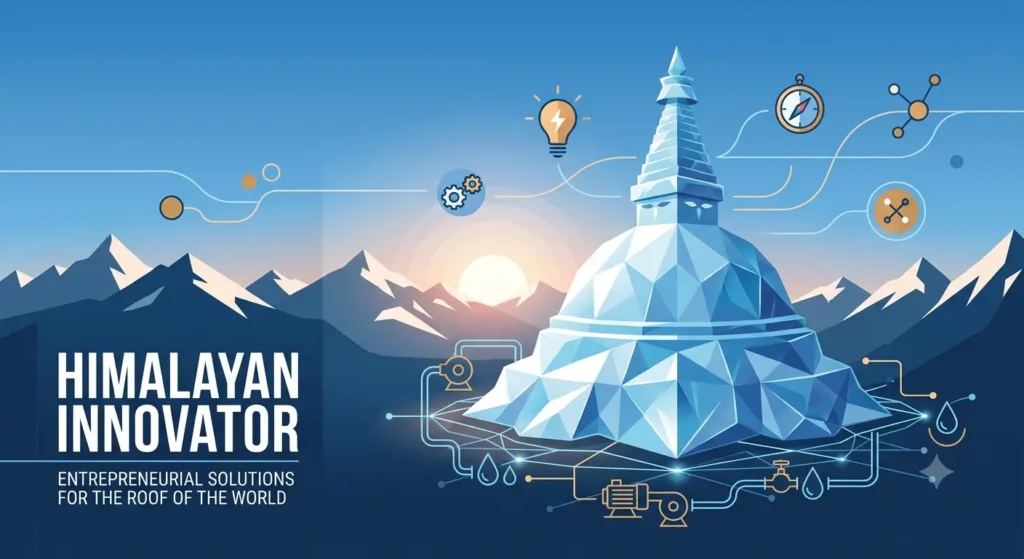
Sonam Wangchuk is an Indian engineer and social innovator best known for founding the Students’ Educational and Cultural Movement of Ladakh (SECMOL) and for developing the Ice Stupa Project, an innovative solution that stores winter water in the form of artificial glaciers for use during the dry season.
Instead of accepting problems as they were, he looked for practical ways to improve education, conserve water, and support local communities. His work has earned national and international recognition, including the prestigious Ramon Magsaysay Award.
Although his achievements are often associated with education and sustainability, his approach reflects the mindset of a successful entrepreneur—identify a problem, design a solution, test it, improve it, and create lasting value.
Why Entrepreneurs Should Learn from Sonam Wangchuk
Many entrepreneurs believe that success depends on raising large amounts of funding or having access to advanced technology.
Sonam Wangchuk’s journey proves otherwise.
His work shows that innovation often begins with curiosity, observation, and the willingness to challenge conventional thinking. These qualities are just as valuable in business as they are in science or engineering.
His philosophy is especially relevant for Indian MSMEs and startups that often operate with limited budgets but unlimited determination.
10 Powerful Business Lessons from Sonam Wangchuk
1. Solve Real Problems
Successful businesses are built around solving genuine customer problems.
Sonam Wangchuk focused on improving education and addressing water scarcity because they directly affected people’s lives.
Business Lesson: Instead of asking, “What can I sell?” ask, “What problem can I solve?”
Businesses that solve meaningful problems often build stronger customer loyalty.
2. Innovation Doesn’t Always Require Big Investment
One of the biggest myths in entrepreneurship is that innovation requires huge funding.
Many of Sonam Wangchuk’s ideas were developed using locally available materials and practical engineering.
For MSMEs, innovation could mean improving packaging, reducing production costs, enhancing customer service, or introducing a better delivery process.
Creativity often matters more than capital.
3. Start Small and Keep Improving
No successful product is perfect from day one.
The Ice Stupa project evolved through continuous experimentation and learning.
Entrepreneurs should follow the same approach by launching a Minimum Viable Product (MVP), collecting customer feedback, and making regular improvements instead of waiting for perfection.
4. Understand Your Customers
Great innovators spend time understanding the people they serve.
Instead of making assumptions, Sonam Wangchuk worked closely with local communities to understand their challenges.
Entrepreneurs should regularly interact with customers, listen to feedback, and improve products based on real needs rather than guesses.
5. Build Sustainable Businesses
Modern consumers increasingly prefer businesses that care about society and the environment.
Sustainability is no longer just a social responsibility—it has become a competitive advantage.
Whether it’s reducing waste, using eco-friendly packaging, or improving energy efficiency, small changes can strengthen both your brand and your business.
6. Learn from Failure
Every entrepreneur experiences setbacks.
Instead of treating failure as the end of the journey, view it as valuable feedback.
Testing ideas, making mistakes, and improving continuously are essential parts of innovation.
Businesses that learn quickly often grow faster than those that avoid taking risks.
7. Think Long-Term
Quick profits are attractive, but lasting businesses focus on long-term value.
Investing in customer satisfaction, product quality, employee development, and brand reputation creates sustainable growth.
The strongest companies are built over years, not weeks.
8. Never Stop Learning
Markets change, technology evolves, and customer expectations continue to grow.
Successful entrepreneurs invest in learning about AI, digital marketing, finance, exports, and industry trends.
Continuous learning helps businesses stay competitive in a rapidly changing world.
9. Simplicity Can Be Your Biggest Advantage
Innovation doesn’t always mean creating complex technology.
Sometimes the simplest solutions create the greatest impact.
A faster ordering system, improved customer support, better communication, or simplified processes can significantly improve customer experience.
10. Create Value Before Chasing Profit
Businesses that focus only on making money often struggle to build lasting relationships.
Businesses that consistently create value naturally earn customer trust—and profits usually follow.
This principle is reflected throughout Sonam Wangchuk’s work and remains one of the most important lessons for entrepreneurs.
How MSMEs Can Apply These Lessons
These ideas are practical and can be implemented by businesses of all sizes.
For example:
- Regularly ask customers for honest feedback.
- Improve one business process every month.
- Adopt digital tools to increase productivity.
- Reduce unnecessary costs through smarter operations.
- Introduce environmentally responsible practices where possible.
- Train employees to develop new skills.
- Focus on solving customer problems instead of competing only on price.
Small improvements made consistently often produce significant long-term results.
Government Schemes That Encourage Innovation
Indian entrepreneurs can also benefit from several government initiatives that promote innovation and business growth.
Some popular schemes include:
- Startup India
- MSME Innovative Scheme
- MSME Champions Scheme
- Credit Guarantee Fund Trust for Micro and Small Enterprises (CGTMSE)
- Prime Minister’s Employment Generation Programme (PMEGP)
- Atal Innovation Mission
- Zero Defect Zero Effect (ZED) Certification
Before applying, always check the latest eligibility criteria and guidelines on the respective government portals.
Key Takeaways
If there is one message entrepreneurs can learn from Sonam Wangchuk, it is this:
Great businesses are built by solving meaningful problems, not by chasing trends.
Innovation does not always require expensive technology or massive investment. It requires curiosity, persistence, customer understanding, and the courage to think differently.
Whether you own a manufacturing unit, trading business, service company, export business, or technology startup, these principles can help you build a stronger and more sustainable business.
Frequently Asked Questions
Why is Sonam Wangchuk an inspiration for entrepreneurs?
Because he demonstrates how practical innovation, perseverance, and solving real-world problems can create lasting impact even with limited resources.
What is the biggest business lesson from Sonam Wangchuk?
Focus on solving genuine customer problems rather than simply selling products.
Can MSMEs apply these lessons?
Yes. Small businesses can innovate through better customer service, improved processes, sustainable practices, and continuous learning without requiring huge investments.
Does innovation always require advanced technology?
No. Many successful innovations are simple improvements that make products or services more useful, affordable, or efficient.
Conclusion
Sonam Wangchuk’s journey is much more than a story of engineering or environmental conservation. It is a powerful example of how innovation, determination, and purpose can transform challenges into opportunities.
For entrepreneurs, startups, and MSME owners, the message is clear: success begins with understanding people’s problems and creating solutions that genuinely improve their lives.
You don’t need unlimited funding to make a difference. You need the willingness to observe, learn, experiment, and keep improving.
The entrepreneurs who embrace these principles will be better prepared to build businesses that are not only profitable but also meaningful and sustainable.
References
- SECMOL (Students’ Educational and Cultural Movement of Ladakh) – Official Website
- Ministry of Micro, Small and Medium Enterprises (MSME), Government of India
- Startup India – Official Portal
- Atal Innovation Mission (AIM), NITI Aayog
- Ramon Magsaysay Award Foundation
Editorial & AI Disclosure
This article has been researched and edited by the BusinessZindagi editorial team. AI tools were used to assist with research organization and language refinement. Readers are encouraged to verify important business or policy-related information from official sources.
Did you find this article helpful? Share it with fellow entrepreneurs, startup founders, and MSME owners. For more practical business guides, startup news, and MSME updates, keep visiting BusinessZindagi.com.