
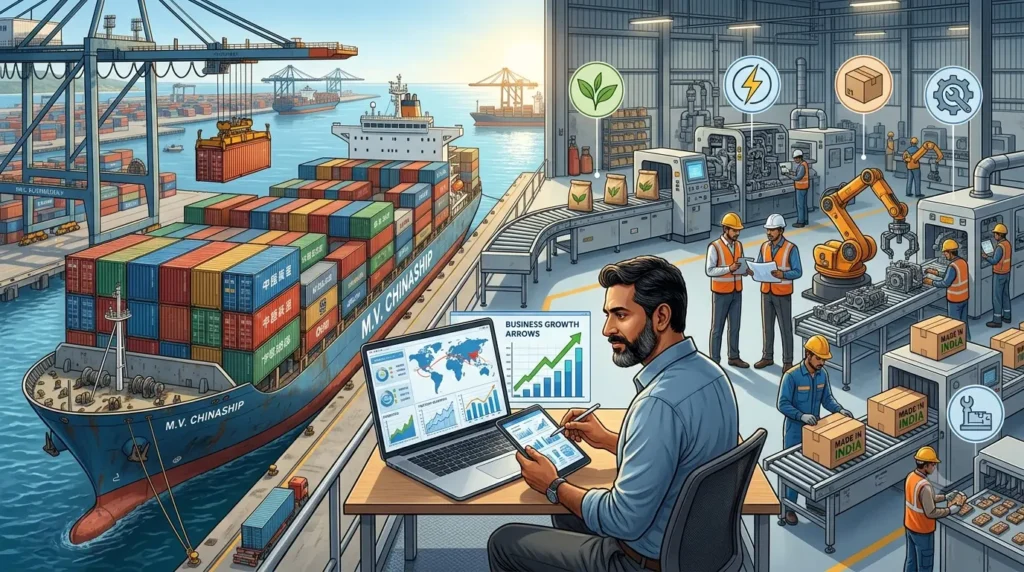
Every Imported Product Is a Future Manufacturing Opportunity
Walk into any wholesale market in India—whether it’s Sadar Bazaar in Delhi, Lamington Road in Mumbai, or Burrabazar in Kolkata—and you’ll find thousands of products labelled “Made in China.”
From LED lights and mobile accessories to packaging materials, industrial tools, plastic products, and machinery parts, Chinese products have become an integral part of India’s supply chain.
Most entrepreneurs look at these products and ask:
“Can I import this from China and make a profit?”
A more valuable question is:
“Can this product eventually be manufactured in India?”
That single question separates traders from long-term industrial entrepreneurs.
If you are planning to import from China, don’t think only about your next shipment. Think about where your business could be in the next five or ten years.
Import from china: Why This Topic Matters More Than Ever?
India imported about US$132 billion worth of goods from China during FY 2025–26, making China India’s largest source of imports. At the same time, the Indian government has identified around 100 priority import items worth roughly US$51 billion for domestic manufacturing as part of a renewed import-substitution strategy.
This sends a clear signal to MSMEs:
- Importing will continue to play an important role.
- But many imported products represent future manufacturing opportunities in India.
- Entrepreneurs who identify these opportunities early may benefit from changing market dynamics, government incentives, and growing domestic demand.
Should MSMEs Stop Importing from China?
No.
This article is not about avoiding Chinese imports.
In fact, many successful Indian brands started by importing products before gradually moving into assembly, customization, and eventually manufacturing.
The smarter question is:
When should you import from China, and when should you invest in manufacturing in India?
Understanding that transition can save lakhs—or even crores—of rupees.
Why China Is Still the World’s Manufacturing Powerhouse
Many people assume Chinese products are cheaper simply because labour costs are low.
Labour is only one part of the story.
China built an ecosystem over several decades that is difficult to replicate quickly.
When Importing from China Makes More Business Sense
For many MSMEs, importing is the financially safer option during the early stages.
Market Validation
Suppose you want to sell smart home devices.
Would you invest ₹3 crore in a factory without knowing whether customers will buy your product?
Probably not.
Instead, importing allows you to:
- Test demand
- Build a customer base
- Understand customer preferences
- Improve your branding
- Reduce financial risk
Once demand becomes stable, manufacturing becomes a realistic option.
Limited Capital
Setting up a manufacturing unit usually requires investment in:
- Land or factory premises
- Machinery
- Power infrastructure
- Skilled workers
- Quality testing
- Pollution compliance (where applicable)
- Working capital
- Inventory
Importing generally requires significantly less capital, allowing entrepreneurs to focus on sales, branding, and customer acquisition.
Changing Technology
Products such as:
- Mobile accessories
- Smart gadgets
- Electronic devices
- Computer peripherals
evolve rapidly.
Investing heavily in manufacturing equipment for products with short life cycles can be risky.
Importing provides flexibility to adapt to changing trends.
When Manufacturing in India Becomes the Better Choice
There comes a point where importing may no longer be the most profitable strategy.
Manufacturing often makes sense when:
- Sales are stable and predictable.
- Production volumes are large enough to reduce unit costs.
- Customers require product customization.
- Quality control is becoming a competitive advantage.
- Import duties, freight costs, or supply-chain risks significantly increase landed costs.
This is the stage where many businesses evolve from traders into manufacturers.
A New Opportunity for Indian MSMEs
Global supply chains have become more uncertain due to geopolitical tensions, shipping disruptions, and trade policy changes.
As a result, India is once again strengthening domestic manufacturing through initiatives such as Make in India, Production Linked Incentive (PLI) schemes, and targeted import-substitution efforts. The latest strategy focuses on products where local manufacturing can improve resilience, reduce import dependence, and generate employment.
For MSMEs, this creates a simple but powerful opportunity:
Instead of asking “What should I import from China?” also ask “Which of these imported products could I manufacture in India within the next five years?”
That mindset can transform a trading business into a manufacturing enterprise.
How to Identify an Import Substitute Product
Before spending money on machinery, evaluate whether a product has the characteristics of a good import-substitution opportunity.
✔ High Import Volume
India imports the product every year.
✔ Repeat Demand
The product is consumed continuously rather than being a one-time purchase.
✔ Medium Technology
The product does not require cutting-edge semiconductor or aerospace technology.
✔ Raw Materials Available in India
Inputs should ideally be available domestically.
✔ Growing Domestic Market
Demand should be increasing due to industrial growth or rising consumer spending.
BusinessZindagi Opportunity Matrix
| Product Type | Import First | Manufacture Later | Suitable for MSMEs |
|---|---|---|---|
| Packaging | ✅ | ✅ | ⭐⭐⭐⭐⭐ |
| Plastic Products | ✅ | ✅ | ⭐⭐⭐⭐⭐ |
| Tea Accessories | ✅ | ✅ | ⭐⭐⭐⭐⭐ |
| Industrial Components | ✅ | ✅ | ⭐⭐⭐⭐ |
| Electrical Accessories | ✅ | ✅ | ⭐⭐⭐⭐ |
| Agricultural Products | ✅ | ✅ | ⭐⭐⭐⭐ |
Products with Lower Entry Barriers
For first-time manufacturers, products requiring simpler production processes may offer a more practical starting point.
Examples include:
- Packaging Tape
- Corrugated Boxes
- Printed Labels
- Plastic Storage Bins
- Rubber Pads
- Cable Clips
- Plastic Trays
- Tea Packaging Materials
- Display Stands
- Wooden Gift Boxes
Products Requiring More Technical Expertise
These may require greater investment, specialized knowledge, or regulatory compliance.
Examples:
- LED Drivers
- Power Supplies
- Printed Circuit Boards
- Industrial Sensors
- Electric Motors
- Advanced Medical Devices
These products may be better suited after gaining manufacturing experience.
Use Import Data Before Investing
One of the biggest mistakes new entrepreneurs make is selecting a product based only on social media trends.
Instead, study:
- Import volumes
- Supplier countries
- Buyer industries
- Seasonality
- Price movements
Trade intelligence platforms such as Volza and official trade statistics can help you understand whether a product is imported consistently or only occasionally. This reduces the risk of investing in products with limited demand.Click free trail of Volza
BusinessZindagi Tip: If you notice that India imports a product every month from multiple countries and multiple Indian companies buy it repeatedly, that’s often a stronger indicator of market demand than a viral YouTube business idea.
BusinessZindagi Insight
Don’t think like a trader. Think like a future manufacturer.
Importing from China can help you understand the market, but long-term value often comes from building local capabilities where they make commercial sense. Not every imported product should be manufactured in India, but many simple, high-volume products present genuine opportunities for MSMEs that are willing to study the market, invest carefully, and compete on quality and service.
Don’t Think Like an Importer. Think Like a Future Manufacturer.
One of the biggest mistakes first-time entrepreneurs make is believing their business model should remain the same forever.
A smarter journey looks like this:
Import Products
        ↓
Understand Customer Needs
        ↓
Build a Brand
        ↓
Increase Sales
        ↓
Assemble in India
        ↓
Manufacture Selected Components
        ↓
Full Manufacturing
This is how many successful Indian companies have evolved over time.
Step 1: Choose the Right Product
Never choose a product simply because someone on YouTube says it is profitable.
Instead, ask:
✅ Is India importing this product every month?
✅ Is demand increasing?
✅ Are multiple Indian companies buying it?
✅ Can it eventually be manufactured in India?
If the answer is “yes” to most of these questions, it’s worth deeper research.
Step 2: Verify Demand Before Importing
Many new importers buy products first and then start looking for customers.
Reverse the process.
Try to get:
- Distributor enquiries
- Dealer interest
- Online pre-orders
- Marketplace demand
- B2B enquiries
before placing a large order.
Step 3: Should You Use a China Agent for Import?
One of the most searched terms is “China agent for import.”
The answer is:
It depends on your experience.
A reputable China sourcing agent can help with:
- Factory identification
- Supplier background checks
- Price negotiation
- Product inspection
- Consolidating shipments from multiple suppliers
- Export documentation
- Coordinating logistics
For first-time importers, this can reduce expensive mistakes.
However, always understand how the agent is compensated. Some charge a transparent service fee, while others may receive commissions from suppliers. Clarify this upfront to avoid conflicts of interest.
What Makes a Good China Sourcing Agent?
A reliable sourcing partner should be able to:
✔ Visit factories
✔ Share inspection reports
✔ Provide product photographs and videos
✔ Verify business registrations where possible
✔ Communicate clearly in writing
✔ Explain shipping terms (FOB, CIF, EXW, etc.)
✔ Respond promptly
Avoid agents who:
❌ Refuse factory details without explanation
❌ Pressure you to pay immediately
❌ Offer prices that seem unrealistically low
❌ Avoid written agreements
Never Choose a Supplier Based Only on Price
Imagine two quotations.
Supplier A
Product Price: US$0.80
Supplier B
Product Price: US$1.00
Most beginners choose Supplier A.
Experienced importers ask:
- Which supplier has better quality?
- Which one has fewer defects?
- Which one offers reliable after-sales support?
- Which one delivers consistently?
Sometimes paying 10–20% more results in far fewer returns, happier customers, and higher long-term profits.
Before Sending Any Advance Payment
Use this checklist:
Company Verification
- Business registration
- Export history (where available)
- Years in operation
- Factory or trading company?
- Product certifications, if required
Product Verification
- Samples
- Product specifications
- Material quality
- Packaging quality
- Label requirements
Shipping Verification
- Incoterms (FOB, CIF, EXW)
- Insurance
- Transit time
- Port of loading
- Expected customs duties in India
Is India Really Reducing Dependence on Imports?
India is encouraging domestic manufacturing in strategic sectors, but the picture is more nuanced than “stop importing.”
Recent reports indicate that the government has identified around 100 priority import items worth approximately US$51 billion for potential domestic production. These are part of a broader assessment of import-substitution opportunities estimated at nearly US$398 billion. The focus is on sectors where India can realistically build manufacturing capability over time rather than replacing every imported product immediately.
For MSMEs, this means there may be new opportunities in components, industrial supplies, packaging, engineering products, textiles, footwear, renewable energy, and other sectors where local production is commercially viable.
The BusinessZindagi Framework
Whenever you see a product imported from China, ask yourself these five questions:
1. Is India importing it regularly?
If yes,
↓
2. Is demand increasing?
If yes,
↓
3. Can MSMEs manufacture it?
If yes,
↓
4. Is the technology accessible?
If yes,
↓
5. Is there room to compete on quality, customization, or faster delivery?
If yes,
Congratulations.
You may have identified a genuine manufacturing opportunity—not just another trading business.
Frequently Asked Questions (SEO Optimized)
Is importing from China still profitable in India?
Yes. Many Indian businesses continue to import products from China because of competitive pricing, product variety, and established manufacturing ecosystems. However, profitability depends on product selection, landed cost, compliance, and market demand.
Should I import first or manufacture first?
For most first-time entrepreneurs, importing is often a lower-risk way to validate demand. Manufacturing generally becomes more attractive after sales become consistent and the economics justify investment.
Can an MSME manufacture products currently imported from China?
In many cases, yes. Packaging materials, plastic products, rubber components, engineering items, and certain electrical accessories are examples where MSMEs may find opportunities, provided they conduct proper market research and financial planning.
Do I need a China agent for import?
Not always. If you have experience, you may work directly with manufacturers. If you are new to importing or sourcing from multiple suppliers, a reputable sourcing agent can help reduce risk by assisting with supplier verification, inspections, and logistics.
Final Thoughts
China should not be viewed only as a source of inexpensive products.
It should also be viewed as a business classroom.
Study what China manufactures efficiently.
Study what India imports repeatedly.
Then ask the question that can change your business:
“Can I build the next successful Indian MSME by manufacturing one of these products?”
That question has created countless businesses around the world—and it may help you build yours too.
If you’re planning to import from China, don’t stop at finding suppliers.
Study import data, understand customer demand, calculate your landed cost, and look for products that could eventually be manufactured in India.Click VOLZA free trail
Today’s imported product could become tomorrow’s Made in India success story.
Want to know whether a product is really worth importing or manufacturing?
Before investing, study real shipment data. Trade intelligence platforms can help you identify:
- Which companies import the product
- How frequently it is imported
- Source countries
- Shipment trends
- Potential overseas suppliers and buyers
Doing this research first can reduce business risk and help you make more informed decisions.
(try free trail volza import export data subscription.)
Final Conclusion
The future of Indian MSMEs is not about choosing between importing and manufacturing—it is about knowing when to do each.
Importing from China can be a smart way to test markets, build a brand, and understand customer needs. Manufacturing in India becomes attractive when demand is proven, quality can be maintained, and the economics support local production.
Every imported product is more than just merchandise—it is market intelligence. It tells you what Indian businesses and consumers are buying, where supply gaps exist, and where future manufacturing opportunities may emerge.
The entrepreneurs who succeed over the next decade will not simply chase the cheapest products. They will identify recurring demand, build reliable supply chains, and gradually move up the value chain—from importer to manufacturer, and ultimately to exporter.
That is the real journey from “Import from China” to “Made in India.”
Suggested Related Articles from BusinessZindagi:
- 10 Government Schemes I Wish I Had Known Before My First Export
- MSME ZED Certification Scheme: Benefits, Eligibility & How to Apply
- Best Free Import Export Databases for Finding Buyers and Suppliers
- How to Export to Russia from India: Opportunities for MSMEs
- What Is ECGC and Why Every Exporter Should Understand It
- How to Use Import Export Shipment Data to Find International Buyers
- How to find Genuine Buyer for Export in 2026: What Has Changed and What Never Will
About the Author
Tabrez is the founder of BusinessZindagi.com and a first-generation entrepreneur from Assam. Drawing on real experience in tea, exports, and MSMEs, he shares practical, research-backed business insights to help entrepreneurs start, grow, and succeed.
Sources & References
This article is based on information from trusted sources, including:
- DGFT
- Ministry of Commerce
- MSME Ministry
- ICEGATE (Indian Customs)
- RBI
- UN Comtrade
- ITC Trade Map
- Reuters
Affiliate Disclosure
Some links on BusinessZindagi are affiliate links. If you purchase through them, we may earn a small commission at no extra cost to you. We recommend only products and services we genuinely believe are useful.
AI Disclosure
This article was researched and reviewed by humans with AI assistance for drafting and editing. We strive for accuracy, but always verify important business, legal, tax, customs, and policy information from official sources.
Disclaimer
This content is for educational purposes only and should not be considered legal, financial, tax, or investment advice. Always conduct your own research before making business decisions.