
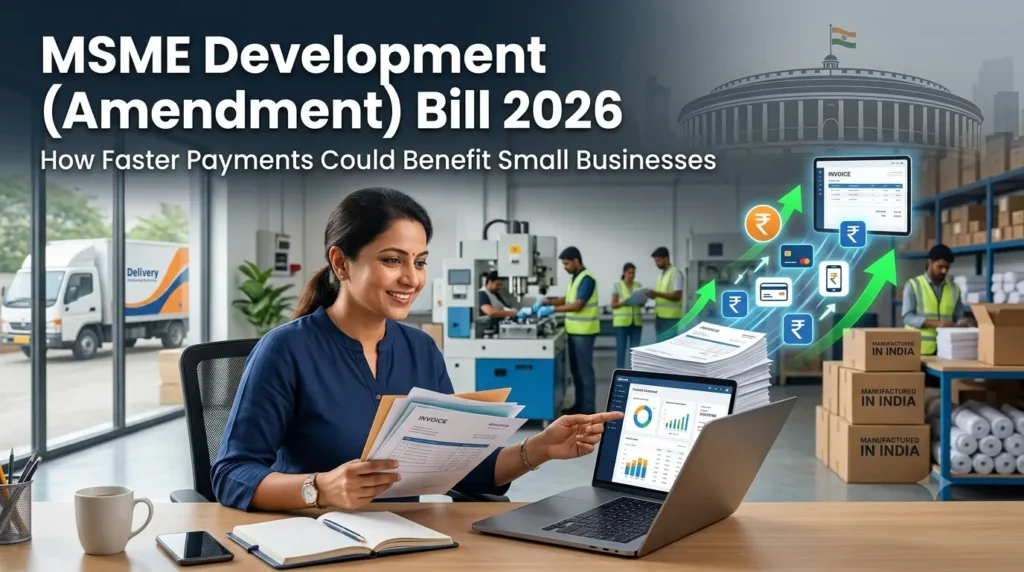
Getting an order is important. But for an MSME, getting paid on time is equally important.
Delayed payments can quickly affect working capital, supplier payments, salaries, GST liabilities and loan repayments.
That is why the Micro, Small and Medium Enterprises Development (Amendment) Act, 2026, popularly referred to as the MSMED Act 2026, is an important development for Indian MSMEs.
The amendment introduces major changes relating to delayed-payment disputes, TReDS, MSME classification, mediation, arbitration, recovery and compliance.
Important: The Act has received Presidential assent and become law. However, its provisions will come into force on dates notified by the Central Government, and different provisions may commence on different dates.
Here are the **7 biggest changes every MSME owner should know.
1. MSME Classification Rules Become More Flexible
The amended law gives the Central Government greater flexibility to notify MSME classification thresholds based on:
- Investment in plant and machinery or equipment
- Annual turnover
This means classification limits can be updated through government notifications as business conditions change.
Why it matters
Your MSME classification can affect access to government schemes, finance and other benefits.
👉 Check the latest official MSME information and notifications.
2. MSME Registration Gets a Stronger Digital Framework
The amendment provides for a free and voluntary registration framework through digital platforms notified by the government.
For businesses, accurate registration details remain important for accessing the wider MSME ecosystem.
BusinessZindagi Tip 💡
Keep your business details, turnover information and other required records updated.
3. TReDS Gets a Major Boost
One of the biggest practical changes involves the Trade Receivables Discounting System (TReDS).
The amendment requires Central Public Sector Enterprises (CPSEs) to settle invoices for procurement from MSMEs through TReDS.
What does this mean?
TReDS helps eligible MSMEs obtain financing against trade receivables.
Instead of simply waiting for a buyer to complete a long credit period, businesses may be able to improve cash flow through invoice financing.
👉 Learn more about TReDS and MSME invoice financing.
4. Payment Dispute Mediation Gets a 90-Day Timeline
The amended framework introduces a time limit for mediation in eligible delayed-payment disputes.
Mediation must generally be completed within 90 days.
This is important because small businesses often struggle not only with delayed payments—but also with slow dispute-resolution processes.
A defined timeline can make the process more predictable.
5. Failed Mediation Moves Faster to Arbitration
If mediation fails, the dispute must generally move towards arbitration within:
30 days
This reduces the risk of disputes remaining stuck between different stages for long periods.
For an MSME with money locked in unpaid invoices, faster movement towards resolution can be extremely important.
6. Arbitration Awards Get a 90-Day Timeline
The amended framework also provides that arbitral awards should generally be made within:
90 days from the completion of pleadings
The new structure creates clearer timelines:
Payment Dispute → Mediation → Arbitration → Award
This does not guarantee instant recovery, but it aims to create a more time-focused framework.
7. Stronger Recovery and Compliance Framework
The amendment strengthens the framework around recovery of certain mediated settlements and arbitral awards.
Eligible amounts can be recovered through mechanisms similar to the recovery of arrears of land revenue, subject to the applicable provisions.
The law also moves towards a more proportionate compliance system for certain violations, using warnings and financial penalties instead of relying entirely on criminal consequences.
Why this matters
Winning a payment dispute is one thing.
Actually receiving the money is another.
A stronger recovery mechanism is therefore an important part of the reform.
What About the 45-Day MSME Payment Rule?
There is a lot of confusion about this.
The 45-day MSME payment framework is NOT completely new.
The MSMED Act already contained protections for eligible micro and small enterprise suppliers against delayed payments.
The major importance of the 2026 amendment is strengthening the ecosystem around disputes through:
- Time-bound mediation
- Faster arbitration
- Defined award timelines
- Digital dispute resolution
- Stronger recovery mechanisms
- TReDS-related reforms
👉 You can also read the official MSMED Act and related legal framework on India Code.
What MSMEs Should Do Now
Regardless of when individual provisions are notified, every small business should improve its payment discipline.
✅ Keep payment terms in writing
Clearly mention payment periods and due dates in purchase orders and agreements.
✅ Track outstanding invoices
Don’t wait until payments become seriously overdue.
Monitor your receivables regularly.
✅ Keep proof of delivery
Maintain:
- Purchase orders
- Invoices
- Delivery challans
- Buyer communications
- Payment reminders
✅ Understand TReDS
Businesses with significant receivables should understand whether invoice financing can help improve cash flow.
✅ Don’t confuse sales with cash flow
Revenue is not cash until the money reaches your bank account.
MSMED Act 2026: The Simple Summary
The 2026 amendment is important because it aims to modernise the MSME ecosystem.
The biggest changes include:
✅ More flexible MSME classification provisions
✅ Stronger digital registration framework
✅ TReDS for CPSE procurement from MSMEs
✅ 90-day mediation timeline
✅ 30-day arbitration referral
✅ 90-day arbitral award timeline
✅ Stronger recovery mechanisms
✅ More proportionate compliance rules
Frequently Asked Questions
Has the MSMED Amendment Act 2026 become law?
Yes. The Act received Presidential assent and was published in the official Gazette.
However, its provisions will come into force on dates notified by the Central Government.
Is the 45-day MSME payment rule new?
No. The delayed-payment framework already existed. The 2026 amendment mainly strengthens dispute resolution and recovery mechanisms.
What is TReDS?
TReDS stands for Trade Receivables Discounting System. It helps eligible MSMEs access financing against trade receivables.
What is the biggest benefit of the amendment?
For many MSMEs, the most important potential benefit is a more structured and time-bound framework for resolving delayed-payment disputes.
BusinessZindagi Verdict
The MSMED Act 2026 is more than just another policy update.
Its biggest focus is on improving how MSME payment disputes are handled through:
- Faster mediation
- Quicker arbitration
- Defined timelines
- Better recovery mechanisms
- Greater use of digital systems
For every entrepreneur, however, the most important lesson remains simple:
A sale is not truly complete until the payment reaches your bank account.
The law may provide stronger protection, but MSMEs should still maintain proper documentation, track receivables and protect their cash flow.
🔗 Related BusinessZindagi Articles
- 📌 MSME Business Tools & Calculators – Free tools for finance, GST, loans and business planning.
- 📌 Procurement and Marketing Support Scheme – Explore government support available for MSMEs.
- 📌 UPI Business Loan: Can Your Digital Payments Help You Get Business Credit? – Understand the growing connection between digital payments and MSME lending.
- 📌 Cash Credit Interest Calculator – Estimate your business working-capital interest costs.
🔗 Authentic Sources
- Press Information Bureau – Government of India: MSMED Amendment Act reforms
- Ministry of MSME – Government of India
- India Code – Official Indian Laws
- SIDBI – Information on TReDS
⚠️ Disclaimer
This article is for general informational purposes only and does not constitute legal or financial advice. Implementation dates and government notifications may change. Readers should verify the latest official notifications and consult a qualified professional for specific legal matters.