ai image
Updated: August 8, 2026
Finding genuine foreign buyers is one of the biggest challenges for Indian exporters.
You may have a good product, competitive pricing and the ability to supply internationally. But finding an overseas company that is actually looking to buy your product can be much harder.
This is where the DGFT Source from India initiative becomes interesting.
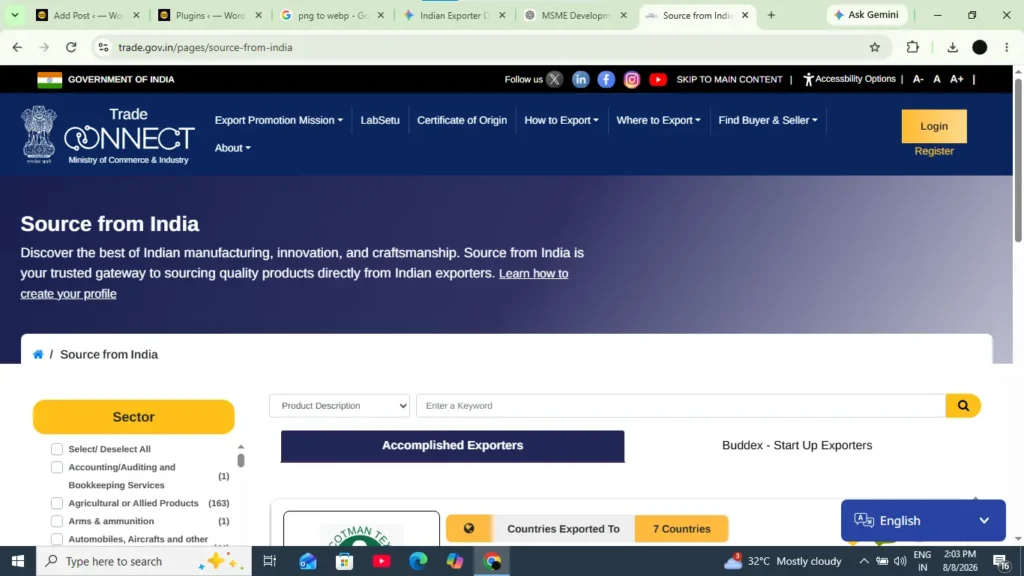
The Source from India service on the Government of India’s Trade Connect ePlatform was created to help international buyers discover Indian exporters and suppliers. Exporters can create digital microsites showcasing their products, company information and credentials.
For Indian MSMEs, manufacturers, startups and exporters looking to expand internationally, this could become an important additional buyer-discovery channel.
But what exactly is DGFT Source from India?
Who can use it?
How has the programme evolved?
And, most importantly, how can an Indian exporter use it to find foreign buyers?
Let’s understand.
What Is DGFT Source from India?
DGFT Source from India is a buyer-discovery facility available through the Government of India’s Trade Connect ePlatform.
Its basic objective is simple:
Help international buyers discover credible Indian exporters and suppliers.
Eligible exporters can create a digital microsite on Trade Connect where they can showcase their:
- Company profile
- Products
- Export capabilities
- Business credentials
- Product information
- Other relevant details
The idea is to create a central digital reference point where foreign buyers can discover Indian suppliers instead of relying entirely on traditional buyer-search methods.
The government has also stated that Indian Missions abroad can use Source from India as a reference when responding to foreign buyers seeking Indian suppliers.
A Brief History of DGFT Source from India
To understand why the latest developments matter, it is useful to look at how the initiative evolved.
September 2024: Trade Connect ePlatform is launched
The story actually begins with Trade Connect.
The Government of India launched the Trade Connect ePlatform in September 2024 as a digital, single-window platform intended to help Indian exporters access international markets and trade-related information.
At launch, the platform included features such as:
- Product and country guides
- Trade agreements
- Tariff Explorer
- Global e-Commerce Guide
- EXIM Paathshaala
- Ask an Expert
- Source from India
The government said the platform was designed particularly to help exporters, including small businesses and entrepreneurs, access global opportunities.
So, Source from India was conceived as one component of a much larger export-support ecosystem.
June 2025: Source from India is formally rolled out
The next major milestone came on 13 June 2025.
DGFT issued Trade Notice No. 5/2025-26, rolling out the Source from India service on Trade Connect for Status Holder exporters.
The concept was straightforward.
Eligible exporters could create their own microsites and showcase their products and credentials to international buyers.
This transformed Source from India from simply being a feature mentioned on Trade Connect into a practical digital exporter-discovery service.
November 2025: DGFT Expands Eligibility
This was an important turning point.
On 29 October 2025, DGFT issued Trade Notice No. 15/2025-26, revising the eligibility criteria.
From 1 November 2025, the facility was expanded beyond Status Holders.
Exporters with:
- a valid IEC,
- an IEC that is not in the Denied Entity List, and
- at least US$100,000 of export realisation in any one of the previous three financial years
could become eligible to create a Source from India microsite.
DGFT specified that its eBRC database would be used as the reference for export realisation.
This was significant because it opened the facility to a considerably wider group of established Indian exporters.
Why Was the Expansion Important for MSMEs?
Many Indian exporters are not Status Holders.
A business may have:
- a valid IEC,
- good products,
- manufacturing capacity,
- international ambitions,
but still not have the export scale required for Status Holder recognition.
The November 2025 expansion therefore created a much larger potential pool of exporters that could become discoverable through Source from India.
The government has specifically described the initiative as a way to strengthen the global discoverability of credible Indian suppliers, including MSMEs.
How DGFT Source from India Can Help You Find Foreign Buyers
Now let’s get to the most important question.
How can an exporter actually use it?
Think of Source from India as your government-backed digital shop window for international buyers.
The process can be thought of in six stages.
Step 1: Have Your Export Basics Ready
Before worrying about Source from India, make sure your export foundation is in place.
You should have:
- Import Export Code (IEC)
- Proper business registration
- Relevant product registrations
- Product specifications
- Export-ready packaging
- Company profile
- Product photographs
- Export pricing structure
Depending on your product, you may also need certifications or approvals.
Step 2: Check Your Source from India Eligibility
Don’t assume that every IEC holder automatically qualifies.
The eligibility criteria have changed over time.
Under the November 2025 framework, eligible exporters included valid IEC holders meeting the US$100,000 export-realisation requirement, in addition to Status Holders. DGFT’s eBRC database is used for verification.
Therefore, exporters should always check the latest DGFT requirements before applying.
Step 3: Create Your Exporter Microsite
This is where many exporters could make a mistake.
Don’t treat your microsite like a government registration form.
Treat it like your international sales presentation.
A foreign buyer should be able to understand quickly:
Who are you?
What do you manufacture or export?
What quantities can you supply?
Where have you exported before?
What certifications do you have?
How can the buyer contact you?
Step 4: Make Your Product Profile Buyer-Friendly
Suppose you export tea.
Don’t simply write:
Indian Tea Exporter
Instead, provide useful information such as:
Assam CTC Black Tea – Bulk Export Supplier from India
Then provide:
- Grade
- Origin
- Packaging
- MOQ
- Monthly supply capacity
- Certifications
- Target markets
- Available packing sizes
- Private-label capability, if applicable
- Shipping terms
- Contact details
The same principle applies to spices, rice, handicrafts, engineering products, chemicals, garments or any other product.
Step 5: Use Source from India Alongside Buyer Research
This is where things become much more powerful.
Don’t simply upload your profile and wait.
Use Source from India as your credibility and discovery layer, while actively researching potential buyers through other channels.
For example:
Source from India
↓
Import-export data
↓
Identify companies importing your product
↓
Research the buyer
↓
Contact the buyer
↓
Send quotation
↓
Sample
↓
Negotiation
↓
Export order
This is much more effective than simply waiting for enquiries.
🔥 BusinessZindagi Tip: Use Import-Export Data to Find Active Buyers
Suppose you export Assam black tea.
Instead of searching Google for:
Tea buyers in Russia
you can research companies that have actually imported tea into Russia.
You can examine:
- Importing company
- Product
- Shipment history
- Origin country
- Quantity
- Frequency
- Port
- Supplier information
This can help you build a much more targeted buyer list.
Find Real Importers Before You Contact Them
Want to identify companies that are already importing your product?
👉 Explore Volza’s Import-Export Data and find potential foreign buyers.
Step 6: Turn Your Profile Into a Sales Tool
Once you have created your Source from India profile, use it in your outreach.
For example, your email to a potential buyer could say:
We are an Indian exporter/manufacturer of [product] and would like to explore supplying your company. Our company and product details are also available through the Government of India’s Trade Connect/Source from India platform.
This gives the buyer another way to verify your business information.
But remember:
A Source from India profile does not replace proper buyer verification.
Does Source from India Guarantee Foreign Buyers?
No.
This is extremely important.
DGFT Source from India is not a guaranteed-order platform.
It can help with:
- Visibility
- Discovery
- Supplier identification
- International exposure
But it cannot guarantee:
- Purchase orders
- Sales
- Enquiries
- Payment
- Long-term contracts
You still have to convince the buyer.
You still need competitive pricing.
You still need quality.
And you still need to conduct proper buyer due diligence.
The Role of Indian Missions Abroad
One of the more interesting aspects of the Source from India initiative is its connection with Indian Missions abroad.
DGFT’s 2025 eligibility revision stated that Indian Missions Abroad had been sensitised to use Source from India as a reference when responding to foreign buyers seeking Indian suppliers.
This is important because it means the platform is not intended to function merely as another online business directory.
It can form part of the broader government-supported trade facilitation ecosystem.
What Should You Put on Your Source from India Profile?
Here’s a practical checklist.
Company information
- Company name
- Location
- Website
- Contact details
- Business type
- Years in business
Product information
- Product name
- HS code where relevant
- Specifications
- Grades
- Sizes
- Packaging
- MOQ
- Production capacity
Export information
- Existing export markets
- Export experience
- Shipping capability
- Preferred Incoterms
- Payment terms
Trust signals
- Certifications
- Factory photographs
- Product photographs
- Quality-control information
- Industry memberships
- Relevant awards
Only include information that is accurate and verifiable.
🚨 Five Mistakes Exporters Should Avoid
1. Creating a poor-quality profile
A profile with one photograph and two lines of text will not impress an overseas buyer.
2. Using generic product descriptions
Be specific.
3. Hiding important commercial information
Buyers want to know whether you can actually supply them.
4. Waiting for buyers
Use the profile actively in your sales outreach.
5. Assuming every enquiry is genuine
Always verify a prospective foreign buyer before accepting an order, particularly when the buyer requests unusual payment arrangements or asks you to incur expenses before placing an order.
This is where exporters often spend hours preparing paperwork.
CTA: Simplify Your Export Documentation
👉 Explore BusinessZindagi Export Tools
DGFT Source from India vs Traditional Buyer-Finding Methods
Source from India should not replace other buyer-finding methods.
Instead, use multiple channels.
| Method | Main advantage |
|---|---|
| DGFT Source from India | Government-backed exporter visibility |
| Import-export data | Identify companies already importing |
| Trade fairs | Meet buyers directly |
| Export Promotion Councils | Industry-specific connections |
| Indian Missions | Institutional trade support |
| Direct decision-maker outreach | |
| Discover companies and distributors | |
| B2B marketplaces | Large buyer databases |
| Own website | Build long-term credibility |
The smartest exporter doesn’t ask:
“Which one buyer-finding platform should I use?”
The smarter question is:
“How can I create several routes through which foreign buyers can discover my company?”
Is DGFT Source from India Useful for Small Exporters?
Potentially, yes—but eligibility remains important.
A small exporter may have excellent products but limited international visibility.
A government-backed digital profile can provide another channel for discovery.
However, exporters should not confuse visibility with demand.
Your product still needs:
- Competitive pricing
- Quality
- Reliable supply
- Appropriate certifications
- Good packaging
- Professional communication
- Attractive payment terms
- Reliable logistics
Source from India can potentially help buyers find you.
Your business must give them a reason to buy from you.
Why This Matters for Indian MSMEs
For many MSMEs, the biggest export problem isn’t manufacturing.
It is market access.
A small manufacturer may be capable of producing ₹1 crore worth of goods but may have no idea which foreign companies are buying those goods.
This is why the combination of:
Government platforms + market intelligence + direct buyer outreach
could become increasingly important.
Trade Connect was designed as a broader digital export ecosystem, connecting exporters with trade information, Indian Missions, Export Promotion Councils and other trade-support institutions.
What You Should Do If You Want to Export From India
If you’re a new exporter, don’t start by asking:
“Where can I get an export order?”
Start with:
1. Choose your product
Identify what you can supply competitively.
2. Identify target countries
Study where demand exists.
3. Find actual importers
Use reliable import-export data and other sources.
4. Verify the buyers
Don’t assume every company found online is genuine.
5. Build your digital presence
Website + product catalogue + Source from India profile where eligible.
6. Start direct outreach
Email, LinkedIn, trade fairs and other channels.
7. Send professional quotations
Be clear about MOQ, price, Incoterms, payment terms and delivery.
8. Convert the first order carefully
Protect yourself against payment and documentation risks.
📌 The Bigger Opportunity
India doesn’t simply need more exporters.
India needs more exporters who can consistently find and retain international buyers.
The evolution of DGFT Source from India shows how the government is trying to build a digital bridge between Indian suppliers and global buyers.
The journey so far is worth noting:
September 2024
Trade Connect launched.
↓
June 2025
Source from India rolled out for Status Holder exporters.
↓
November 2025
Eligibility expanded to qualifying exporters with valid IECs and at least US$100,000 export realisation in one of the previous three financial years.
↓
Today
Source from India forms part of India’s broader digital trade-connect ecosystem.
The direction is clear:
Make Indian exporters easier for international buyers to discover.
❓ Frequently Asked Questions
What is DGFT Source from India?
DGFT Source from India is a service on the Government of India’s Trade Connect ePlatform that enables eligible Indian exporters to create digital microsites showcasing their products and business credentials to international buyers.
When was Source from India launched?
The Source from India service was rolled out through DGFT Trade Notice No. 5/2025-26 dated 13 June 2025, initially for Status Holder exporters.
When was Source from India eligibility expanded?
DGFT issued Trade Notice No. 15/2025-26 on 29 October 2025, with the revised eligibility taking effect from 1 November 2025.
Who became eligible under the November 2025 expansion?
In addition to Status Holders, valid IEC holders whose IEC was not in the Denied Entity List and who had achieved at least US$100,000 export realisation in any one of the previous three financial years became eligible, subject to the applicable requirements.
How does DGFT verify export performance?
DGFT stated that its eBRC database would be the reference for export-realisation data for determining eligibility.
Can Source from India guarantee export orders?
No. It is a discovery and visibility facility. Exporters still need to market their products, respond to enquiries, negotiate and conduct buyer due diligence.
Can I use Source from India with Volza or other buyer-finding tools?
Yes. In fact, using several buyer-discovery methods can create a stronger export-sales pipeline.
Is Trade Connect only for finding buyers?
No. Trade Connect is a broader export-support platform with features including market information, trade agreements, tariff information, learning resources, expert assistance and other trade services.
Final Takeaway
DGFT Source from India is not a magic machine that will deliver foreign buyers to your inbox.
But it can become a valuable part of an Indian exporter’s digital presence.
The best strategy is not:
Create profile → Wait for buyer
It is:
Create Source from India profile → Research markets → Identify real importers → Verify buyers → Contact them → Send your profile → Quote professionally → Convert the enquiry into an order.
For Indian MSMEs and exporters, the biggest advantage may ultimately be discoverability.
Because your next foreign buyer may already be looking for an Indian supplier.
The question is:
Will they be able to find you?
🔗 Authentic Sources & References
1. DGFT — Trade Notice No. 15/2025-26
The official DGFT notice that expanded Source from India eligibility from 1 November 2025.
Read the DGFT Source from India Trade Notice
2. Ministry of Commerce & Industry / PIB — Trade Connect
Official government information on the Trade Connect ePlatform and its purpose.
Read the official PIB announcement on Trade Connect
3. Trade Connect ePlatform
Visit the official Trade Connect ePlatform
4. DGFT
Visit the official DGFT website
5. Ministry of Commerce & Industry — Export reforms
Official government information describing Source from India as a discovery tool connecting foreign buyers with verified Indian exporters.
Read the Ministry’s official export-system update
📚 Suggested BusinessZindagi Articles
Best Import-Export Data Websites to Find Foreign Buyers
How Indian MSMEs Can Use Import-Export Data to Find International Buyers
How to Find Companies That Import Your Product From India
For export documentation
Export Documents Required From India: Complete Checklist for New Exporters
Proforma Invoice vs Commercial Invoice: What Is the Difference?
Export Documentation From India: Step-by-Step Guide
For government export support
Trade Connect ePlatform: Complete Guide for Indian Exporters
DGFT: Complete Guide to Import Export Code (IEC)
Export Promotion Mission: New Government Support for Indian Exporters
SEO INFORMATION
Primary Focus Keyword
DGFT Source from India
Secondary Keywords
DGFT Source from India: How Indian Exporters Can Find Foreign Buyers
Suggested image text
DGFT Source from India
How Indian Exporters Can Find Foreign Buyers
Find Potential Foreign Buyers
Already exporting or planning to export? Use import-export shipment data to identify companies that are actually buying products like yours.
👉 Find Potential Buyers with Volza
CTA 2 — After export documentation section
Simplify Export Documentation
Found a buyer? Now prepare the documents you need to move from enquiry to shipment.
👉 Explore BusinessZindagi Export Tools
CTA 3 — At the end
Ready to Start Exporting?
Finding a buyer is only the first step. Learn how to choose your product, research markets, verify buyers and complete your first export successfully.
👉 Read: How to Start Exporting From India
About the Author
Tabrez Khan is an entrepreneur, tea exporter and founder of BusinessZindagi. He writes about MSMEs, entrepreneurship, exports, business opportunities and practical tools for Indian businesses, with a focus on real-world business experience and actionable insights.
Affiliate Disclosure
Some links in this article may be affiliate links. If you purchase or sign up through these links, BusinessZindagi may earn a small commission at no extra cost to you. We recommend products and services based on their relevance to our readers, not solely on commission potential.
AI Disclosure
This article may have been researched, structured or edited with the assistance of AI tools. BusinessZindagi reviews and verifies important information against official and authoritative sources before publication. Readers should refer to the linked official sources for the latest rules and requirements.
Authentic Sources & References
We prioritize official and authoritative sources for government policies, regulations and export-related information.
- DGFT — Directorate General of Foreign Trade
- Trade Connect ePlatform — Government of India’s Trade Connect Platform
- Ministry of Commerce & Industry / PIB — Press Information Bureau
- Ministry of Commerce & Industry — Department of Commerce
Note: Government rules, eligibility criteria and procedures can change. Always verify the latest information on the relevant official government website before taking business or financial decisions.
About the Author