
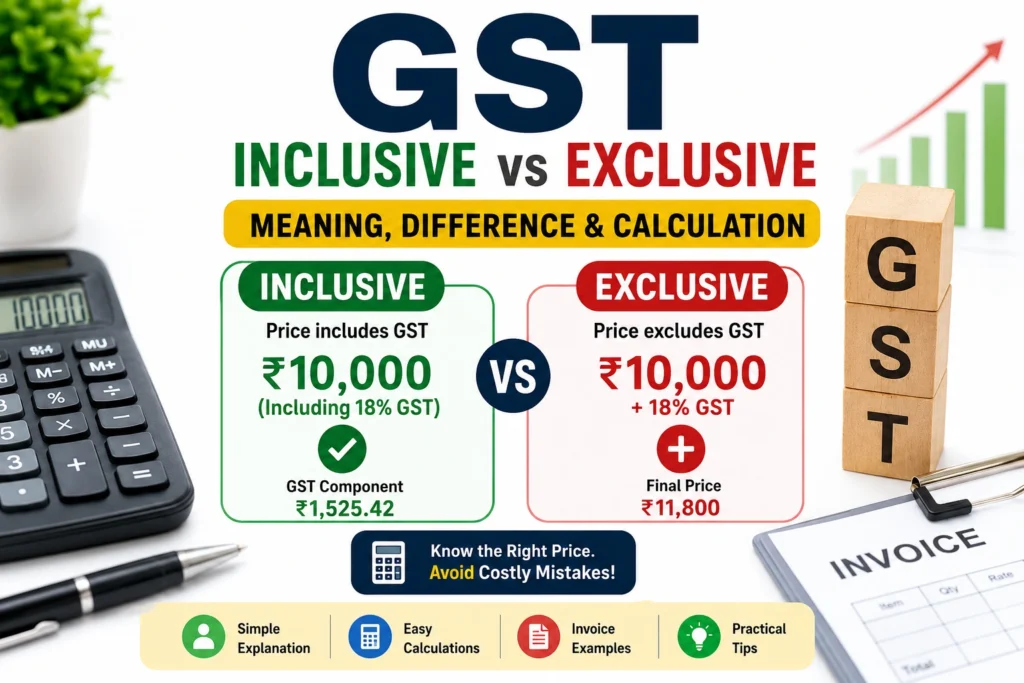
GST Inclusive vs Exclusive is one of those simple-looking concepts that can create confusion when preparing quotations, invoices, product prices or service proposals.
If a customer says, “Give me a final price of ₹10,000 including GST,” the calculation is different from saying “₹10,000 + GST.”
For a small business, getting this wrong can directly affect your quotation, profit margin and the amount collected from the customer.
In this guide, we explain GST inclusive vs exclusive pricing in simple language, with formulas, examples and practical tips.
GST Inclusive vs Exclusive: Quick Difference
The easiest way to understand the difference is:
- GST Exclusive Price: GST is added to the quoted price.
- GST Inclusive Price: GST is already included in the quoted price.
Example
Suppose the taxable price of a service is ₹10,000 and GST is 18%.
GST exclusive:
₹10,000 + ₹1,800 GST = ₹11,800
GST inclusive:
If the customer has to pay exactly ₹10,000 including 18% GST, the taxable value is ₹8,474.58 and GST is ₹1,525.42.
So, ₹10,000 inclusive of GST does not mean ₹10,000 + 18%.
What Does GST Exclusive Mean?
A GST-exclusive price is a price before GST is added.
For example, a consultant quotes:
Professional service fee: ₹10,000 + GST @ 18%
The calculation is:
Basic price = ₹10,000
GST = ₹10,000 × 18% = ₹1,800
Total payable = ₹11,800
Therefore:
₹10,000 + 18% GST = ₹11,800
This pricing method is commonly useful when businesses deal with other businesses and want to clearly show the taxable value and GST separately.
What Does GST Inclusive Mean?
A GST-inclusive price already contains GST.
For example:
Total price including GST: ₹10,000
If the applicable GST rate is 18%, you cannot simply calculate GST as ₹10,000 × 18%.
Why?
Because the ₹10,000 already contains the GST component.
You have to separate the GST from the total amount.
Formula
GST component = Inclusive price × GST rate ÷ (100 + GST rate)
For ₹10,000 at 18%:
GST = ₹10,000 × 18 ÷ 118
GST = ₹1,525.42
Therefore:
Taxable value = ₹10,000 − ₹1,525.42
Taxable value = ₹8,474.58
GST Inclusive vs Exclusive: Comparison
| Particular | GST Exclusive | GST Inclusive |
|---|---|---|
| Basic price | ₹10,000 | ₹8,474.58 |
| GST @ 18% | ₹1,800 | ₹1,525.42 |
| Customer pays | ₹11,800 | ₹10,000 |
| GST already included? | No | Yes |
| GST needs to be added? | Yes | No |
The important point is that the GST rate is applied differently depending on whether the quoted amount is before or after GST.
How to Calculate GST on an Exclusive Price
This is the simpler calculation.
Formula
GST = Basic Price × GST Rate ÷ 100
Example: ₹20,000 at 18% GST
Basic price = ₹20,000
GST = ₹20,000 × 18 ÷ 100
GST = ₹3,600
Final price:
₹20,000 + ₹3,600 = ₹23,600
So:
₹20,000 + 18% GST = ₹23,600
How to Calculate GST from an Inclusive Price
When the price already includes GST, use this formula:
Formula
GST = Inclusive Price × GST Rate ÷ (100 + GST Rate)
Example: ₹20,000 including 18% GST
GST = ₹20,000 × 18 ÷ 118
GST = ₹3,050.85
Taxable value:
₹20,000 − ₹3,050.85 = ₹16,949.15
Therefore:
| Component | Amount |
|---|---|
| Taxable value | ₹16,949.15 |
| GST @ 18% | ₹3,050.85 |
| Total | ₹20,000 |
GST Inclusive Calculation Examples
Here are some quick examples.
At 5% GST
If the final price is ₹10,000 including 5% GST:
GST = ₹10,000 × 5 ÷ 105
GST = ₹476.19
Taxable value = ₹9,523.81
At 12% GST
If the final price is ₹10,000 including 12% GST:
GST = ₹10,000 × 12 ÷ 112
GST = ₹1,071.43
Taxable value = ₹8,928.57
At 18% GST
If the final price is ₹10,000 including 18% GST:
GST = ₹10,000 × 18 ÷ 118
GST = ₹1,525.42
Taxable value = ₹8,474.58
At 28% GST
If the final price is ₹10,000 including 28% GST:
GST = ₹10,000 × 28 ÷ 128
GST = ₹2,187.50
Taxable value = ₹7,812.50
The Easy Trick to Remove GST from a Price
If you know the final GST-inclusive price, remember:
5% GST
Divide the total by 1.05 to find the taxable value.
12% GST
Divide the total by 1.12.
18% GST
Divide the total by 1.18.
28% GST
Divide the total by 1.28.
For example:
₹10,000 ÷ 1.18 = ₹8,474.58
That is the taxable value when ₹10,000 already includes 18% GST.
How to Add GST to a Price
If your price is GST exclusive:
Final price = Basic price × (100 + GST rate) ÷ 100
For ₹10,000 at 18%:
₹10,000 × 118 ÷ 100
= ₹11,800
GST Inclusive vs Exclusive Invoice Example
Suppose a business provides consulting services worth ₹50,000 and charges GST at 18%.
GST Exclusive Invoice
| Description | Amount |
|---|---|
| Service value | ₹50,000 |
| GST @ 18% | ₹9,000 |
| Total invoice value | ₹59,000 |
If the supply is intra-State, the GST may be shown as CGST and SGST as applicable.
For example:
- Taxable value: ₹50,000
- CGST @ 9%: ₹4,500
- SGST @ 9%: ₹4,500
- Total: ₹59,000
For an inter-State supply, IGST may apply instead.
What If the Quotation Says “₹59,000 Including GST”?
Now the calculation changes.
At 18% GST:
GST = ₹59,000 × 18 ÷ 118
= ₹9,000
Taxable value:
₹59,000 − ₹9,000
= ₹50,000
So both approaches can arrive at the same final amount:
₹50,000 + 18% GST = ₹59,000
or
₹59,000 inclusive of 18% GST = ₹50,000 taxable value + ₹9,000 GST
Should Your Business Quote Prices Inclusive or Exclusive of GST?
There is no single answer for every business.
It depends on your customers, industry, pricing strategy and how you communicate your quotations.
GST-exclusive pricing can be useful when:
- You mainly sell to other businesses.
- Your customers understand GST.
- You want the taxable value to be clearly visible.
- You prepare formal quotations and purchase orders.
- You want to show the GST component separately.
For example:
Product price: ₹25,000 + GST as applicable.
GST-inclusive pricing can be useful when:
- You sell directly to consumers.
- You want customers to immediately understand the final amount.
- You operate an online store.
- Your marketing focuses on a simple “payable price.”
- Price comparison is important.
For example:
Final price: ₹29,500 including GST.
The important thing is to clearly state whether the quoted amount includes GST or not.
A Common GST Pricing Mistake
One of the biggest mistakes is treating an inclusive price as if it were exclusive.
Suppose you tell your customer:
“₹10,000 including 18% GST.”
You cannot calculate:
₹10,000 × 18% = ₹1,800 GST.
That would make the total:
₹10,000 + ₹1,800 = ₹11,800.
You have effectively treated ₹10,000 as the pre-GST price.
For a genuine ₹10,000 GST-inclusive price:
GST = ₹1,525.42
and
Taxable value = ₹8,474.58
GST Inclusive vs Exclusive and Profit Margin
This distinction becomes particularly important when calculating profit margins.
Suppose you sell a product for ₹11,800 including 18% GST.
Your sales value before GST is not ₹11,800.
The taxable value is:
₹11,800 ÷ 1.18 = ₹10,000
The ₹1,800 GST component is tax collected on the taxable supply; it should not simply be treated as business revenue.
This is why businesses should separate:
Sales value → GST → expenses → profit
rather than calculating profit from the GST-inclusive amount alone.
What About Input Tax Credit?
For a registered business, GST paid on eligible business purchases may potentially qualify as input tax credit subject to the applicable GST rules and conditions.
Therefore, GST should not automatically be treated as a normal business expense in every situation.
However, input tax credit eligibility depends on the nature of the purchase, use of the goods/services and other GST requirements.
For important tax decisions, businesses should verify the applicable rules or consult a qualified tax professional.
GST Inclusive Pricing for Retailers
Retail businesses often think about pricing from the customer’s point of view.
For example:
MRP / selling price: ₹1,180
If this amount includes 18% GST:
Taxable value = ₹1,180 ÷ 1.18
= ₹1,000
GST = ₹180
This makes it easier to understand how much of the customer’s payment represents the taxable value and how much represents GST.
GST Inclusive Pricing for Service Businesses
Freelancers, consultants, designers, agencies and other service providers should be especially careful when quoting prices.
Suppose you want to receive ₹25,000 as the taxable service value and GST is 18%.
You should quote:
₹25,000 + ₹4,500 GST = ₹29,500
But if the customer says:
“My total budget is ₹25,000 including GST.”
Your taxable value would be:
₹25,000 ÷ 1.18 = ₹21,186.44
GST = ₹3,813.56
That’s a difference of more than ₹3,800 in the taxable value.
So always clarify the meaning of the quoted amount before accepting an order.
GST Inclusive vs Exclusive for Quotations
A quotation should make the GST treatment clear.
Instead of writing:
Total: ₹50,000
Write:
Professional fee: ₹50,000 + GST @ applicable rate
or:
Total price: ₹59,000 including GST @ 18%
This simple wording can prevent misunderstandings between the buyer and seller.
Quick GST Calculation Cheat Sheet
| If you know… | Formula |
|---|---|
| Exclusive price → GST | Price × GST rate ÷ 100 |
| Exclusive price → Final price | Price × (100 + GST rate) ÷ 100 |
| Inclusive price → GST | Inclusive price × GST rate ÷ (100 + GST rate) |
| Inclusive price → Taxable value | Inclusive price × 100 ÷ (100 + GST rate) |
Example at 18%
Add GST:
₹10,000 × 18% = ₹1,800
Final price:
₹11,800
Remove GST from ₹10,000 inclusive:
₹10,000 × 18 ÷ 118 = ₹1,525.42 GST
Calculate GST Instantly
Don’t want to calculate GST manually every time?
Try the BusinessZindagi GST Calculator
Use the BusinessZindagi GST Calculator to quickly calculate GST, final prices and GST-inclusive/exclusive amounts.
[Use the BusinessZindagi GST Calculator →]
It can be particularly useful when preparing quotations, checking invoices or calculating customer-facing prices.
Useful Business Software for MSMEs
GST calculation is only one part of running a small business.
If you’re looking to streamline invoicing, bookkeeping, expenses and other business processes, accounting and business-management software can save considerable time.
Explore Zoho for Small Businesses
[Try Zoho Books / Explore Zoho →]
Zoho offers tools for invoicing, accounting, expense management and other business operations that can be useful for growing MSMEs.
Affiliate disclosure: This may be an affiliate link, which means BusinessZindagi may earn a commission if you purchase through the link, at no additional cost to you.
GST Inclusive vs Exclusive: Frequently Asked Questions
Is GST inclusive the same as GST exclusive?
No.
GST-inclusive means GST is already included in the quoted amount.
GST-exclusive means GST is added separately to the quoted amount.
How do I calculate 18% GST from an inclusive price?
Use:
Inclusive amount × 18 ÷ 118
For ₹10,000:
₹10,000 × 18 ÷ 118 = ₹1,525.42 GST
How do I remove 18% GST from ₹10,000?
Divide ₹10,000 by 1.18:
₹10,000 ÷ 1.18 = ₹8,474.58
Therefore, the GST component is:
₹1,525.42
Is ₹10,000 plus GST the same as ₹10,000 including GST?
No.
At 18% GST:
₹10,000 + GST = ₹11,800
But:
₹10,000 including GST = ₹8,474.58 taxable value + ₹1,525.42 GST
Should businesses quote GST-inclusive or GST-exclusive prices?
It depends on the business and customer.
B2B businesses often show the taxable value and GST separately, while consumer-facing businesses may prefer displaying a final price including applicable taxes.
The important thing is to clearly communicate what the quoted price includes.
Can I calculate GST manually?
Yes. But when you are dealing with multiple quotations, products or rates, a GST calculator can reduce calculation mistakes.
📊 Make Invoicing & GST Management Easier
Tired of manually managing invoices, GST calculations and business accounts? Zoho Books can help small businesses manage invoicing, expenses, accounting and GST-related workflows in one place.
👉 Explore Zoho Books for Your Business
Affiliate disclosure: This may be an affiliate link. BusinessZindagi may earn a commission if you purchase through the link, at no additional cost to you.
Final Takeaway
The difference between GST inclusive and GST exclusive is simple once you remember one thing:
Exclusive means GST is added. Inclusive means GST is already inside the price.
For GST-exclusive pricing:
GST = Price × Rate ÷ 100
For GST-inclusive pricing:
GST = Total × Rate ÷ (100 + Rate)
If you run an MSME, sell products, provide services or regularly prepare quotations, understanding this distinction can help you avoid pricing and invoicing mistakes.
Need a quick calculation? Use the BusinessZindagi GST Calculator and calculate GST in seconds.
Disclaimer: This article is for general educational purposes and should not be treated as professional tax advice. GST rates, exemptions and compliance requirements can change. Always verify the applicable GST rate and rules for your specific goods or services from official government sources or consult a qualified tax professional.
About the Author
Tabrez is the founder of BusinessZindagi, helping MSMEs and entrepreneurs understand GST, finance, business tools, exports and government schemes in simple language.
AI Disclaimer
This article was created with AI assistance and reviewed for general accuracy. Always verify current GST rules and rates with official sources or a qualified tax professional.
Affiliate Disclaimer
Some links may be affiliate links. BusinessZindagi may earn a commission if you purchase through them, at no extra cost to you. Our recommendations remain independent.