For a small business, getting in front of the right buyers can be difficult.
Digital marketing can help. B2B platforms can help. Export databases can help.
But sometimes, meeting potential customers face-to-face can still make a huge difference.
That is why the India International Trade Fair (IITF) can be an interesting opportunity for Indian Micro and Small Enterprises (MSEs).
And there is an important 2026 update that businesses should know now.
The Office of the Development Commissioner, Ministry of MSME, has announced that the IITF 2026 application portal will remain open from 1 September 2026 to 20 September 2026.
More importantly, only MSEs having a valid Udyam Registration as on 31 August 2026 will be eligible under the announced MSME participation process.
So if you are considering IITF 2026, don’t wait until September to start preparing.
🚨 IITF 2026: The Important Dates MSMEs Should Know
Here is the key information currently announced by the Office of the Development Commissioner, MSME:
| IITF 2026 | Important information |
|---|---|
| 🗓️ Application opens | 1 September 2026 |
| ⏰ Application closes | 20 September 2026 |
| 🏢 Udyam requirement | Valid Udyam Registration |
| ⚠️ Udyam cut-off | 31 August 2026 |
| 🎯 Eligible businesses | Eligible Micro & Small Enterprises |
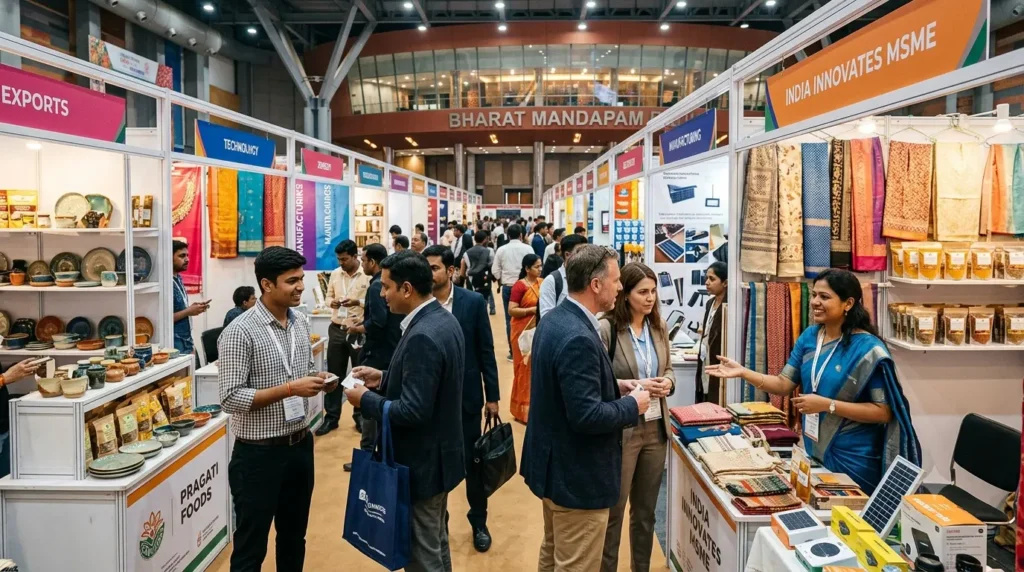
| 📍 Trade-fair venue | Bharat Mandapam, New Delhi |
The important point is that 31 August and 20 September are two different dates.
Your Udyam Registration needs to meet the announced eligibility condition before the application window opens.
The official DC-MSME website specifically advises MSEs to ensure that their Udyam Registration is updated before the deadline.
Don’t leave your Udyam Registration until September
If you are seriously considering IITF 2026, check your Udyam details now.
You can also read our practical guide:
Udyam Registration: The Ultimate Identity Proof Every MSME Must Secure in India
🌍 Trade Fair Finder
Discover trade fairs, expos and B2B events with dates, venues, sectors, organisers, contacts and official registration links.
What Is IITF 2026 ?
The India International Trade Fair (IITF 2026) is one of India’s major multi-sector trade exhibitions.
For an MSME, the attraction isn’t simply the opportunity to put up a stall.
It can potentially provide access to:
- Buyers
- Distributors
- Retailers
- Business partners
- Manufacturers
- Service providers
- Government organisations
- Export-related contacts
- Competitors and industry trends
But there is an important distinction:
Participating in a trade fair and using a trade fair effectively are two completely different things.
Simply displaying your products and handing out visiting cards isn’t enough.
The real opportunity is to turn the event into a business-development exercise.
Why Should an MSME Consider participating in IITF 2026?
1. Meet Potential Buyers Face-to-Face
A buyer who spends five minutes discussing your product may provide insights that dozens of online enquiries don’t.
You can immediately understand:
- What they are looking for
- Their preferred price range
- Packaging requirements
- Minimum order expectations
- Quality concerns
- Delivery requirements
- Whether they are genuinely interested
That conversation can be much more valuable than simply collecting a phone number.
2. Study Your Competitors
This is one of the biggest benefits of physical trade fairs.
You can walk around and observe:
Packaging → pricing → presentation → product range → branding → customer response
You may discover that your product is good but your packaging is weak.
Or perhaps your pricing is competitive but your presentation isn’t.
Or you may discover a completely new product category.
For a small business, this type of market intelligence can be extremely valuable.
3. Discover New Distribution Opportunities in IITF 2026.
A small manufacturer may be excellent at production but struggle to reach new markets.
A trade fair can introduce you to:
- Distributors
- Dealers
- Retail chains
- Institutional buyers
- Resellers
- Importers
- Other manufacturers
The objective should not be:
“How many people visited my stall?”
Instead ask:
“How many qualified business leads did I generate?”
4. Learn What Buyers Actually Want
Sometimes entrepreneurs spend months developing a product based on assumptions.
A trade fair puts that product directly in front of potential customers.
Their questions can reveal:
- Missing features
- Packaging problems
- Price sensitivity
- Quality expectations
- New applications
- New markets
That feedback can help you improve the product even if the visitor doesn’t place an order immediately.
5. Build Your Brand
For a small business, credibility matters.
Being physically present at a major trade event can help create visibility and give potential customers an opportunity to understand your business.
But don’t confuse visibility with sales.
A beautiful stall without a follow-up system can still produce very little business.
Is IITF 2026 Worth It for a Small Business?
This is an important question.
Trade fairs involve costs.
You may have to consider:
- Stall-related expenses
- Travel
- Accommodation
- Transportation
- Samples
- Packaging
- Promotional material
- Staff
- Food and local expenses
- Follow-up costs
So don’t participate simply because everyone else is participating.
Before going, define your objective.
For example:
My objective is to generate 25 qualified buyer enquiries and identify at least five potential distributors.
Now you have something measurable.
My Personal Experience With Trade Fairs
What I learned from participating in trade fairs
I have personally participated in trade fairs and exhibitions, and one of the biggest lessons I learned was that the value of a trade fair isn’t limited to the sales made at the event.
One of the most useful things is simply observing the market.
You see competitors.
You see how established companies present their products.
You see packaging trends.
You hear what customers ask.
You notice which products attract attention and which don’t.
And sometimes you realise that your own assumptions about the market were wrong.
For an MSME, that learning can be extremely valuable.
I also learned that mistakes are part of the process
In the beginning, it is easy to concentrate too much on your own product.
But a successful trade fair requires you to look outward.
Who is visiting?
What are they looking for?
What problems are they trying to solve?
What are competitors offering?
Those questions can teach you more than simply standing behind your stall and waiting for visitors.
That is one reason I believe trade fairs can be particularly useful for first-generation entrepreneurs and small businesses.
How Should an MSME Prepare for IITF 2026?
Don’t start preparing after receiving your stall allocation.
Start now.
1. Select your hero products
Don’t try to display everything.
Choose your strongest products.
Ideally, visitors should understand within seconds:
What you sell → Who it’s for → Why it’s different
2. Prepare a professional product catalogue
Your catalogue should contain:
- Product photographs
- Product specifications
- MOQ
- Packaging details
- Price information where appropriate
- Certifications
- Contact information
- Website
- WhatsApp/contact QR code
Make it easy for a buyer to take your information away.
3. Create a QR code
One QR code can take the visitor directly to:
Website → Product catalogue → WhatsApp → Enquiry form
This is much better than depending entirely on printed brochures.
4. Prepare samples
If your product can be physically demonstrated or sampled, prepare carefully selected samples.
Don’t simply carry a large quantity.
Choose samples that demonstrate your strongest selling points.
5. Prepare a Buyer Enquiry Sheet
This is one of the simplest things many small businesses overlook.
Record:
| Information | Why it matters |
|---|---|
| Name | Identification |
| Company | Business verification |
| Location | Market potential |
| Product interest | Qualification |
| Quantity | Potential order size |
| Phone/email | Follow-up |
| Requirement | Understand need |
| Follow-up date | Prevent lost leads |
A business card sitting in a drawer is not a lead.
A lead becomes valuable when you follow it up.
How to Find Serious Buyers at a Trade Fair
Don’t treat everyone as a buyer.
Try to identify:
🔥 Hot lead
Already buying similar products and discussing quantity.
🟠 Warm lead
Interested but needs information or internal approval.
🔵 Cold lead
Interested in the category but no immediate requirement.
This simple classification can dramatically improve your follow-up.
For Exporters: Use IITF 2026 as a Buyer-Discovery Exercise
If you are an exporter, your preparation should be slightly different.
Have an export-ready product sheet containing:
- Product name
- HS code
- Specifications
- MOQ
- Packaging
- Country of origin
- Certifications
- Lead time
- Payment terms
- Port of loading
- Contact details
You can also research potential markets and buyers before attending the event.
Don’t rely only on the visitors who walk into your stall.
You can use trade-fair networking alongside online buyer research.
For example, our guide:
How to Find International Buyers Without Visiting Trade Fairs
explains how exporters can combine B2B platforms, LinkedIn, direct outreach and buyer verification.
🔎 Want Better Buyer Research?
If you’re an exporter, a trade fair can give you contacts—but import-export shipment data can help you research markets and companies before and after the event.
For example, you can investigate:
- Who imports your product?
- Which companies are already buying it?
- Which countries have demand?
- Who are competitors supplying?
- How frequently do buyers import?
👉 Explore Volza for Import-Export Buyer Intelligence
🔎 Find Importers, Buyers & Trade Opportunities with Volza →
Government Support for MSME Trade-Fair Participation
The Ministry of MSME’s Procurement and Marketing Support (PMS) Scheme includes support for participation in domestic and international trade fairs/exhibitions and MSME expos. The official scheme page describes its scope as promoting new market-access initiatives through such events.
The government continues to issue PMS sanctions for participation of individual MSEs in domestic trade fairs/exhibitions during FY 2026–27.
However, don’t assume that every IITF expense will automatically be reimbursed.
Eligibility, approval, documentation, reimbursement limits and event-specific conditions matter.
The DC-MSME’s PMS records also show that reimbursement is subject to scheme provisions and actual eligible claims.
My advice
Before spending money based on an expected subsidy:
- Check the current PMS guidelines.
- Check whether the event/participation is covered.
- Check your eligibility.
- Understand the application process.
- Keep every required document and invoice.
- Don’t assume reimbursement is guaranteed.
The official MyMSME portal provides access to exhibitions/fairs, applications and claims.
💻 Don’t Forget the Back Office
This is another lesson that small businesses often learn the hard way.
You can generate 50 enquiries at an exhibition.
But if you don’t properly record:
- Customer name
- Enquiry
- Quotation
- Follow-up
- Payment
- Order status
those leads can quickly disappear.
For a growing MSME, cloud accounting can make this process much easier.
👉 Looking to organise your business accounts?
It can help businesses manage accounting, invoices, expenses, GST-related workflows and financial records from one system.
Affiliate link: BusinessZindagi may earn a commission if you purchase or sign up through our link, at no additional cost to you.
You can also read:
Zoho Bookkeeping: The Complete Guide for Small Businesses & MSMEs in India
10 Mistakes MSMEs Should Avoid at IITF 2026.
❌ 1. Going without a clear objective
Decide what success means before you arrive.
❌ 2. Trying to showcase everything
Focus on your strongest products.
❌ 3. Having poor product photographs
Your catalogue may be seen long after the event.
❌ 4. No price/MOQ information
Serious buyers need commercial clarity.
❌ 5. Collecting hundreds of unqualified contacts
Quality beats quantity.
❌ 6. Not recording buyer requirements
A phone number alone isn’t enough.
❌ 7. Ignoring competitors
Their stalls are free market research.
❌ 8. Not carrying enough samples or brochures
Be prepared for genuine interest.
❌ 9. Waiting weeks to follow up
Follow up while the conversation is still fresh.
❌ 10. Measuring success only by sales during the event
Some of the most valuable deals may happen weeks or months later.
Your IITF 2026 MSME Checklist
Before the event:
☐ Valid Udyam Registration
☐ Check official IITF/MSME application information
☐ Apply within the announced window
☐ Select your strongest products
☐ Prepare catalogue
☐ Prepare samples
☐ Prepare visiting cards
☐ Create QR code
☐ Prepare enquiry form
☐ Set buyer targets
☐ Prepare export information if relevant
☐ Plan follow-up system
During the event:
☐ Talk to visitors
☐ Identify serious buyers
☐ Record requirements
☐ Study competitors
☐ Take useful market notes
☐ Photograph your display
☐ Categorise leads
After the event:
☐ Contact hot leads first
☐ Send quotations
☐ Send product catalogues
☐ Schedule calls
☐ Track negotiations
☐ Measure enquiries and conversions
A Trade Fair Should Not End When the Exhibition Ends
This is perhaps the most important lesson.
The exhibition is only the beginning.
Imagine you collect 40 genuine buyer enquiries.
If you follow up properly and convert even a few into repeat customers, the value of the exhibition can be far greater than the sales made during those few days.
Think of IITF as:
Meeting → Learning → Qualifying → Following up → Converting
not simply:
Stall → Visitors → Business cards → Home
Final Thoughts
For an MSME, participating in a major trade fair can be exciting—but it can also become expensive if approached without a strategy.
The businesses that get the most from exhibitions are not necessarily the ones with the biggest stalls.
They are often the ones that know:
Who they want to meet.
What they want to learn.
What they want to sell.
And what they will do after the event.
With IITF 2026 applications scheduled for 1 September to 20 September 2026, and the announced Udyam eligibility cut-off of 31 August 2026, businesses interested in participating should start preparing now.
For a small business, the biggest opportunity may not be the person who buys from you at the exhibition.
It may be the person who says:
“Let’s discuss this after the fair.”
That’s where the real business can begin.
🔗 Suggested articles
- Udyam Registration: The Ultimate Identity Proof Every MSME Must Secure in India — immediately after the Udyam eligibility section.
- How to Find International Buyers Without Visiting Trade Fairs — in the exporter/buyer research section.
- The Importance of Participating in Trade Fairs & Exhibitions for MSMEs — link this as your older, deeper trade-fair experience article, particularly in the personal-experience section.
- 6 New MSME Digital Platforms Every Small Business Should Know — excellent additional link in the buyer-research/digital tools section.
📚 Authentic sources & references
- Development Commissioner, Ministry of MSME — IITF 2026 application announcement and Udyam cut-off.
- DC-MSME Procurement & Marketing Support Scheme — official PMS scheme and trade-fair participation information.
- DC-MSME PMS Circular Orders — current 2026 trade-fair/exhibition implementation updates.
- DC-MSME PMS Sanction Orders — current FY 2026–27 participation sanctions.
- MyMSME portal — exhibitions/fairs, applications and claims.
Official government source to link prominently:
Editorial / AI / Affiliate disclosure
Editorial & AI Disclosure:
This article has been researched and prepared with the assistance of AI tools for research, structuring and editing. BusinessZindagi reviews and refines its content with the aim of providing practical and useful information to MSMEs and entrepreneurs. Official government sources should be checked for the latest eligibility, dates, application procedures and scheme conditions before taking action.
Affiliate Disclosure:
Some links in this article are affiliate links. If you purchase a product or service through an affiliate link, BusinessZindagi may earn a commission at no additional cost to you. Affiliate relationships do not determine our editorial recommendations.
One SEO decision I’d strongly recommend
Use IITF 2026 for MSMEs as the focus keyword and /iitf-for-msmes/ as the permanent permalink.
Don’t put 2026 in the permalink. That way, if you update this page for IITF 2027 next year, you can retain the same URL and build the page’s authority rather than starting SEO from zero again.
Also, because the 1–20 September application window is only about to open, I would publish this article before 1 September, not after. The official DC-MSME announcement is already live.