
Updated: August 30, 2026
You have shipped the goods.
The buyer has accepted them.
The invoice has been raised.
But your money may still be 30, 60, 90 or even 180 days away.
Meanwhile, your Indian supplier wants payment.
Your employees need salaries.
Your next export order needs working capital.
And your bank balance keeps getting smaller.
For many Indian MSME exporters, this is not a hypothetical problem. It is one of the biggest challenges of growing an export business.
Now ECGC has something particularly interesting for MSMEs.
ECGC’s official website currently lists an “Export Factoring Facility” specifically for Micro, Small & Medium Enterprises. The ECGC page was updated on August 3, 2026.
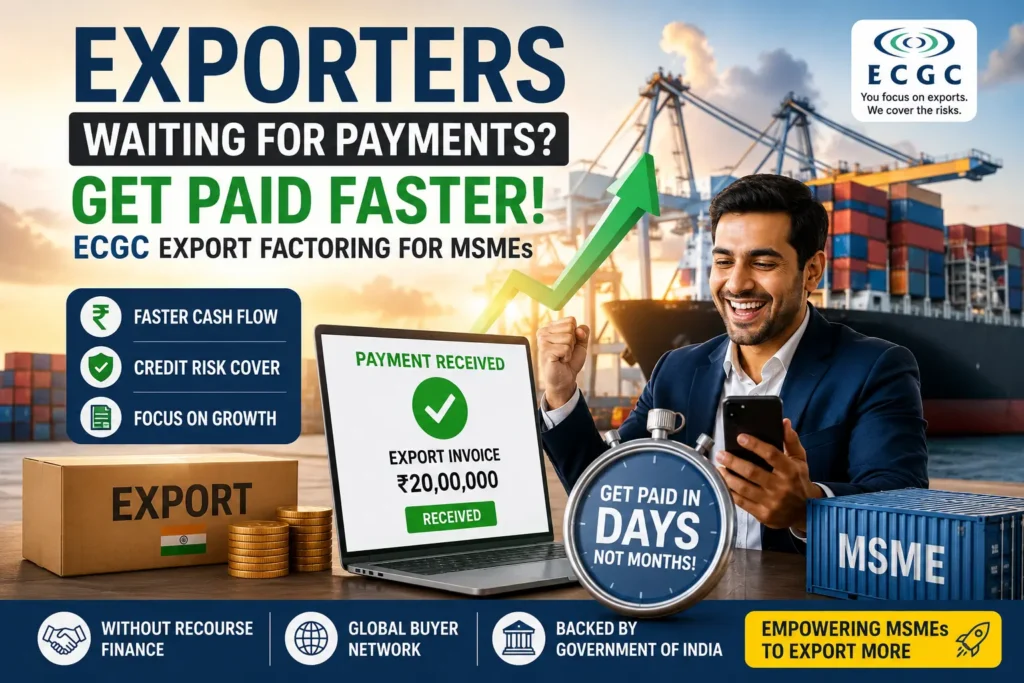
The ECGC Export Factoring for MSMEs facility is designed to provide finance against export receivables while also providing credit-risk protection on eligible overseas buyers.
But there is an important catch.
Although ECGC calls it an MSME facility, it is not necessarily meant for every small exporter.
The published eligibility criteria require at least three years of export experience, a good export track record and satisfactory business/financial performance during the previous three years.
So the big question for a very small exporter is:
Can a small exporter with only a few shipments actually benefit?
Or is this really a facility for established small and medium-sized exporters?
Let’s examine what the ECGC Export Factoring for MSMEs actually says.
What Is Export Factoring?
Export factoring is essentially a way of turning eligible export receivables into working capital before the overseas buyer actually pays.
Imagine this:
You export goods worth $50,000 to a buyer.
Your agreement allows the buyer to pay after 90 days.
You have already spent money on:
- Raw materials
- Manufacturing
- Packaging
- Freight
- Insurance
- Customs
- Employee costs
- Supplier payments
But your customer hasn’t paid you yet.
Normally, you wait 90 days for the money.
With factoring, an eligible factor can purchase the export receivable and provide financing against it.
This can bring money into your business much earlier.
In ECGC’s model, the company says its Export Factoring Facility combines working-capital financing, credit-risk protection, sales-ledger maintenance and collection of export receivables.
Most importantly, ECGC’s published material says the receivables can be purchased without recourse, with ECGC assuming the credit risk on the overseas buyer for eligible undisputed liabilities.
Why Is This Interesting for Indian MSME Exporters?
Because export growth can actually create a cash-flow problem.
Suppose your business receives a large export order.
That sounds like good news.
But imagine the buyer wants:
90-day payment terms.
You need to manufacture and ship the goods today.
So your business may have to finance the entire production and shipment for three months.
If you win five similar orders, your sales may be growing rapidly while your bank balance becomes tighter.
This is where export factoring can become useful.
It attempts to solve the gap between:
EXPORT SALE
and
EXPORT PAYMENT.
ECGC’s Export Factoring Facility: What Does It Offer?
According to ECGC’s published information, the facility can provide several benefits:
- Finance against export receivables
- Working-capital support
- Without-recourse finance on eligible undisputed export bills
- Credit-risk protection on the overseas buyer
- Maintenance of the sales ledger for transactions with a specific buyer
- Collection of export proceeds
- Recovery of unpaid bills
- Improved cash flow
- Ability to offer competitive credit terms to overseas buyers
The “Without Recourse” Part Is Particularly Interesting
This is one of the most important features to understand.
In a conventional loan, you borrow money and remain responsible for repayment.
In factoring, the receivable itself is being financed or purchased.
In ECGC’s published description, the Export Factoring Facility is structured around purchase of export receivables without recourse, with ECGC assuming credit risk on the overseas buyer for eligible undisputed liability.
That can potentially provide something more valuable than simply another loan:
Liquidity plus buyer-credit-risk protection.
But There Is a BIG Catch for Small Exporters
This is where BusinessZindagi believes exporters should look beyond the headline.
ECGC’s website says the facility is for MSMEs.
That sounds extremely encouraging.
But “MSME” does not automatically mean “every tiny exporter qualifies.”
The official ECGC factoring document lists these eligibility conditions:
- The exporter must be a Micro, Small or Medium Enterprise.
- The exporter must have a minimum three years’ experience in exports with a good track record.
- The exporter must have satisfactory business/financial performance for the previous three years.
- Exports must be to acceptable buyers in A1 and A2 countries.
- Exports must be on Open Account terms with a credit period of up to 180 days.
- Certain commodities are excluded.
- Assignment of accounts receivables is required.
So, Does ECGC Require a Minimum Export Turnover?
This is where the ECGC facility appears different from the private factoring companies many exporters encounter.
In the ECGC material I reviewed, I did NOT find a published minimum annual export turnover or minimum number of shipments requirement for this Export Factoring Facility.
That is important.
However, exporters should not interpret this as:
“No turnover requirement means anybody with an IEC can get factoring.”
It does not.
ECGC still requires:
Three years of export experience.
A good export track record.
Satisfactory business and financial performance for the previous three years.
Acceptable overseas buyers.
Eligible open-account transactions.
And assignment of receivables.
In other words, the entry barrier appears to be based more on the exporter’s history, financial performance and transaction quality than on a publicly stated minimum turnover number.
My Own Experience With Private Export Factoring
This is something I think is worth sharing because it is the kind of problem many small exporters may face.
When I was involved in export business, I had earlier explored private export factoring companies because delayed overseas payments can put enormous pressure on working capital.
What I found was that some private factoring providers were looking for exporters with an established operating history.
In my discussions, I was asked about things such as:
- Minimum annual turnover
- Export turnover during previous years
- Number of shipments
- Length of export history
- Financial performance
- Buyer profile
For a very small exporter with only a handful of shipments, these requirements could make factoring difficult to access.
That experience is precisely why ECGC’s current facility caught my attention.
The ECGC eligibility document does not appear to publish the same kind of fixed minimum annual turnover or minimum shipment threshold.
But there is another hurdle:
ECGC itself requires at least three years of export experience and satisfactory performance for the previous three years.
So the facility may be easier to understand as:
“MSME-focused factoring for established exporters”
rather than:
“Factoring for every new or tiny exporter.”
Does ECGC Export Factoring Help Very Small Exporters?
This is the most important question.
My answer is:
YES — potentially.
But NOT necessarily the smallest or newest exporters.
Consider three exporters.
Exporter A: New Exporter
- Started exporting 8 months ago
- 5 export shipments
- Limited financial history
- One overseas buyer
- Wants factoring for a 90-day invoice
This exporter is unlikely to satisfy ECGC’s published three-year export experience and three-year performance requirements.
So this facility is probably NOT designed for this profile.
Exporter B: Small but Established Exporter
- Exporting for 4 years
- Relatively small annual turnover
- Regular shipments
- Good payment history
- Financial statements available
- Established overseas buyers
- Exports on open-account terms
This exporter looks much closer to the target profile.
Importantly, ECGC’s published criteria do not state that the exporter must have a huge turnover.
So a small exporter should not automatically assume that factoring is only for large companies.
The exporter should approach ECGC and ask for an assessment.
Exporter C: Growing Medium-Sized MSME
- 5+ years of exports
- Multiple overseas buyers
- Regular export receivables
- 60–180 day credit terms
- Strong financial records
- Increasing working-capital requirement
This is probably the clearest fit for the facility.
Why?
Because the exporter has exactly the problem factoring is designed to solve:
Growing sales are creating growing receivables.
The 3-Year Rule Is the Biggest Barrier for Tiny Exporters
This deserves special attention.
If you started exporting last year, ECGC’s Export Factoring Facility does not appear to be an immediate solution based on the published eligibility criteria.
You need a minimum three years’ export experience.
And ECGC also requires satisfactory business/financial performance for the previous three years.
Therefore, this facility is unlikely to solve the working-capital problem of a brand-new exporter.
But that doesn’t make it unhelpful.
It could be extremely valuable for the next category:
Small exporters who have survived the first few years and are now trying to scale.
What About the Minimum Number of Shipments?
This is another interesting difference.
The ECGC eligibility document I reviewed does not specify a minimum number of shipments.
That is good news.
But exporters should understand that ECGC will still need to evaluate the exporter, the receivables and the overseas buyer.
So:
No published minimum shipment count
does NOT mean:
Every invoice automatically qualifies.
What About Minimum Annual Turnover?
Again, the ECGC published factoring eligibility criteria I found do not specify a minimum annual export turnover.
This is potentially significant for smaller MSMEs.
Private factoring companies may have commercial underwriting policies that require minimum turnover or transaction volume.
ECGC’s published eligibility appears to take a different approach.
The key requirements are:
3 years of export experience
+
Good export track record
+
Satisfactory three-year business/financial performance
+
Acceptable buyers
+
Eligible open-account receivables
Which Countries and Buyers Are Eligible?
This is another major limitation.
ECGC’s published factoring document says exports must be to acceptable buyers from A1 and A2 countries.
Therefore, the facility is not simply:
“Any overseas buyer in any country.”
The buyer and country matter.
This makes sense because factoring involves taking credit exposure on the overseas buyer.
A financially strong buyer in an acceptable country is very different from an unknown buyer in a high-risk market.
What Payment Terms Are Eligible?
ECGC specifies:
Open Account terms
with a credit period of:
Up to 180 days.
This is important.
If your buyer is paying you in advance, there may be little need for factoring.
But if your buyer says:
“Ship now and I’ll pay you in 90 days.”
then factoring becomes much more relevant.
Likewise, a 120-day or 180-day receivable can create a substantial working-capital requirement for an MSME.
What Export Products Are Excluded?
The ECGC document says certain commodities are not eligible.
These include:
- Gold
- Diamond
- Gems
- Jewellery
- Iron Ore
- Granite
- Software
Therefore, exporters should check product eligibility before assuming their invoices qualify.
How Does the Money Flow?
A simplified example can help.
Suppose an Indian MSME exports:
₹20 lakh worth of goods.
The overseas buyer gets:
90 days credit.
The exporter now has ₹20 lakh tied up in receivables.
Instead of waiting the entire 90 days, an eligible factoring arrangement can provide finance against the receivable, subject to the factor’s assessment, terms and charges.
The exporter gets liquidity earlier.
The buyer pays the factor according to the arrangement.
The factor manages the receivable and collection.
This can shorten the exporter’s working-capital cycle.
But Factoring Is NOT Free Money
This is an important warning.
Factoring has a cost.
The exporter needs to compare:
- Financing cost
- Factoring charges
- Credit-risk protection cost
- Collection charges
- Other applicable fees
- Currency-related costs, where applicable
against the benefit of receiving money earlier.
The right question isn’t:
“Can ECGC give me money faster?”
The better question is:
“Will the cost of factoring improve my business enough to justify it?”
Example: When Factoring Could Make Sense
Suppose you have:
₹50 lakh export receivables
Average payment period:
90 days
Your business has another ₹50 lakh order waiting to be produced.
If you don’t receive the first ₹50 lakh, you may need expensive working-capital finance to execute the next order.
Factoring could potentially release liquidity from the first set of receivables.
That may allow you to:
- Buy raw materials
- Pay suppliers
- Manufacture the next order
- Accept another export order
- Offer better credit terms to buyers
In that situation, the financing cost may be justified by the additional business generated.
When Factoring May NOT Make Sense
If your export customer normally pays within 15 days, factoring may not provide enough benefit to justify the cost.
Likewise, if:
- Your margins are extremely thin
- Your buyer is risky
- Your export history is too short
- Your financial performance is weak
- Your receivables are disputed
- Your country/buyer is outside the eligible profile
factoring may not be suitable.
Factoring vs Export Loan: What’s the Difference?
This is another question exporters should understand.
An export loan is essentially credit provided to finance your business.
Factoring focuses on your export receivables.
In simple terms:
Export loan:
“I need money to finance my export business.”
Factoring:
“My export business has already generated receivables. Can those receivables be converted into working capital sooner?”
The two can sometimes complement each other, subject to lender and factor arrangements.
But exporters must avoid double financing the same receivables.
Factoring vs TReDS
If you already know about TReDS, you may wonder:
“Isn’t this basically the same thing?”
Not exactly.
TReDS is primarily an MSME receivables-financing platform involving eligible buyers and financiers.
RBI explains that on TReDS, a factoring unit represents an invoice or bill of exchange, financiers bid on it, and the MSME receives payment at the agreed discount rate. TReDS transactions are without recourse to the MSME.
But TReDS is focused on eligible receivables from buyers on the platform.
ECGC’s Export Factoring Facility is specifically designed around export receivables and overseas buyers.
So an exporter should evaluate which mechanism fits the transaction.
Who Is ECGC Export Factoring Really For?
Based on the published criteria, I would divide exporters into four groups.
🟢 Strong Potential Fit
Established MSME exporter
3+ years export experience
Good track record
Satisfactory financial performance
Acceptable overseas buyers
Open-account receivables
90–180 day credit terms
Growing working-capital requirement
🟡 Possible Fit — Needs Discussion
Small exporter with relatively low turnover
3+ years export experience
Regular but limited shipments
Good financial records
Strong overseas buyers
No published minimum turnover appears in the ECGC eligibility document
This exporter should contact ECGC rather than assuming they are too small.
🔴 Weak Fit
New exporter
Less than three years of export history
Limited financial records
Irregular export activity
Unproven overseas buyers
This exporter is unlikely to satisfy the published criteria.
🔴 Not Suitable for the Published Facility
Exporter dealing in excluded commodities
Exporter with receivables outside the permitted structure
Exporter whose transactions do not meet the buyer/country or open-account requirements
Again, eligibility should be confirmed directly with ECGC.
The Big Question: Is ECGC Really Helping the Smallest Exporters?
This is where I think the answer needs some nuance.
The headline:
“ECGC offers Export Factoring to MSMEs”
is encouraging.
But the actual criteria show that this is not a universal financing solution for every micro exporter.
A new exporter cannot simply obtain an IEC, make one shipment and immediately expect ECGC factoring.
The three-year export-history requirement is significant.
At the same time, there is an important positive point:
ECGC’s published eligibility criteria do not specify a minimum annual turnover or minimum number of shipments.
That could make the facility potentially more accessible to an established small exporter than private factoring products that impose commercial minimums.
So I would describe the facility this way:
“Not a startup-exporter facility — but potentially a valuable working-capital facility for established small and medium-sized MSME exporters.”
What Should a Small Exporter Do?
If you have been exporting for at least three years, don’t reject the facility simply because your turnover is small.
Instead, prepare:
- IEC
- MSME/Udyam details
- Export history
- Financial statements for the previous three years
- Buyer details
- Outstanding export receivables
- Export contracts/purchase orders
- Invoice details
- Payment terms
- Country information
- Buyer payment history
- Banking details
Then contact ECGC and ask specifically whether your exporter-buyer combination qualifies for Export Factoring.
ECGC’s current website lists the Policy/Factoring Department contact and says exporters can contact ECGC for further details.
A Very Important Question to Ask ECGC
If you are a small exporter, don’t just ask:
“Do you provide export factoring?”
Ask:
“I am an MSME exporter with three or more years of export history but relatively small annual turnover and limited shipments. There is no minimum turnover or shipment threshold shown in the published eligibility criteria. Can my exporter-buyer combination be considered for ECGC Export Factoring?”
That question goes directly to the issue that matters.
BusinessZindagi’s View
ECGC’s Export Factoring Facility is one of the more interesting export-finance developments for Indian MSMEs because it addresses a very real problem:
The gap between making an export sale and receiving the money.
But exporters should not confuse:
“Available to MSMEs”
with:
“Available to every MSME exporter.”
The three-year export experience and three-year satisfactory performance requirements mean that brand-new exporters are unlikely to benefit immediately.
For established small exporters, however, the absence of a published minimum turnover or shipment threshold in ECGC’s factoring eligibility document is worth investigating.
That could be particularly useful for exporters who have previously struggled to meet the minimum turnover or shipment requirements demanded by private factoring companies.
In other words:
ECGC may not solve the financing problem of the newest exporter.
But it could potentially solve a much more important problem for an established small exporter:
“I have orders. I have invoices. My buyers will pay. I just need working capital while I wait.”
Before You Apply: 7 Questions to Ask
- Does my exporter profile satisfy the three-year export experience requirement?
- Do I have satisfactory business and financial performance for the previous three years?
- Is my overseas buyer in an acceptable A1/A2 country?
- Is the transaction on open-account terms?
- Is the buyer’s payment period 180 days or less?
- Is my product eligible?
- What will be the total cost of factoring compared with my current working-capital cost?
Final Verdict: Is ECGC Export Factoring Worth Exploring?
For established MSME exporters:
YES.
It is certainly worth investigating.
For a brand-new exporter:
Probably not yet, because the published three-year export experience requirement is a significant hurdle.
For a very small exporter with three or more years of export experience:
This is where the opportunity becomes particularly interesting.
The ECGC document I reviewed does not state a minimum annual turnover or minimum shipment count.
That does not guarantee approval.
But it means a small established exporter should not assume:
“My turnover is too small, so ECGC won’t consider me.”
Instead, contact ECGC and ask.
The biggest attraction is not simply faster access to money.
It is the combination of:
Export receivables financing
+
Buyer credit-risk protection
+
Collection support
+
Working-capital improvement
For an MSME trying to grow exports, that combination could be valuable.
And perhaps the biggest lesson is this:
Export growth is not only about finding more buyers.
It is also about financing the time between shipping the goods and getting paid.
BusinessZindagi Tools for Exporters
Export Profit Calculator
Before accepting an export order with long credit terms, calculate your actual shipment cost, margin and expected profit.
Use the BusinessZindagi Export Profit Calculator →
HS Code Finder
Find the relevant HS code before calculating export costs, duties and trade requirements.
Use the BusinessZindagi HS Code Finder →
FTA Finder
Check whether your target market has a relevant Free Trade Agreement and explore potential tariff advantages.
Use the BusinessZindagi FTA Finder →
DGFT Source from India
Explore the official DGFT-related resources useful for Indian exporters.
Visit BusinessZindagi’s DGFT Export Resources →
Track Export Receivables
If your export invoices are getting delayed, track outstanding payments and due dates before taking additional working
🚀 Want to Find More Overseas Buyers?
Getting export finance is only one part of growing an export business.
The bigger question is: Who should you sell to?
Instead of searching randomly for importers, use shipment and trade data to identify companies that are actually importing your product.
With Volza, exporters can:
🔎 Find potential buyers in global markets
📦 Track actual import and export shipments
🌎 Discover new countries and markets for your products
📊 Analyse competitors and their shipment activity
🎯 Identify buyers based on real trade data
If you’re serious about growing your exports, better buyer intelligence can help you spend less time searching and more time approaching the right companies.
👉 Find Overseas Buyers & Grow Your Exports with Volza →
Frequently Asked Questions
What is ECGC Export Factoring?
ECGC Export Factoring is a facility offered by ECGC for eligible MSME exporters. It combines financing against export receivables with credit-risk protection and collection-related services.
Who is eligible for ECGC Export Factoring?
ECGC’s published eligibility criteria include MSMEs with at least three years of export experience, a good export track record and satisfactory business/financial performance for the previous three years. Other conditions relating to buyers, countries, payment terms, products and assignment of receivables also apply.
Is there a minimum export turnover for ECGC Export Factoring?
The ECGC factoring eligibility document reviewed for this article does not specify a minimum annual export turnover.
Is there a minimum number of export shipments?
The ECGC published eligibility criteria reviewed for this article do not specify a minimum number of shipments.
Can a new exporter use ECGC Export Factoring?
The published ECGC eligibility criteria require a minimum of three years’ export experience with a good track record, so a brand-new exporter would not appear to meet this requirement.
Does ECGC factoring cover every overseas buyer?
No. The published criteria specify exports to acceptable buyers from A1 and A2 countries. Buyer and country eligibility should be confirmed with ECGC.
What payment terms are eligible?
The published criteria specify open-account exports with a credit period of up to 180 days.
Is ECGC factoring available for all products?
No. ECGC’s published factoring document excludes certain commodities, including gold, diamonds, gems, jewellery, iron ore, granite and software.
Is export factoring the same as an export loan?
No. Export loans provide credit to finance business requirements, whereas factoring is based on eligible receivables and can provide liquidity against invoices.
Should very small exporters contact ECGC?
If they have at least three years of export experience and satisfactory financial/business performance, it may be worth contacting ECGC even if their turnover is relatively small, because the published factoring criteria do not state a minimum annual turnover or shipment count.
Authentic Sources & References
- ECGC — Export Factoring Facility
ECGC’s official page confirms that it is currently offering an Export Factoring Facility specifically for Micro, Small & Medium Enterprises. The page shows a last update date of August 3, 2026.
https://main.ecgc.in/factoring
- ECGC — Export Factoring Facility Details
ECGC’s official factoring document provides the eligibility conditions, benefits, buyer/country requirements, open-account credit period and excluded commodities.
https://main.ecgc.in/wp-content/themes/pcwebecgc/images/pcECGPagePDF/Factoring/Factoringdoc.pdf
- RBI — Factoring and MSME Receivables
RBI’s regulations and directions provide the regulatory framework for factoring and recognise eligible MSME factoring transactions, including those conducted through TReDS.
- RBI — TReDS FAQ
RBI explains how TReDS factoring units work, how financiers bid and how MSMEs receive payment against eligible receivables. RBI also states that TReDS transactions are without recourse to MSMEs.
https://www.rbi.org.in/scripts/FAQView.aspx/FAQView.aspx/FAQView.aspx?Id=132
- ECGC — Small Exporters Policy
ECGC also operates a separate Small Exporters Policy for exporters with anticipated annual export turnover of up to ₹5 crore. This is a different product from Export Factoring and should not be confused with the factoring eligibility criteria.
https://main.ecgc.in/small-exporters-policy-sep
Editorial Disclaimer
This article is published by BusinessZindagi.com for general informational and educational purposes only. It is not financial, banking, export, investment, legal, tax or professional advice.
ECGC’s eligibility criteria, underwriting decisions, charges, buyer limits, country classifications and product terms may change. Meeting the published eligibility criteria does not guarantee approval or financing.
Exporters should confirm their individual eligibility, costs, buyer limits and transaction terms directly with ECGC before making financial or commercial decisions.
Personal Experience Disclosure
The section describing the author’s earlier experience with private export factoring companies is based on the author’s own experience and is included to provide practical context.
The experience should not be interpreted as a statement that every private factoring company has the same minimum turnover, shipment or underwriting requirements. Different providers may apply different commercial criteria.
AI Disclosure
Parts of this article were prepared with the assistance of artificial intelligence for research, organisation, drafting and editing.
The article’s key eligibility information has been checked against ECGC’s published Export Factoring Facility material and relevant RBI sources available at the time of publication.
Because financial and export policies can change, readers should verify current terms directly with ECGC or the relevant authority before making decisions.
Affiliate Disclosure
BusinessZindagi.com may use affiliate links in some articles. If a reader purchases a product or service through an eligible affiliate link, BusinessZindagi may receive a commission at no additional cost to the reader.
Transparency Note
BusinessZindagi has distinguished between officially published ECGC eligibility requirements and the author’s personal experience with private export factoring providers.
Where this article discusses the absence of a published minimum turnover or shipment requirement, that statement refers specifically to the ECGC Export Factoring eligibility document reviewed for this article. It should not be interpreted as a guarantee that ECGC will approve an application regardless of exporter size or transaction volume.
Last Updated: August 30, 2026