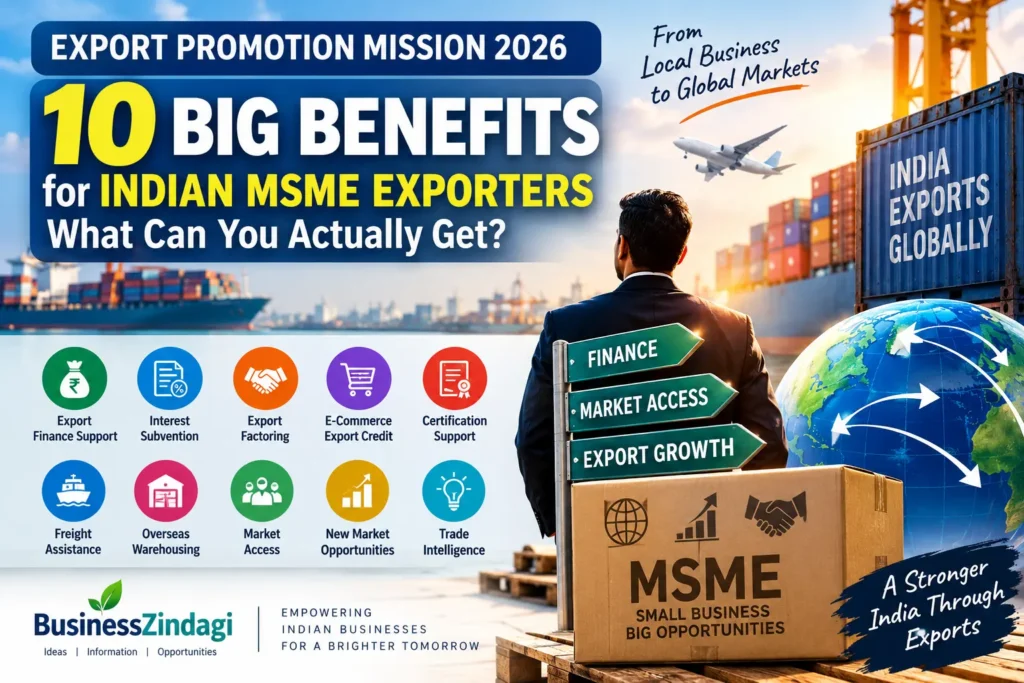
Export Promotion Mission 2026 is not just another export subsidy. It is a ₹25,060 crore government framework designed to help Indian exporters—especially MSMEs and first-time exporters—with finance, export compliance, logistics, market access and overseas expansion.
But there is an important catch:
You do not automatically get ₹25,060 crore or a fixed cash benefit.
The Mission contains different interventions, and each has its own eligibility rules, limits and application process.
So what can an Indian MSME exporter actually use?
Let’s break it down simply.
BusinessZindagi Quick Answer: If you are an eligible MSME exporter, the Export Promotion Mission can potentially help reduce the cost of export finance, support export factoring, provide credit support for e-commerce exports, reduce certain certification and freight costs, and improve access to international buyers and markets.
What Is the Export Promotion Mission 2026?
The Export Promotion Mission (EPM) was approved by the Government of India in November 2025 with a total outlay of ₹25,060 crore for FY 2025–26 to FY 2030–31.
It is focused particularly on:
- Micro, Small and Medium Enterprises (MSMEs)
- First-time exporters
- Labour-intensive sectors
- Export diversification
- Emerging markets
- Global market access
The Mission is organised around two broad pillars:
1. Niryat Protsahan
This focuses mainly on financial support and trade finance.
2. Niryat Disha
This focuses on market access, compliance, logistics, trade intelligence and other non-financial export support.
The Government describes EPM as an integrated framework covering the exporter journey from market and product analysis to finance, compliance, logistics and overseas market access.
10 Export Promotion Mission Benefits MSMEs Should Know
1. Export Factoring Support
One of the most interesting EPM benefits is support for export factoring.
If a foreign buyer owes you money after you have exported goods, waiting 30, 60 or 90 days can create a working-capital problem.
Export factoring can potentially help you convert those export receivables into cash earlier.
Under the EPM intervention:
2.75% interest subvention is available on eligible factoring costs, subject to a maximum of ₹50 lakh per IEC per year.
Both recourse and non-recourse factoring are supported under the framework, subject to the applicable rules.
Why this matters
For an MSME exporter, the problem is often not lack of orders.
It is:
Order → production → shipment → invoice → waiting for payment
The longer the waiting period, the more working capital gets locked up.
Export factoring is designed to address exactly this problem.
2. Export Credit Interest Subvention
EPM also provides interest subvention on eligible pre-shipment and post-shipment export credit.
The current framework provides:
2.75% interest subvention
subject to a maximum of:
₹50 lakh per exporter
and other eligibility conditions.
The support applies to eligible export products covered under the notified tariff-line framework.
In simple terms
If your bank provides eligible export finance, the EPM support can reduce the effective cost of that finance.
However, this is not a blanket 2.75% discount on every business loan.
The export, product, credit facility and lender must satisfy the applicable conditions.
3. Collateral Support for Export Credit
Collateral can be one of the biggest problems for small exporters trying to obtain bank finance.
Under EPM’s collateral support intervention, credit guarantee coverage is available for eligible export credit.
The Government’s February 2026 backgrounder states:
- 85% guarantee coverage for micro and small enterprises
- 65% guarantee coverage for medium enterprises
- Maximum eligible credit limit of ₹10 crore per exporter
This does not mean the Government simply gives the exporter ₹10 crore.
Instead, the guarantee support is intended to make it easier for eligible exporters to obtain formal credit from lending institutions.
4. E-Commerce Export Credit
This could become particularly important for India’s growing cross-border e-commerce businesses.
EPM provides structured credit support for MSME exporters using channels such as:
- Postal exports
- Courier exports
- Overseas inventory-based fulfilment
- Cross-border e-commerce
There are two important facilities.
Direct E-Commerce Credit Facility
Up to:
₹50 lakh
with up to:
90% guarantee coverage
Overseas Inventory E-Commerce Credit Facility
Up to:
₹5 crore
with up to:
75% guarantee coverage
Eligible financing can also receive 2.75% interest subvention, subject to an annual ceiling of ₹15 lakh per applicant.
The Government’s February 2026 backgrounder says the intervention is implemented through EXIM Bank and includes eligibility requirements such as a valid IEC and Udyam Registration for MSME exporters, with provisions also covering certain new MSME exporters with prior domestic e-commerce turnover.
This could be particularly relevant for Indian businesses selling products internationally through digital channels.
5. Support for Entering New or Riskier Export Markets
What if you have a genuine foreign buyer but the destination market is considered underserved or higher risk?
EPM’s Support for Emerging Export Opportunities is designed for situations like this.
The intervention provides risk-sharing and credit support intended to encourage banks and exporters to undertake transactions in new or higher-risk markets.
The Government has specified risk-sharing support ranging from:
10% to 90% of transaction value
depending on the applicable risk model and subject to prescribed exposure limits.
Why this matters
A small exporter may have a good product and a genuine buyer but still face difficulty getting a bank comfortable with an unfamiliar market.
This intervention attempts to reduce that financing barrier.
6. Export Certification & Compliance Support
Exporting increasingly means meeting the buyer country’s technical, safety, environmental and quality requirements.
That can become expensive.
EPM’s TRACE — Trade Regulations, Accreditation & Compliance Enablement intervention provides support for eligible testing, inspection and certification costs.
For eligible certifications:
Positive List
Support of:
60% of eligible actual cost, or ₹25 lakh, whichever is lower
Priority Positive List
Support of:
75% of eligible actual cost, or ₹25 lakh, whichever is lower
The annual support cap is:
₹25 lakh per exporter
Examples of certifications listed by the Government include areas such as:
- CE marking
- FDA certification
- ISO standards
- SABER/SASO
- BRCGS
- FSSC 22000
- HACCP
- MSC/ASC
- SMETA
But remember:
Not every certification automatically qualifies.
The certification must fall within the applicable notified list and the exporter must satisfy the scheme conditions.
7. Freight & Transport Support for Eligible MSME Exporters
For exporters located far from ports, logistics can destroy an otherwise competitive export price.
This is particularly important for exporters in:
- Hinterland districts
- Low-export-intensity districts
- Geographically disadvantaged areas
The EPM LIFT — Logistics Interventions for Freight & Transport component can provide support of up to:
30% of eligible transport cost
subject to a maximum of:
₹20 lakh per exporter per financial year
The intervention covers eligible movement from MSME premises to locations such as:
- Inland Container Depots
- Container Freight Stations
- Sea ports
- Air Cargo Complexes
subject to the notified products, districts and conditions.
BusinessZindagi Tip
If you are exporting from a geographically disadvantaged location, don’t assume freight support is available just because you are an MSME.
Check:
Your district + product + shipment + applicable EPM rules
before building the benefit into your export pricing.
8. Overseas Warehousing & Fulfilment Support
Sometimes the problem isn’t finding a buyer.
It is delivering products efficiently after finding one.
EPM’s FLOW — Facilitating Logistics, Overseas Warehousing & Fulfilment intervention supports eligible overseas infrastructure and fulfilment arrangements.
The framework can support areas including:
- Overseas warehousing
- Overseas fulfilment
- Display and market-access facilities
- E-Commerce Export Hubs
Assistance can extend to 30% of approved project cost, subject to the specific ceiling and eligibility rules.
For example, the Government’s February 2026 framework specifies ceilings including:
- Overseas warehousing: lower of ₹10 crore or 30% of approved project cost
- Overseas fulfilment: lower of ₹5 lakh per month or 30% of approved project cost
- Display and market access facilities: lower of ₹5 crore or 30%
- E-Commerce Export Hubs: lower of ₹10 crore or 30%
Important
This is not a simple individual-exporter subsidy.
FLOW is primarily structured around eligible Export Promotion Councils, Commodity Boards, logistics/warehousing/fulfilment providers, industry associations and organisations recommended by governments.
So exporters may benefit from the ecosystem without necessarily applying as an individual MSME.
9. Market Access Support: Trade Fairs, Buyer-Seller Meets & Delegations
This is one of the most practical parts of EPM for businesses trying to find buyers.
The Market Access Support (MAS) intervention supports activities such as:
- Buyer-Seller Meets
- International trade fairs
- Trade delegations
- Reverse Buyer-Seller Meets
Support is intended to improve buyer connectivity and help Indian exporters enter new markets.
The Government has also provided for airfare support for eligible small exporters and preferential support for priority sectors and markets.
The framework gives special attention to MSME participation.
Why this matters
For a small exporter:
A buyer meeting can be more valuable than another advertisement.
But simply attending a trade fair isn’t enough.
The real objective should be:
Meet buyer → qualify buyer → follow up → sample → quotation → order → repeat order
That is where a trade-fair strategy becomes useful.
🌍 Looking for Foreign Buyers for Your Export Product?
Government support can help you export—but finding the right overseas buyers is the next big step.
Use Volza to research global buyers, importers and shipment-backed trade data before approaching a new market.
👉 Find Potential Foreign Buyers with Volza
BusinessZindagi may earn a commission if you use this link, at no extra cost to yo
10. Trade Intelligence & Export Market Support
The final opportunity many small exporters overlook is INSIGHT — Integrated Support for Trade Intelligence & Facilitation.
It is intended to address information gaps and strengthen exporter preparedness through areas such as:
- Trade intelligence
- Research
- Training
- Capacity building
- District and cluster facilitation
- Toolkits
- Pilot projects
- Export analytics
Support can extend up to 50% of approved project cost for eligible activities, with higher support possible for government entities.
For an individual exporter, the bigger benefit may be indirect:
better information → better market selection → better buyer targeting → fewer costly export mistakes.
So Which EPM Benefit Is Best for Your Business?
Don’t look at the ₹25,060 crore headline.
Look at your actual export problem.
| Your problem | EPM area worth checking |
|---|---|
| Export finance is expensive | Interest subvention |
| Buyer payment is delayed | Export factoring |
| Bank wants collateral | Collateral support |
| You sell internationally through e-commerce | E-commerce credit |
| New market is difficult/risky | Emerging Export Opportunities |
| Certification is expensive | TRACE |
| Freight from your district is expensive | LIFT |
| Need overseas storage/fulfilment | FLOW |
| Need foreign buyers | Market Access Support |
| Need better export intelligence | INSIGHT |
This is the real value of EPM.
It is not one scheme. It is an export-support ecosystem.
How Can an MSME Actually Apply?
This is where exporters need to be careful.
There isn’t one universal “Apply for Export Promotion Mission” form that automatically gives you every benefit.
The application route depends on the intervention.
For several Niryat Protsahan interventions, exporters are required to file an Intent-to-Claim (IC) on the DGFT portal before obtaining the relevant support.
A Unique Identification Number (UIN) is generated.
The exporter then shares the UIN with the relevant lending institution or factoring entity.
For TRACE and LIFT, the Government’s framework provides for filing an Intent-to-Claim through the Trade portal before obtaining eligible services, followed by reimbursement claims with supporting documents.
For FLOW, INSIGHT and MAS, the process is proposal-based through the Trade portal.
Important
Do not spend money first and assume the Government will reimburse you later.
For interventions requiring prior Intent-to-Claim or approval, missing that step can potentially make the expense ineligible.
Always check the latest operational guidelines before committing money.
What Should an MSME Exporter Prepare?
Before exploring EPM support, keep your export foundation ready:
Basic
- Udyam Registration
- IEC
- PAN
- GST details, where applicable
- Bank details
- Export product details
- HS codes
- Export turnover/history
- Shipping/export documents
For finance
- Bank statements
- Financial statements
- Existing borrowing details
- Export orders
- Invoices
- Receivables
- Buyer details
- Credit requirements
For certification support
- Certification requirement
- Overseas market
- Testing/certification quotation
- Applicable certification category
- Supporting invoices/documents
For freight support
- Product/HS code
- District
- Origin location
- Port/ICD/CFS/ACC
- Freight invoices
- Shipment documentation
One Important Warning: EPM Is Not Free Money
This is probably the most important thing an exporter should understand.
EPM support may come through:
interest subvention
or
credit guarantee
or
reimbursement
or
risk-sharing
or
institutional support
or
market-access assistance.
These are very different things.
For example:
₹10 crore eligible credit limit does not mean the Government deposits ₹10 crore into your bank account.
Similarly:
85% credit guarantee does not mean an exporter receives 85% of the loan as a subsidy.
And:
30% freight support does not mean every freight bill automatically gets a 30% reimbursement.
Eligibility, notified products, districts, documentation, ceilings and procedures matter.
What Does This Mean for a Small Exporter in 2026?
The biggest change is that export support is increasingly moving beyond the old idea of simply giving exporters incentives after shipment.
The EPM architecture addresses several points in the export journey:
Find market
↓
Find buyer
↓
Get finance
↓
Meet certification requirements
↓
Produce & ship
↓
Manage freight
↓
Receive payment
↓
Expand into new markets
That is why EPM deserves attention from MSMEs that are serious about exporting.
BusinessZindagi Take
If you are an Indian MSME exporter, don’t ask:
“How much subsidy can I get under Export Promotion Mission?”
Ask:
“Which part of my export business is currently holding me back?”
If it is working capital → investigate interest subvention or factoring.
If it is collateral → investigate export credit guarantee support.
If it is e-commerce → check E-Commerce Credit.
If it is certification → check TRACE.
If it is freight → check LIFT.
If it is finding buyers → explore Market Access Support and official trade platforms.
If it is entering a difficult market → investigate Emerging Export Opportunities.
That approach is far more useful than treating EPM as one generic subsidy.
🔎 For Exporters: Finding the Right Buyers Still Matters
Government support can reduce the cost and risk of exporting.
But it doesn’t solve the first question:
Who should you sell to?
If you already know your HS code and target market, shipment-based trade intelligence can help you research companies that are actually importing products similar to yours.
👉 Explore Volza for international buyer and trade-data research.
Affiliate disclosure: BusinessZindagi may earn a commission if you use certain affiliate links, at no additional cost to you. Our editorial recommendations remain independent.
🔗 Useful BusinessZindagi Resources
- :contentReference[oaicite:1]{index=1} — useful if your working-capital problem involves receivables.
- :contentReference[oaicite:2]{index=2}
- :contentReference[oaicite:3]{index=3}
- :contentReference[oaicite:4]{index=4}
📌 Official Sources
- :contentReference[oaicite:5]{index=5}
- :contentReference[oaicite:6]{index=6}
- :contentReference[oaicite:7]{index=7}
- :contentReference[oaicite:8]{index=8}
- :contentReference[oaicite:9]{index=9}
Frequently Asked Questions
What is the Export Promotion Mission 2026?
It is a ₹25,060 crore Government of India framework for FY 2025–26 to FY 2030–31 designed to strengthen Indian exports, particularly for MSMEs, first-time exporters and labour-intensive sectors.
Is Export Promotion Mission a single subsidy scheme?
No. It is an umbrella framework containing different financial and non-financial interventions.
Can every MSME exporter claim EPM benefits?
No. Eligibility varies by intervention, product, exporter category, district, financing arrangement and other conditions.
How much export finance interest support is available?
The current EPM framework provides 2.75% interest subvention on eligible pre- and post-shipment export credit, subject to applicable conditions and a ₹50 lakh annual exporter cap.
Can MSMEs get support for export factoring?
Yes, eligible MSME exporters can receive 2.75% interest subvention on eligible factoring costs, subject to the applicable conditions and ₹50 lakh per IEC annual cap.
Does EPM support e-commerce exporters?
Yes. The EPM e-commerce intervention includes a Direct E-Commerce Credit Facility up to ₹50 lakh with up to 90% guarantee coverage and an Overseas Inventory Credit Facility up to ₹5 crore with up to 75% guarantee coverage, subject to eligibility and scheme conditions.
Does EPM pay export freight?
The LIFT intervention can provide up to 30% support for eligible transport costs, subject to notified products, districts, conditions and a ₹20 lakh per IEC annual ceiling.
Does EPM help with export certification?
Yes. TRACE provides support for eligible testing, inspection and certification expenses, with different reimbursement rates for the Positive List and Priority Positive List.
Where should exporters check the latest EPM rules?
Exporters should check the latest notifications and operational guidelines issued through official Government channels, particularly the DGFT and Department of Commerce/Trade portals, before spending money or applying.
🔗 Related BusinessZindagi Guides
- Interest Subsidy Scheme for Exporters
- TReDS Registration for MSMEs 2026
- TReDS Portal Mandate 2026
- DGFT Source from India – Find Foreign Buyers
- Payment Risks in Exports
- Global Trade Data
Editorial, AI & Affiliate Disclosure
Editorial & AI Disclosure:
This article was researched using official Government of India sources and prepared with AI assistance for research, structuring and editing. It has been reviewed and written for BusinessZindagi with the aim of making complex MSME and export policies easier to understand. Government schemes, eligibility criteria, ceilings and procedures can change. Always verify the latest official notification or guideline before making a financial or export decision.
Affiliate Disclosure:
Some links on BusinessZindagi may be affiliate links. BusinessZindagi may earn a commission at no additional cost to the user. Affiliate relationships do not determine our editorial conclusions or recommendations.
Official Sources