Getting an MSME loan has traditionally meant submitting financial statements, bank statements, ITRs, GST records, business documents and other paperwork.
But MSME loan eligibility is increasingly being assessed in a more digital environment.
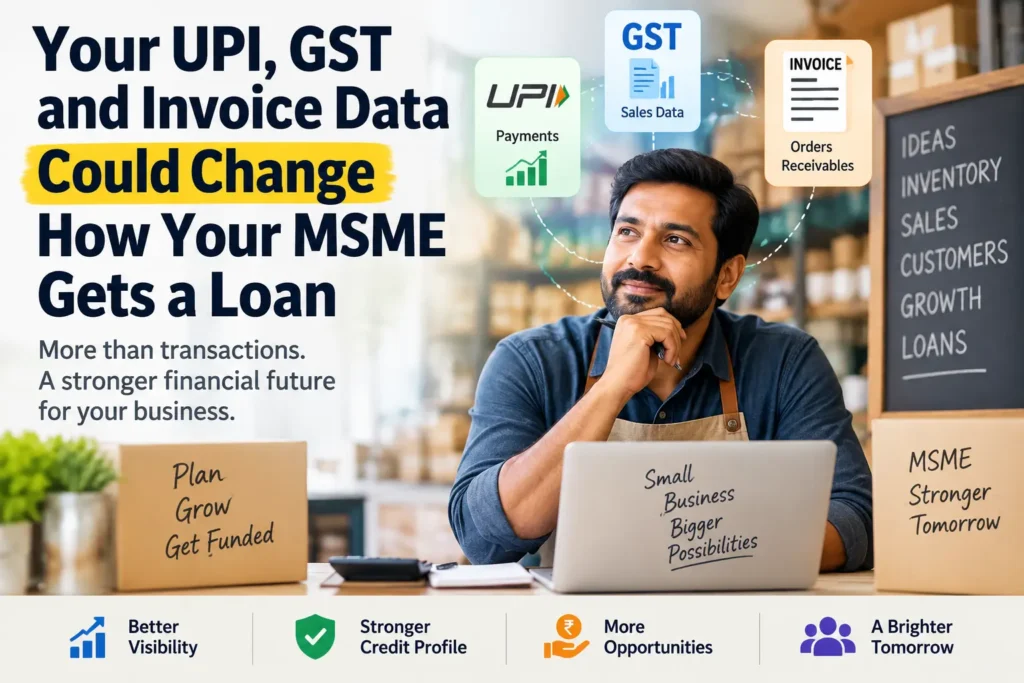
Your UPI transactions can show business activity.
Your GST data can show reported sales.
Your invoices can show customers, orders and receivables.
Your bank account can show cash movement.
And new technology, including AI, can potentially analyse these different sources together.
This does not mean banks will simply look at your UPI transactions and approve a business loan.
The bigger change is this:
Your digital business activity can increasingly become part of your financial profile.
That could be particularly important for micro and small businesses that have limited traditional financial records.
What is changing in MSME loan eligibility?
Traditionally, a lender might look at:
Financial statements + ITR + bank statements + GST + credit history + business documents
The emerging digital credit assessment model can potentially add:
UPI + invoices + digital payments + cash-flow data + other permitted business information
The objective is not necessarily to replace traditional credit assessment.
It is to give lenders more information with which to understand a business.
This is becoming a current issue in India’s MSME finance ecosystem.
In September 2026, SBI said it was developing a solution that could use UPI transaction data as a proxy for sales for small businesses without GST registration. SBI’s management said the objective was to use regular digital sales activity to help assess businesses outside the GST system.
NITI Aayog Vice-Chairman Ashok Lahiri has also said UPI transaction data could help improve credit appraisal and risk pricing and bring more MSMEs into the formal credit system.
This is why UPI data for MSME loans is becoming an important topic for small business owners.
1. Can UPI data help with MSME loan eligibility?
Consider a small retailer that receives most customer payments through UPI.
Over six or twelve months, the business may generate a digital transaction history showing:
- frequency of transactions
- transaction values
- sales patterns
- seasonal changes
- digital collections
- customer payment activity
This creates a potentially useful picture of business activity.
For example:
January: ₹4 lakh digital collections
February: ₹4.5 lakh
March: ₹5.2 lakh
April: ₹3.8 lakh
May: ₹4.1 lakh
A lender could potentially use such information as one part of a broader MSME credit assessment.
SBI has specifically said it is developing a lending solution using UPI data for certain small businesses without GST registration.
But there is an important limitation.
UPI receipts are not the same as profit.
A business receiving ₹50 lakh through UPI does not necessarily make ₹50 lakh in profit.
It may have:
- ₹42 lakh of expenses
- supplier payments
- salaries
- rent
- interest
- taxes
- existing debt
- customer refunds
So UPI transaction history for a loan can potentially demonstrate business activity, but it cannot by itself establish repayment capacity.
2. Can you get an MSME loan without GST?
This is where the current development becomes particularly interesting.
Some micro and small businesses may not have GST data available for a lender to analyse.
That creates an information gap.
Traditionally, a lender may have had fewer formal indicators with which to assess such a business.
UPI transactions could potentially provide another source of information.
SBI’s September 2026 announcement specifically discussed developing a UPI-based lending solution for businesses outside the GST system.
This does not mean every business without GST will automatically qualify for a business loan.
It means digital transaction data could potentially become another input into credit assessment.
So if you search for “MSME loan without GST” or “business loan without GST”, the important question isn’t simply whether GST registration exists.
The lender may also look at the overall financial and operational profile of the business.
3. GST data can strengthen the financial picture
For businesses registered under GST, GST records can provide another layer of information.
Depending on the lending process, GST-related information can help establish things such as:
- reported turnover
- sales activity
- filing history
- business trends
- transaction information
- consistency of reported activity
SBI’s FY2024-25 Sustainability Report says its Business Risk Engine (BRE) for MSME loans up to ₹5 crore uses bureau, GST, ITR and banking data for risk assessment and decision-making. SBI reported 93,942 loans worth ₹47,789 crore sanctioned through BRE by March 2025.
This is a useful example of how GST data for business loans can form part of a broader digital credit assessment.
It also shows why maintaining accurate GST records can matter beyond tax compliance.
4. Your invoices could become another important data point
Imagine a small manufacturer has issued:
100 invoices
for a total value of:
₹35 lakh
to:
40 customers
over several months.
Those invoices may contain useful information about:
- customers
- order frequency
- invoice values
- sales concentration
- outstanding receivables
- payment terms
- business seasonality
When invoice information can be compared with bank transactions and other records, it can provide a more detailed picture of the business.
But once again, an invoice is not the same thing as cash.
A ₹5 lakh invoice does not guarantee that the customer will pay ₹5 lakh on time.
That is why invoices should be considered alongside actual cash flow and repayment information.
5. Why digital invoicing matters for MSMEs
Many small businesses still manage invoices through a mixture of:
- notebooks
- Excel files
- PDFs
- accounting software
- handwritten records
This can make it difficult to get a complete picture of outstanding payments.
A structured invoicing system can help you track:
Customer → Invoice → Amount → Due date → Payment → Outstanding balance
That can make everyday business management easier while also creating better financial records.
Want to organise your business digitally?
If you’re looking for software for invoicing, accounting and broader business management, you can explore Zoho’s business software solutions.
👉 Explore Zoho for your business
Disclosure: BusinessZindagi may earn a commission if you purchase through this affiliate link. This does not affect the factual information in this article.
The important principle is simple:
Use accurate records to make your real business activity easier to understand and verify.
6. AI-based MSME lending could connect the data
This is where AI-based MSME lending becomes interesting.
Instead of examining each document separately, technology can potentially help lenders analyse multiple sources together.
For example:
UPI
GST
Invoices
Bank transactions
Credit history
Accounting information
Other permitted business data
↓
Digital credit assessment
↓
Risk assessment
↓
Lending decision
AI can potentially help identify patterns across large volumes of information.
But AI does not automatically make a lending decision correct.
Human oversight, lender policies, data quality and regulatory requirements still matter.
The broader industry is already discussing how AI can analyse fragmented MSME information, including invoices, ledgers, GST filings, inventory movement and other operational signals.
7. How banks assess MSME loans could change
The traditional question was often:
“Show me your financial statements.”
The emerging question can increasingly become:
“Show me the financial and operational data that demonstrates how your business actually works.”
This doesn’t make traditional financial statements irrelevant.
Instead, the data sources can complement one another.
For example:
| Business data | What it may show |
|---|---|
| UPI transactions | Digital collection activity |
| GST records | Reported sales and tax activity |
| Invoices | Orders and receivables |
| Bank statements | Cash movement |
| ITR | Reported income |
| Credit report | Borrowing and repayment history |
| Accounting records | Revenue, expenses and profit |
| Inventory records | Stock movement |
The more consistent these records are, the easier it may be to understand the business.
8. What does this mean for MSME loan eligibility in 2026?
If you’re searching for MSME loan eligibility 2026, don’t focus only on one number such as annual turnover.
Loan assessment can involve multiple factors.
Depending on the lender and product, these can include:
- business vintage
- turnover
- profitability
- cash flow
- credit history
- repayment behaviour
- existing debt
- banking activity
- GST records
- ITR
- invoices
- receivables
- business documents
- collateral or security requirements
- lender-specific criteria
Therefore, having strong UPI transactions does not automatically mean that your loan will be approved.
Similarly, having GST registration does not guarantee loan approval.
The lender still needs to assess the overall credit profile.
9. Your MSME loan readiness checklist
You don’t have to wait until you need finance to start preparing.
Build a clean financial trail now.
Keep a business bank account
Where practical, separate business transactions from personal transactions.
Keep digital payments organised
Make sure your business collections can be identified and reconciled properly.
Maintain proper invoices
Keep invoice numbers, customer details, amounts and payment status organised.
Track receivables
Know exactly:
Who owes you → How much → Since when → When payment is expected
Maintain GST records
If GST applies to your business, make sure filings and records are accurate and consistent.
File your ITR
Your income-tax records can provide another important part of your financial history.
Monitor your credit history
Pay attention to existing loans, repayment behaviour and outstanding obligations.
Track actual profit
Don’t confuse turnover with profit.
Track cash flow
A business can be profitable and still face a working-capital shortage.
For example:
Customer payment after 90 days
while
Supplier payment is due in 30 days.
That 60-day gap can create a cash-flow problem.
Keep business documents ready
Depending on the lender and product, this may include:
- PAN
- Udyam registration
- GST documents
- ITR
- bank statements
- financial statements
- business address documents
- KYC documents
The goal isn’t to manipulate your data.
The goal is to make your genuine business activity easy to verify.
10. UPI, GST and invoices don’t tell the whole story
It is tempting to think that digital data will replace traditional lending assessments.
It won’t necessarily work that way.
Consider this example:
A business has:
₹60 lakh UPI collections
but also:
₹55 lakh expenses
and:
₹10 lakh existing debt
The UPI number alone doesn’t tell the lender whether the business can comfortably service another loan.
Similarly:
₹80 lakh GST turnover
doesn’t automatically mean:
₹80 lakh available cash.
And:
₹20 lakh outstanding invoices
doesn’t mean:
₹20 lakh already sitting in the bank.
This is why cash flow, profitability, repayment history and other information remain important.
11. Digital lending also raises privacy questions
More data can potentially improve credit assessment.
But more data also means greater responsibility around data privacy and consent.
RBI’s digital lending framework says regulated entities should ensure that data collection by digital lending apps is need-based and based on prior explicit consent, with an audit trail. Borrowers should also have options concerning specific data use, subject to the applicable framework.
So don’t automatically click “Allow” whenever a lending application requests access to information.
Before sharing data, understand:
- What information is being requested?
- Why is it required?
- Who will receive it?
- How will it be used?
- How long will it be retained?
- What are your consent and privacy options?
RBI has also established a public repository intended to help customers verify digital lending apps reported by regulated entities.
Check the RBI repository: RBI Public Repository of Digital Lending Apps
12. The real opportunity: cash-flow-based lending
One of the biggest changes could be a greater focus on cash-flow-based lending.
For many small businesses, the balance sheet doesn’t always tell the complete story.
A business may have:
- regular customers
- steady digital collections
- predictable seasonal sales
- consistent invoice payments
- healthy banking activity
but relatively limited fixed assets.
Digital data can potentially help lenders understand these patterns.
That could be particularly relevant for service businesses, retailers, small manufacturers and other businesses where cash flow is more important than physical assets.
But cash-flow visibility is not the same as guaranteed repayment capacity.
The lender still needs to evaluate the overall risk.
13. What should MSME owners do now?
You don’t need expensive technology to start.
Begin with the basics.
Build a clean digital trail
Use traceable business payments wherever appropriate.
Keep invoices organised
Don’t let important sales records disappear into WhatsApp chats.
Reconcile payments
Match your invoices with actual payments.
Track expenses
Know where your money is going.
Monitor receivables
Don’t confuse sales with money already collected.
Maintain tax records
Keep GST and ITR information accurate where applicable.
Maintain your credit profile
Avoid unnecessary delays and uncontrolled borrowing.
Understand your cash flow
Know how much money is coming in, when it is coming in and what obligations must be paid.
These practices are useful whether you need a loan or not.
UPI + GST + Invoice Data: What Each One Tells a Lender
| Data source | What it can indicate | What it cannot prove by itself |
|---|---|---|
| UPI transactions | Digital transaction activity and patterns | Profitability |
| GST data | Reported sales and tax activity | Future repayment ability |
| Invoices | Sales, customers and receivables | Whether every invoice will be paid |
| Bank statements | Cash movement | Complete profitability |
| ITR | Reported income and tax information | Current business performance |
| Credit history | Borrowing and repayment behaviour | Overall business health |
| Inventory data | Stock movement | Future demand |
| Accounting records | Revenue, expenses and profit | Future market conditions |
The key is not one particular data source.
It is the consistency between different data sources.
14. Your business data could become part of your financial identity
For years, many entrepreneurs viewed business records mainly as compliance paperwork.
GST → Tax filing → Accountant → Compliance
But the role of business data is expanding.
Your records can also help demonstrate:
What you sell
How much you sell
Who buys from you
How customers pay
How much customers owe you
How much you spend
How much profit you generate
How you manage existing debt
That creates a much more complete picture of your business.
The BusinessZindagi takeaway
The important development is not that banks are suddenly giving loans based only on UPI.
The bigger change is that digital business activity is becoming increasingly visible to the financial system.
For an MSME owner, the lesson is simple:
Don’t just build sales. Build a verifiable financial trail.
If your business has regular digital collections, organised invoices, accurate tax records, clean banking activity and controlled receivables, you are making your business easier to understand.
That doesn’t guarantee an MSME loan.
But it can give lenders more information with which to assess your business.
As digital lending, UPI, GST data, AI and other financial infrastructure continue to develop, MSME loan eligibility may increasingly involve the digital footprint of the business alongside traditional financial information.
The future loan application may contain fewer piles of paper — but much more business data.
Useful BusinessZindagi Tools
👉 Profit Margin Calculator
👉 Cash Credit Interest Calculator
👉 EMI Calculator
👉 CostTrack Expense Tracker
👉 AI CashBook
🔎 Explore All BusinessZindagi Tools
Frequently Asked Questions
Can UPI transactions help with MSME loan eligibility?
Potentially. UPI transaction history can provide information about digital business activity and cash-flow patterns. However, lenders may consider it alongside credit history, banking data, financial records and other information.
Can I get an MSME loan without GST?
Some businesses may be able to obtain financing without GST registration, depending on the business, lender and loan product. SBI has specifically discussed using UPI transaction data to assess certain small businesses outside the GST system.
Will banks give a business loan based only on UPI?
Not necessarily. UPI data can be one input into digital credit assessment, but lenders can consider many other factors.
Does GST registration guarantee a business loan?
No. GST data can provide useful information about reported business activity, but loan decisions depend on the lender’s overall credit assessment.
Can AI approve my MSME loan?
AI can support data analysis and credit assessment, but the specific lending process depends on the lender and its systems, policies and regulatory requirements.
Why are invoices important for MSMEs?
Invoices create a structured record of sales, customers, amounts and receivables. They can help both the business owner and, where permitted, a lender understand business activity.
Should I maintain digital records even if I don’t need a loan?
Yes. Organised digital records can help with accounting, taxation, cash-flow management, receivables and future financing.
Editorial Disclaimer
This article is for general informational and educational purposes. MSME loan eligibility, interest rates, documentation requirements and credit decisions vary by bank, NBFC, lending product and borrower profile. The examples and explanations in this article should not be treated as a guarantee of loan approval or as financial advice. Always check the latest terms and eligibility criteria directly with the relevant lender.
AI Disclaimer
This article discusses the potential use of artificial intelligence and digital data in MSME credit assessment based on publicly available information and industry developments. AI-assisted lending systems may vary between lenders, and their use does not mean that a loan decision is made solely by AI. Specific lending decisions remain subject to the policies, verification processes and credit assessment of the respective lender.
Sources & Further Reading
SBI — UPI data and lending to small businesses without GST
SBI to use UPI data to lend to small businesses without GST registration — Business Standard
NITI Aayog — UPI data and formal MSME credit
UPI data can help bring informal sector into formal credit — Business Standard
SBI — Annual Reports
RBI — Digital Lending Data & Consent Requirements
RBI Digital Lending Guidelines
RBI — Digital Lending Apps Repository