
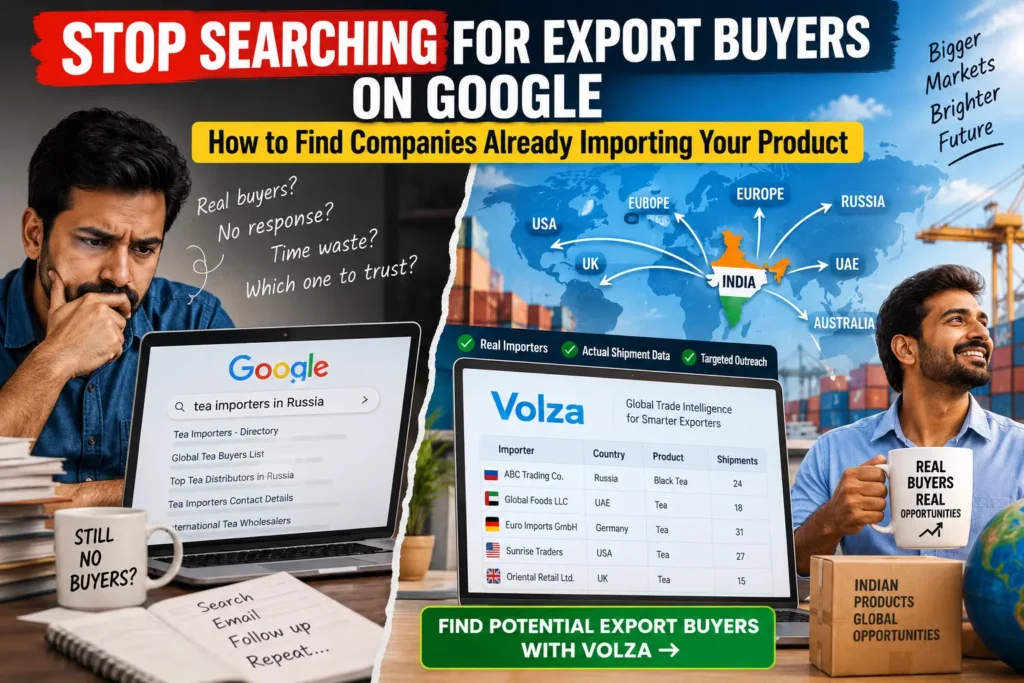
How to find export buyers is one of the biggest challenges for a new exporter.
You may have a good product, competitive pricing and all the necessary export registrations—but finding the right company to approach can still be difficult.
A common starting point is Google.
You search:
“tea importers in Russia”
or
“spice buyers in Dubai”
and get hundreds of websites, directories and company listings.
But there is one important question:
Which of these companies are actually importing your product?
Instead of simply collecting company names, exporters can research companies that are already importing similar products.
Why Google Search Alone Is Not Enough
Google is useful for finding companies, distributors, wholesalers and industry websites.
But a Google result does not necessarily tell you:
- Whether the company currently imports your product
- How frequently it imports
- Which countries it sources from
- Who its existing suppliers are
- Whether it buys directly or through an intermediary
- Whether it is still active in international trade
For example, if you export Assam CTC tea, searching “tea importers in Russia” may give you hundreds of results.
But the more useful question is:
Which companies are actually importing tea?
That is where trade-data research can become valuable.
A Better Way to Find Foreign Buyers
A practical export buyer-research process can look like this:
Product → Target country → Importers → Shipment activity → Buyer shortlist → Company research → Contact
You don’t have to stop using Google.
Instead, use Google for company research and use trade data to investigate actual import activity.
Step 1: Start With a Specific Product
Don’t begin with:
“I want to find foreign buyers.”
Start with:
“I want to find companies importing my specific product.”
For example:
- Assam black tea
- Cardamom
- Turmeric
- Rice
- Handicrafts
- Engineering components
- Garments
- Packaging materials
- Processed food products
You should also understand the relevant HS/HSN code because product descriptions can vary between companies and countries.
Step 2: Choose Your Target Market
Don’t try to sell everywhere at once.
Start with a few markets based on:
- Existing demand
- Import requirements
- Tariffs and trade agreements
- Competition
- Logistics
- Product suitability
- Your ability to serve the market
Indian exporters can also use the Government of India’s Trade Connect platform for country guides, trade information and market-access resources.
Trade Connect – Government of India →
Step 3: Don’t Just Search for Buyers—Search for Importers
Instead of asking:
“Who sells tea in Russia?”
ask:
“Which companies have imported tea into Russia?”
That is a much more useful question for an exporter.
Import shipment data can potentially help you investigate information such as:
- Buyer/importer
- Supplier
- Product description
- Shipment date
- Quantity
- Origin
- Destination
- HS/HSN information
- Shipment frequency
The exact information available can vary by country and data source.
Step 4: Use Import Data to Build a Buyer Shortlist
This is where a platform such as Volza can become useful.
Volza provides shipment-based trade intelligence that can help exporters research buyers, suppliers, products and international trade activity.
Instead of starting with hundreds of random company names, you can use trade data to identify companies that have demonstrated import activity.
Example: You Export Assam Tea
Your research could look like this:
Product: Assam Black Tea
↓
Target market: Russia
↓
Research companies importing similar tea
↓
Check shipment activity
↓
Shortlist relevant buyers
↓
Research each company
↓
Contact the most relevant prospects
Find Potential Export Buyers With Volza
If you want to go beyond ordinary Google searches and research potential buyers using shipment-based trade intelligence:
Find Potential Export Buyers With Volza →
Disclosure: This is an affiliate link. BusinessZindagi may earn a commission if you sign up through this link, at no additional cost to you.
Step 5: Don’t Contact Every Company You Find
Finding 100 importers doesn’t mean you should email all 100.
Create a shortlist and research each potential buyer.
Check:
Product Fit
Does the company import the same or a similar product?
Import Activity
Has it imported recently or repeatedly?
Supplier Profile
Which countries and companies currently supply it?
Business Type
Is it a distributor, wholesaler, manufacturer, retailer or trading company?
Decision-Maker
Try to identify the person responsible for:
- Purchasing
- Imports
- Procurement
- Sourcing
- International trade
Step 6: Study Their Existing Suppliers
This can provide useful information for an exporter.
Suppose you discover that a potential buyer imports your product from China, Vietnam and Sri Lanka.
That tells you something about its existing sourcing pattern.
You can then ask:
Can my product offer something different?
Perhaps you have:
- Better pricing
- Different quality
- Indian origin
- Smaller MOQ
- Better packaging
- A specific certification
- A product variation
Knowing a buyer’s sourcing pattern can help you create a more relevant sales pitch.
Step 7: Don’t Send a Generic Export Email
One common mistake is sending:
Dear Sir/Madam,
We are an Indian exporter of high-quality products. Please let us know if you have any requirements.
That gives the buyer very little reason to respond.
Instead, show that you have researched the company.
For example:
We noticed that your company imports black tea and would like to introduce our Assam-origin CTC tea as an additional sourcing option from India.
Then briefly mention:
- Product
- Grade
- Packaging
- MOQ
- Certifications
- Port
- Indicative pricing, if appropriate
- Sample availability
The objective is simple:
Show the buyer that your message is relevant to their business.
Google Still Has an Important Role
This isn’t about Google vs. Volza.
You can use both.
Google can help you find:
- Company websites
- Contact pages
- Product ranges
- News
- Trade associations
- Business information
Trade data can help you investigate:
- Import activity
- Buyer/supplier relationships
- Product movements
- Shipment frequency
- Trade routes
- Existing sourcing patterns
Together, they can give you a better picture of a potential buyer.
A Simple Export Buyer Research Workflow
1. Select your product
↓
2. Identify the HS/HSN code
↓
3. Select 2–5 target countries
↓
4. Research import demand
↓
5. Find companies importing similar products
↓
6. Check recent shipment activity
↓
7. Study their existing suppliers
↓
8. Shortlist relevant buyers
↓
9. Find the appropriate decision-maker
↓
10. Send a customized introduction
↓
11. Follow up
↓
12. Verify the buyer before accepting major commercial risk
What About Trade Fairs?
Trade fairs can still be valuable for exporters.
India’s Export Promotion Mission includes market-access support covering activities such as buyer-seller meets, trade fairs and buyer delegations.
Export Promotion Mission – Government of India →
But don’t stop at collecting business cards.
After a trade fair, research the companies you met.
Ask:
- What do they import?
- Who supplies them?
- How frequently do they buy?
- Does their requirement match my product?
This can turn a trade-fair contact into a more informed sales lead.
What If You Are a Small Indian Exporter?
You don’t need hundreds of buyers.
Suppose you are a small MSME exporting:
- Assam tea
- Spices
- Handicrafts
- Food products
- Engineering components
Your immediate objective could be to identify 10–20 relevant companies and research them properly.
Ten well-researched prospects can be more useful than hundreds of generic email addresses.
Don’t Forget Buyer Verification
Import activity alone does not guarantee that a company is a good customer.
Before entering into a commercial relationship, conduct additional due diligence.
Check:
- Company registration
- Website
- Physical address
- Business history
- Trade references
- Payment terms
- Creditworthiness
- Bank details
- Actual purchase requirement
Shipment data is a research tool—not a guarantee that a buyer is trustworthy or will place an order.
The Real Goal Is Not to Find “A Buyer”
The goal is to find a relevant buyer.
There is a big difference.
A company that once imported a product years ago may be less relevant than a company that regularly imports similar products.
Similarly, a company that imports your product doesn’t necessarily mean it wants to buy from you.
A smarter approach is to combine:
Trade data + company research + product fit + market knowledge + buyer verification + targeted outreach.
Final Takeaway
If you are trying to find export buyers, don’t rely on one source.
Use Google to discover companies.
Use government resources to understand markets and export requirements.
Use trade fairs and business networks to generate relationships.
And where available, use import/export shipment data to investigate which companies are actually participating in the trade you’re targeting.
Research Potential Export Buyers With Volza →
The objective isn’t to collect the biggest possible list of buyers.
It is to build a smaller list of relevant companies that deserve a personalized sales approach.
Useful BusinessZindagi Articles
- Amazon Global Selling vs India Post Export →
- How I Started Exporting With Nothing →
- RODTEP Scheme for Exporters →
Official Sources & References
- DGFT – Government of India →
- Trade Connect – Government of India →
- Volza Buyer Intelligence →
- Volza Global Buyers Directory →
SEO Settings
Focus Keyword:
how to find export buyers
Secondary Keywords:
how to find foreign buyers, how to find buyers for export, how to find importers for your product, find international buyers, export buyers from India, importer database, import data for exporters, overseas buyers
SEO Title:
How to Find Export Buyers: Find Companies Already Importing
Meta Description:
Learn how to find export buyers using Google, trade data and importer research. Discover how Indian exporters can find companies already importing their products.
URL Slug:how-to-find-export-buyers
Suggested Featured Image Text:
STOP SEARCHING. START FINDING REAL BUYERS.
Category:
Export / International Business
Tags:
Export Buyers, Foreign Buyers, Importers, Export Business, Indian Exporters, Import Data, Volza