
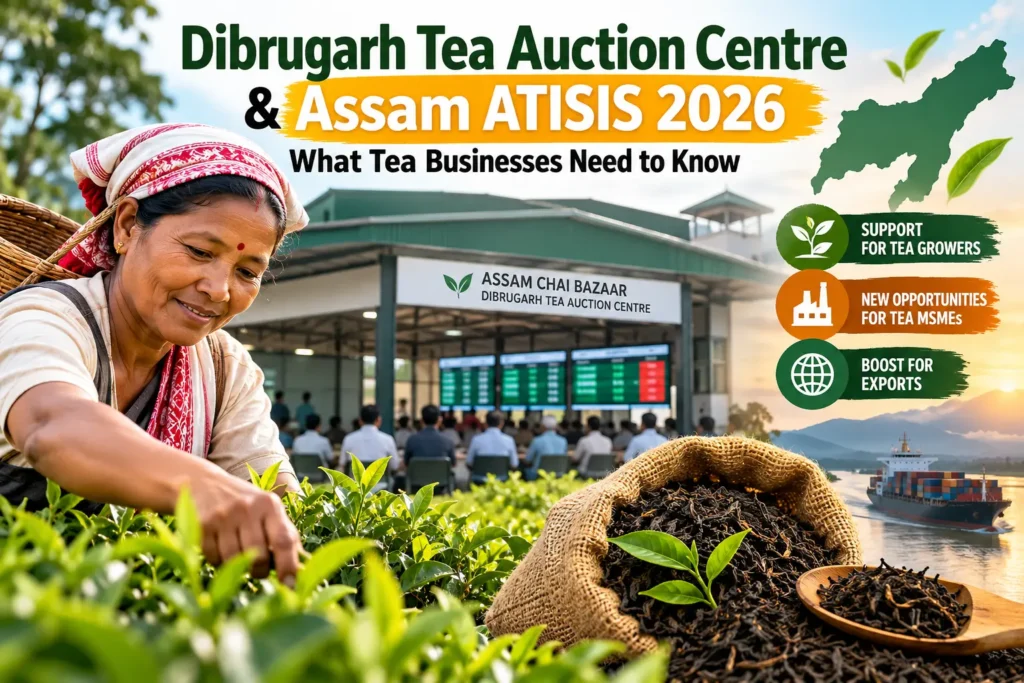
Assam’s tea industry is seeing two important developments in September 2026.
The Assam Chai Bazaar has conducted its maiden tea auction in Dibrugarh, bringing organised tea trading closer to one of the state’s major tea-producing regions. At the same time, the Assam Government has revised the Assam Tea Industries Special Incentives Scheme (ATISIS), 2020, with new provisions aimed at supporting tea production and exports.
For a small tea grower, bought-leaf factory, tea manufacturer, trader or tea exporter, the important question is not simply what has changed?
The bigger question is:
What could these developments mean for your tea business?
Dibrugarh Tea Auction Centre: What Happened?
Assam Chai Bazaar conducted its first tea auction in Dibrugarh on 25 September 2026.
According to reports, the auction attracted 18 buyers. In the CTC Leaf category, 175 lots containing about 1.49 lakh kg were offered and 61.33% was sold at an average of about ₹206 per kg.
In CTC Dust, 83 lots containing about 74,694 kg were offered and 63.16% was sold at around ₹210 per kg. The combined average was about ₹207 per kg.
The platform is described as a brokerless digital tea auction platform. Tea Board officials have also stressed the importance of following Tea Board rules and bringing more buyers onto the platform to improve competition and price discovery.
These figures represent the first auction and should not be treated as a guaranteed future price for Assam tea.
Why Is the Dibrugarh Tea Auction Important for Small Tea Businesses?
For a small tea grower, the biggest issue is often not producing tea but finding an efficient market for the produce.
An organised auction platform can potentially provide another selling channel and improve access to buyers.
However, small growers should understand one important point:
An auction does not automatically mean a higher price.
Price depends on factors such as:
- tea quality and grade
- buyer demand
- quantity available
- market conditions
- competition between buyers
- transportation and other costs
- consistency of supply
The long-term value of the Dibrugarh tea auction will therefore depend partly on how many buyers participate and how regularly sellers use the platform.
What Is Assam ATISIS 2026?
The Assam Tea Industries Special Incentives Scheme (ATISIS), 2020 was introduced by the Assam Government to support the state’s tea industry.
The original scheme covered tea plantations and tea manufacturing units producing CTC, Orthodox and speciality teas, subject to its eligibility conditions.
The Assam Government has now revised the scheme. According to reporting on the revised notification issued on 18 September 2026, important changes include:
- ₹3 per kg incentive for exported Single Origin Assam Quality CTC Tea, subject to the scheme’s conditions.
- CTC tea sold through the Guwahati Tea Auction Centre (GTAC) is recognised as Quality CTC Tea for the export incentive.
- The subsidy for Orthodox and Speciality Tea production has been increased from ₹10 to ₹15 per kg.
- The maximum annual claim has been increased to ₹1 crore per unit or garden.
- Matcha tea has been included.
- Working-capital interest subvention has been increased from ₹15 lakh to ₹20 lakh.
- The scheme has been extended up to 31 March 2031.
Tea businesses should check the latest official notification and eligibility requirements before making any investment or assuming that a particular incentive is available to them.
Who Should Pay Attention to Assam ATISIS 2026?
The scheme is particularly relevant to businesses involved in tea cultivation, manufacturing, value addition and export.
| Tea business | Why it matters |
|---|---|
| Small tea growers | Understand how changes in the tea market may affect buyers and processors |
| Tea plantations | Review applicable incentives and eligibility |
| Bought-leaf factories | Monitor opportunities linked to processing and quality |
| CTC tea manufacturers | Export-related provisions may be particularly relevant |
| Orthodox/speciality tea manufacturers | Higher production subsidy may create additional relevance |
| Tea packaging businesses | Growing value-added tea markets can create downstream opportunities |
| Tea exporters | Export incentives and auction-linked provisions deserve attention |
| Tea traders | Organised auction platforms may provide another sourcing channel |
Important: Being a tea-related business does not automatically mean you qualify for every ATISIS benefit. Eligibility, product type, location, documentation and other conditions must be checked against the applicable notification.
Small Tea Grower: Auction or Direct Sale?
Small growers should think about tea marketing as a business decision rather than depending on a single channel.
Auction channel
Tea production → processing → organised auction → buyer → wholesaler/exporter
Potential advantages include organised price discovery and access to multiple buyers.
Direct selling
Tea production → factory/trader → negotiated price
This may provide a simpler relationship-based selling model, depending on the buyer and local market.
The right approach can vary from business to business. A grower should compare the net realisation after transportation, processing, deductions and other costs, rather than looking only at the headline tea price.
Why Quality Will Matter Even More
More organised tea trading means tea businesses need to pay attention to quality records and consistency.
For small growers and tea MSMEs, useful records include:
- quantity produced
- date of production
- buyer/factory details
- grade and quality
- weighment records
- selling price
- transportation expenses
- payment received
- outstanding payments
These records can help a business understand its actual profitability rather than simply looking at sales revenue.
Opportunity Beyond Selling Green Leaf
The Assam tea business is much larger than cultivation alone.
Small entrepreneurs can explore businesses such as:
- tea processing
- CTC tea manufacturing
- tea blending
- tea packaging
- private-label Assam tea
- wholesale tea trading
- institutional tea supply
- specialty tea
- online tea sales
- tea export
This is where Assam’s tea ecosystem can create opportunities for MSMEs beyond the tea garden itself.
If you are considering a tea business, also read our Tea Business in India guide and our practical guide on How to Start Tea Export From India.
Can Small Tea Businesses Move Towards Export?
Yes, but exporting should be approached as a separate business process rather than simply finding an overseas buyer.
A tea exporter needs to understand:
Product → quality → HS classification → packaging → buyer → pricing → documentation → logistics → payment
For a small Assam tea business, one possible route is to first build reliable domestic sourcing and quality consistency and then explore merchant exporting or private-label opportunities.
If you are looking for overseas buyers, shipment intelligence platforms such as Volza can help identify companies that have actually participated in import/export transactions rather than relying only on generic online directories.
BusinessZindagi Export Tip: Don’t approach every tea importer with the same offer. Study the buyer’s product, origin, shipment history, quantity and destination market before sending your quotation.
A Simple Checklist for Assam Tea Businesses
Before taking advantage of the changing tea market, check these five areas:
1. Know your numbers
Calculate your actual production, processing, transport and selling costs.
2. Track quality
Maintain proper records of grades, production and sales.
3. Compare selling channels
Don’t compare only the quoted price. Compare your final net realisation.
4. Check government incentives carefully
Read the latest ATISIS notification and verify eligibility before investing based on an expected subsidy.
5. Think beyond bulk tea
Packaging, branding, specialty tea and exports can create additional value for a tea MSME.
BusinessZindagi Tools for Tea MSMEs
If you are running a tea-related MSME, financial discipline becomes especially important when raw material, processing, working capital and transport costs fluctuate.
You can use BusinessZindagi’s business tools to calculate costs, margins, loans and project requirements before making an investment decision.
For exporters, the Export Shipment Profit Tracker can help you understand shipment-level profitability.
For entrepreneurs planning a new tea-processing, packaging or manufacturing project, the Project Report Maker can help structure a project report.
Final Takeaway
The new Dibrugarh tea auction centre and the revised Assam ATISIS 2026 are two developments that Assam’s tea ecosystem should closely watch.
For small tea growers, the Dibrugarh auction could provide another organised market channel as the platform develops and attracts more buyers.
For tea MSMEs, the revised ATISIS may create opportunities in areas such as CTC exports, Orthodox and speciality tea, working capital and value-added production, subject to the scheme’s conditions.
But the biggest opportunity may be to think beyond simply producing and selling tea.
Grow better. Process better. Track your costs. Build your brand. And where practical, move from local tea trading towards value-added and export markets.
🔗 Authentic Sources & References
- Assam Government — ATISIS 2020: Official ATISIS notification
- Assam Directorate of Tea: Official Assam Tea Directorate
- Tea Board India: Official Tea Board India
- Tea Board — 2026 Auction Prices: Weekly Tea Auction Prices 2026
- Latest Dibrugarh Auction Report: Dibrugarh’s maiden tea auction — Times of India
- Revised ATISIS 2026 details: Revised ATISIS 2026 — Economic Times
🍵 BusinessZindagi Resource Links
Useful for Tea Businesses:
👉 Tea Business Guide
Planning a Tea Business:
👉 Free Project Report Maker
Planning to Export Assam Tea:
👉 Export from India Guide
Finding Overseas Buyers:
👉 Find Tea Buyers with Volza
Editorial Note
This article is an independent BusinessZindagi explainer prepared to help small tea growers, tea entrepreneurs and MSMEs understand recent developments in Assam’s tea sector. Government-scheme information can change, and eligibility should always be verified against the latest official notification before making financial or investment decisions.
AI Disclaimer
This article was prepared with the assistance of AI for research organisation, drafting and editing. Current scheme provisions and recent developments have been checked against available government and reputable news sources. Readers should verify the latest official notification, eligibility conditions and application procedure with the concerned Assam Government department or Tea Board of India before acting on the information.