
An MSME can have a healthy order book, good customers and plenty of invoices — and still run short of cash.
Why?
Because sales are not the same as cash in the bank.
A ₹10 lakh invoice may have been raised today, but if the buyer pays after 45 or 60 days, the MSME still has to pay salaries, suppliers, electricity, rent and other business expenses in the meantime.
This is where TReDS can help.
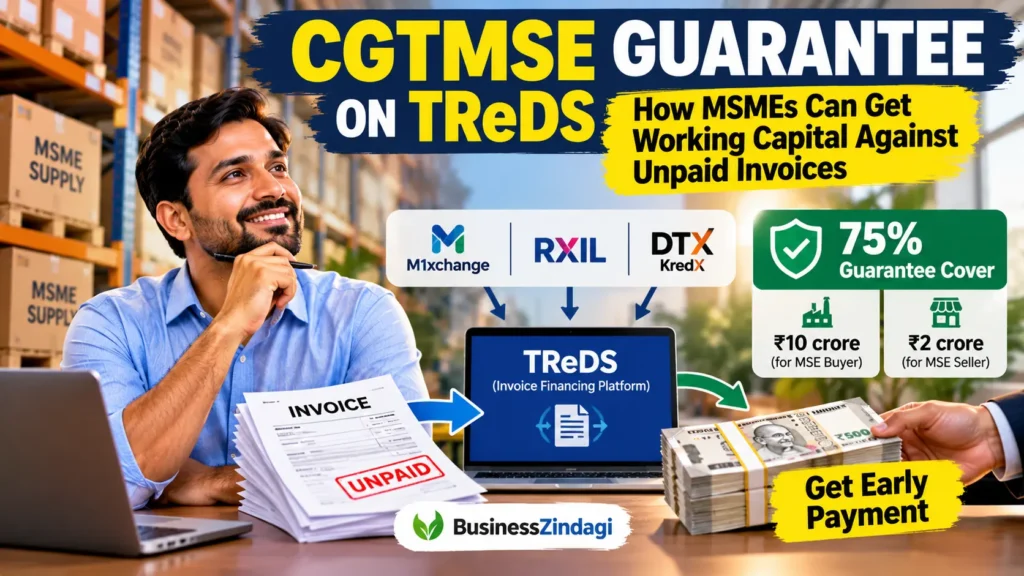
And now there is an important new development: the CGTMSE guarantee cover on TReDS has gone live, potentially making eligible invoice financing easier for Micro and Small Enterprises.
What Is the CGTMSE Guarantee on TReDS?
On 25 September 2026, the Ministry of MSME announced that the CGTMSE portal has been integrated with the TReDS ecosystem.
The guarantee cover is currently available through M1xchange, RXIL and DTX (KredX).
The objective is to help financiers provide financing against eligible MSME receivables while reducing part of their credit risk.
This is important because a financier may be more comfortable financing an eligible invoice when the transaction has applicable CGTMSE guarantee support.
First, Understand TReDS
TReDS stands for Trade Receivables Discounting System.
It is an RBI-regulated electronic platform through which MSME trade receivables can be financed or discounted by multiple financiers.
The basic process is:
MSME supplies goods/services → Invoice is raised → Buyer accepts invoice → Financiers bid → MSME receives early payment → Buyer pays financier on due date
So instead of waiting for the full credit period, the MSME can potentially convert an accepted receivable into cash earlier.
The financier charges a financing/discounting cost, so the MSME receives less than the invoice’s full face value.
What Has Changed With CGTMSE?
Previously, TReDS already provided a mechanism for invoice financing.
The new development is that CGTMSE guarantee support is now integrated into eligible TReDS financing transactions.
According to the Ministry of MSME, the special provision provides:
- 75% guarantee cover of the amount in default
- Maximum exposure of ₹10 crore for an MSE buyer
- Maximum exposure of ₹2 crore for an MSE seller
- Exposure limits are on a revolving basis
- Both the buyer and seller must be Micro or Small Enterprises (MSEs) for this particular guarantee provision.
Important: This Is NOT a 75% Invoice Subsidy
This is one of the most important points MSMEs should understand.
Suppose you have a ₹10 lakh eligible invoice.
You should not assume that the government will give you ₹7.5 lakh.
The 75% figure refers to the guarantee cover on the amount in default, subject to the applicable scheme conditions.
The guarantee is designed to support the financing ecosystem and reduce the financier’s risk. It is not a direct cash subsidy paid to the MSME.
How Could This Help an MSME?
Imagine a small manufacturer supplies ₹20 lakh worth of products to an eligible buyer.
The invoice is accepted, but payment is due after 60 days.
The manufacturer needs money now to purchase raw materials for the next order.
Instead of simply waiting for 60 days, the business could potentially use TReDS to seek invoice financing.
Without invoice financing
₹20 lakh invoice → Wait 60 days → Receive payment
With TReDS
₹20 lakh accepted invoice → Financiers bid → MSME receives early payment → Buyer pays financier on due date
The MSME pays the applicable financing/discounting cost, but it may get access to working capital much earlier.
The new CGTMSE guarantee provision is intended to make eligible receivables more financeable by providing additional risk support to financiers.
Who Can Benefit?
The development is particularly relevant to Micro and Small Enterprises that sell to eligible buyers and have genuine trade receivables.
Potentially relevant businesses include:
- Manufacturers
- Suppliers
- Engineering units
- Packaging businesses
- Food-processing MSMEs
- Traders
- Service providers
- Component suppliers
- Government/PSU suppliers
- Small businesses supplying larger MSE buyers
However, don’t assume that every unpaid invoice qualifies.
The specific CGTMSE-backed TReDS guarantee provision requires both buyer and seller to be Micro or Small Enterprises, according to the Ministry’s current announcement.
Other TReDS transactions can have different participant structures and should not be confused with this specific guarantee provision.
What About a ₹10 Lakh Invoice?
Here’s a simple example.
Suppose:
Invoice value: ₹10 lakh
Payment period: 60 days
Buyer: Eligible MSE
Seller: Eligible Micro/Small Enterprise
The seller submits the eligible receivable through TReDS.
Financiers can bid to finance the invoice.
If the seller accepts an offer, the financier provides early payment after applicable discounting/financing charges.
The buyer subsequently pays the financier on the due date.
If the transaction is covered under the CGTMSE special provision, the applicable guarantee provides the specified protection to the financier in case of covered default, subject to scheme conditions.
The key idea:
Your invoice becomes a potential source of working capital instead of simply sitting in your receivables ledger.
Why This Matters for Small Businesses
For a large company, waiting 60 days for payment may be manageable.
For a small manufacturer, the same 60-day wait can create a serious cash-flow problem.
Consider a simple cycle:
Customer payment delayed → Working capital gets stuck → Supplier payment due → New order arrives → More money required
The business may actually be profitable but still struggle because its cash is locked in receivables.
TReDS addresses this particular timing problem by allowing eligible receivables to be financed.
What Does TReDS Cost?
TReDS financing is not free money.
The financier provides funds before the invoice’s normal maturity date and charges a financing/discounting cost.
Therefore, an MSME should compare:
Cost of TReDS financing
versus
Cost of waiting / alternative working-capital finance
For example, if receiving money 45 days earlier allows you to accept a profitable new order or avoid expensive emergency borrowing, the financing cost may make commercial sense.
But the calculation should be based on your actual business numbers.
TReDS Is Not the Same as a Normal Business Loan
Traditional working-capital loan
You generally borrow based on your overall credit profile, banking relationship, financial statements, collateral/guarantee structure and lender assessment.
TReDS invoice financing
The financing is linked to an eligible trade receivable/invoice and its acceptance by the buyer.
The RBI describes TReDS as an electronic platform for financing and discounting MSME trade receivables through multiple financiers.
For TReDS transactions, RBI also states that the financing is without recourse to the MSME seller.
The exact transaction structure and applicable conditions still matter.
What Should an MSME Do Now?
If your business regularly has money stuck in invoices, take these steps.
1. Check your MSME status
Make sure your enterprise has the necessary registration with treds and falls within the applicable Micro or Small Enterprise category.
2. Review your buyers
Identify customers who regularly purchase from you but pay after 30, 45 or 60 days.
3. Check whether your buyer can participate
Not every buyer automatically qualifies for the CGTMSE-backed TReDS guarantee provision.
For this particular provision, the Ministry says both buyer and seller must be MSEs.
4. Explore authorised TReDS platforms
Compare the available financing process, participating financiers, costs and transaction requirements.
5. Calculate the real cost
Don’t look only at the financing rate.
Consider:
Financing cost + platform/other applicable charges + taxes, where applicable
Then compare this with your alternative working-capital cost.
Don’t Confuse Sales With Cash Flow
This is perhaps the biggest lesson.
Suppose your business makes:
₹1 crore sales
but:
₹35 lakh is stuck in customer receivables.
Your profit-and-loss statement may look healthy, but your bank account may tell a different story.
This is why MSMEs should track:
- Sales
- Receivables
- Inventory
- Supplier dues
- Working capital
- Cash in bank
- Loan repayments
A growing business can actually face more working-capital pressure because larger orders require more money before customers pay.
CGTMSE Guarantee on TReDS: What It Does — and What It Doesn’t
| What it can do | What it does not mean |
|---|---|
| Provide guarantee support for eligible TReDS financing | It is not a direct cash grant |
| Reduce part of financier’s credit risk | Every invoice is not automatically covered |
| Potentially improve financing access | It does not eliminate financing costs |
| Support working-capital access | It does not guarantee approval of every invoice |
| Help address delayed-payment pressure | It does not mean every buyer qualifies |
The Bigger Picture
TReDS has been growing rapidly.
According to the Ministry of MSME, invoice discounting on the platform increased from ₹40,000 crore in FY 2021–22 to ₹3.5 lakh crore in FY 2025–26.
That shows how receivables financing is becoming increasingly important to the MSME financing ecosystem.
The new CGTMSE integration adds another layer of credit support to eligible transactions.
For an MSME, however, the practical question remains simple:
How much of my working capital is currently stuck in unpaid invoices, and what will it cost me to unlock it?
That is the number worth calculating.
The CGTMSE guarantee on TReDS is an important development for eligible Micro and Small Enterprises dealing with delayed receivables.
But it should not be misunderstood as a government payment of 75% of an invoice.
Instead, the new mechanism provides guarantee support for eligible TReDS financing, potentially reducing risk for financiers and helping eligible receivables get financed.
For an MSME facing a cash-flow squeeze because customers take 30, 45 or 60 days to pay, TReDS is therefore worth understanding.
Your unpaid invoice may not just be money you’re waiting for — it could also be an asset that can help fund your next order.
Editorial & AI Disclaimer
This article has been researched and prepared with AI assistance for research organisation, drafting and editing and reviewed for BusinessZindagi. Government schemes, financial regulations and eligibility conditions can change. Readers should verify the latest terms directly with the Ministry of MSME, CGTMSE, RBI or the relevant TReDS platform before making financial decisions.
Affiliate Disclosure
Some links on BusinessZindagi may be affiliate links. If you purchase a service through an affiliate link, BusinessZindagi may receive a commission at no additional cost to you. Affiliate relationships do not determine our editorial content.
🔗 Authentic Sources & References
Primary source — Ministry of MSME / PIB: The 25 September 2026 release confirms the rollout, the three platforms, eligibility, 75% guarantee cover and ₹10 crore/₹2 crore exposure limits.
CGTMSE Guarantee Cover Goes Live on TReDS — PIB
RBI — TReDS FAQ: Explains how TReDS works, the participants, factoring units, financier bidding and the without-recourse structure.
RBI — TReDS Frequently Asked Questions
Union Budget 2026–27 / Government background: The Budget announced CGTMSE-backed credit guarantee support for invoice discounting on TReDS.
Union Budget 2026–27 — MSME Liquidity Support
🔗 Short BusinessZindagi Resources
Already using TReDS?
👉 TReDS Registration for MSMEs 2026 — Step-by-Step Guide
Want to understand the bigger TReDS opportunity?
👉 TReDS Portal Mandate 2026
Track your invoice payments:
👉 BusinessZindagi Invoice Payment Tracker
Calculate working-capital interest:
👉 BusinessZindagi Cash Credit Interest Calculator