
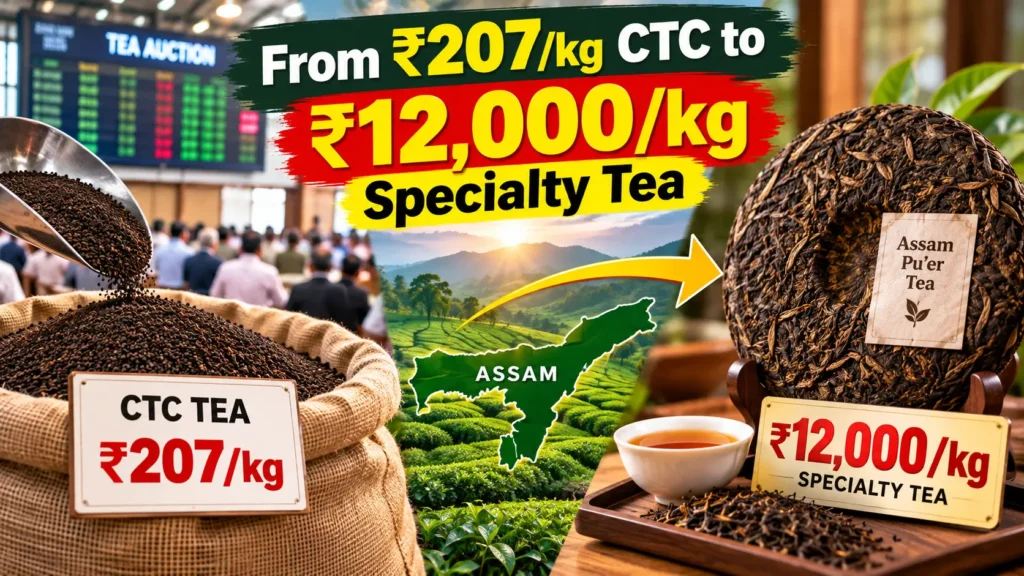
₹207/kg. ₹12,000/kg.
Two very different tea prices have recently emerged from Assam—and they reveal an interesting opportunity for Assam’s tea businesses.
At the maiden Assam Chai Bazaar auction in Dibrugarh, CTC Leaf and CTC Dust recorded a combined average of around ₹207/kg.
Around the same time, a 5-kg lot of Assam-made Pu’er tea from Gauripur Tea Industry, Golaghat, fetched ₹12,000/kg at the Guwahati Tea Auction Centre.
But don’t make the mistake of comparing these as two normal market prices.
They are completely different products, quantities and business models.
The real question is:
Can Assam tea businesses create more value by moving beyond bulk tea into specialty products, value addition, branding and niche markets?
₹207/kg: The Bulk CTC Business
The maiden Dibrugarh auction attracted 18 buyers.
According to reports, the CTC Leaf category had 175 lots containing about 1.49 lakh kg, with 61.33% sold at an average of ₹206/kg.
CTC Dust had 83 lots containing about 74,694 kg, with 63.16% sold at around ₹210/kg.
The combined average was approximately ₹207/kg.
Assam Chai Bazaar is a brokerless digital auction platform intended to connect producers and buyers and improve price discovery.
This represents the traditional volume-driven tea business:
Production → Processing → Bulk CTC → Auction → Buyer/Blender
For businesses with scale, consistent quality and established buyers, this remains an important market.
₹12,000/kg Assam Specialty Tea: A Very Different Tea Business
Now look at the other end of the spectrum.
A 5-kg lot of Pu’er tea produced by Gauripur Tea Industry in Golaghat sold for ₹12,000/kg at GTAC.
That is ₹60,000 for the 5-kg lot at the auction price.
The tea was a highly differentiated specialty product rather than conventional bulk CTC.
This is not evidence that Assam tea normally sells for ₹12,000/kg.
It is an example of what can happen when a tea product moves into a specialty, differentiated market.
And that distinction is extremely important for entrepreneurs.
You may also like to read: Assam black tea–The strongest tea of india
The Real Opportunity: Move Up the Value Chain
Think about two possible routes.
Traditional route
Green leaf → CTC processing → Bulk tea → Auction → Buyer
Value-added route
Selected leaf → Specialised processing → Specialty tea → Packaging → Branding → Niche buyer/consumer
The second route potentially creates more value per kilogram—but it also requires more skill, investment, marketing and market development.
So the goal shouldn’t be:
“Stop producing CTC.”
It should be:
“Where can I create additional value?”
Assam Specialty Tea: What Can Create More Value?
Specialty tea can be differentiated through:
- Processing method
- Leaf selection
- Origin
- Limited production
- Flavour profile
- Traditional methods
- Innovative processing
- Packaging
- Traceability
- Brand story
- Quality consistency
- Specialty domestic markets
- Export markets
Assam already has opportunities beyond conventional CTC, including orthodox and other specialty teas. The recent Pu’er example shows that Assam producers are also experimenting with differentiated formats.
Assam Specialty Tea:What About Small Tea Growers?
A small grower doesn’t necessarily need to build a complete specialty tea factory.
There are several possible routes.
1. Improve the raw material
Better plucking, handling, quality control and consistency can improve the value of the leaf entering the processing chain.
2. Work collectively
Small growers can explore SHGs, cooperatives, FPO/FPC structures or other suitable collective models for processing and value addition.
The Assam Directorate of Tea specifically lists support for small growers, tea factories, bought-leaf factories and common facility centres for groups of small growers.
3. Partner with a processor
Instead of investing immediately in an entire factory:
Grower → Processing partner → Specialty product → Market
This can reduce the initial infrastructure burden.
4. Build a specialty brand
Entrepreneurs with processing access can explore products such as:
- Specialty black tea
- Orthodox tea
- Green tea
- White tea
- Matcha
- Pu’er-style tea
- Limited-batch teas
- Traditional regional teas
The revised ATISIS framework reported in September 2026 also increased the production subsidy for orthodox and specialty tea from ₹10/kg to ₹15/kg, with Matcha included. Businesses should verify the latest notification and eligibility conditions before relying on any incentive.
Assam Specialty Tea:But Don’t Confuse High Price With High Profit
This is perhaps the biggest lesson from the ₹12,000/kg headline.
Selling price is not profit.
A specialty tea business may have additional costs for:
- Raw material
- Processing
- Skilled labour
- Packaging
- Testing
- Certification
- Storage
- Transport
- Branding
- Marketing
- Distribution
- Working capital
- Unsold inventory
And there is another difference.
You might sell thousands of kilograms of CTC, while a specialty product may sell only a few kilograms or hundreds of kilograms.
Therefore:
₹12,000/kg does not automatically mean ₹12,000/kg profit.
The real calculation is:
Selling price − Total cost = Contribution per kg
Then consider:
Contribution per kg × Actual quantity sold
That is what matters for the business.
CTC or Assam Specialty Tea?
The answer depends on the business.
| Situation | Opportunity to explore |
|---|---|
| Large production volume | Bulk CTC |
| Established CTC buyers | Conventional tea |
| Strong-quality leaf | Specialty/orthodox |
| Processing capability | Value-added tea |
| Small distinctive batches | Specialty tea |
| Strong consumer brand | Packaged specialty tea |
| Export ambitions | Niche international markets |
| Small growers working together | Collective processing |
| Unique regional story | Origin/traditional tea |
There is no need to choose only one route.
A tea business can potentially combine bulk production with a smaller specialty line.
Assam’s Story Can Also Become a Product
Premium tea buyers don’t always buy only a commodity.
They can also buy:
Origin + Story + Quality + Craftsmanship + Experience
Compare:
“Assam Black Tea – 1 kg”
with:
“Limited-Batch Single-Origin Assam Specialty Tea – Produced in Upper Assam from Selected Leaves.”
The second product creates more room for storytelling and differentiation.
It doesn’t guarantee a premium price—but it gives the entrepreneur something more than price alone to sell.
The Export Opportunity
This becomes even more interesting when combined with exports.
A bulk tea exporter may compete on:
Price + Quality + Volume + Reliability
A specialty tea exporter may additionally compete through:
Origin + Uniqueness + Flavour + Story + Packaging + Niche positioning
But don’t manufacture first and search for buyers later.
Research the market first:
- Which countries import the product?
- Who are the buyers?
- What quantities do they purchase?
- What prices are being paid?
- What specifications are required?
- What certifications are needed?
- What packaging is required?
- What import regulations apply?
For buyer research, BusinessZindagi readers can explore Volza’s international shipment and importer data.
Looking for International Buyers for Assam Tea?
Producing a specialty tea is only half the business. Finding the right buyers is the next challenge.
If you’re planning to export Assam CTC, orthodox or specialty tea, you can use Volza’s trade intelligence platform to research international importers and buyers based on shipment data.
You can explore buyer activity, importing countries, suppliers, shipment history and other trade information before approaching potential customers.
👉 Find International Tea Buyers with Volza
BusinessZindagi Tip: Don’t produce a new specialty tea only because you see a premium price. First research who is importing similar tea, where they are buying from and how regularly they purchase.
Affiliate disclosure: This is a BusinessZindagi affiliate link. We may earn a commission if you sign up or purchase through the link, at no additional cost to you.
A 10-Question Test Before Investing
Before investing in a specialty tea project, ask:
- Who is my buyer?
- Why will they buy my tea?
- What price can they realistically pay?
- Can I produce consistent quality?
- How much can I produce?
- What is my actual cost per kg?
- How much working capital is required?
- Do I need testing or certification?
- How will I reach the customer?
- Can I repeat the business profitably?
Market first. Machinery later.
Calculate Before You Invest
If you’re considering a specialty tea project, calculate:
Raw material + Processing + Labour + Packaging + Testing + Transport + Marketing + Working Capital + Wastage
Then test different selling prices and quantities.
BusinessZindagi’s Profit Margin Calculator can help you test the economics.
If you’re considering a larger tea project, the Free Project Report Maker can help structure the investment, cost and revenue assumptions.
The Bigger Lesson for Assam Tea
The Dibrugarh auction and the ₹12,000/kg Pu’er sale are not competing tea prices.
They demonstrate two different parts of Assam’s tea economy.
One is volume-driven.
The other is differentiation-driven.
And between them lies a large opportunity:
Value addition.
For Assam’s tea entrepreneurs, the future may not simply be about producing more kilograms.
It may be about finding more value in every kilogram.
That could mean better processing, specialty products, packaging, branding, direct sales, collective processing or export-market development.
The ₹12,000/kg sale is not a new normal for Assam tea.
But it is a useful reminder that Assam tea can potentially be more than a commodity.
Editorial Disclaimer
This article is for general business and informational purposes. Tea prices, auction results, government incentives, eligibility criteria and market conditions can change. Businesses should verify the latest official notifications, scheme guidelines, auction information and applicable regulations before making investment or business decisions.
AI Disclosure
This article was prepared with AI assistance and reviewed and structured for BusinessZindagi. Readers should independently verify important financial, regulatory and government-scheme information from the original sources provided below.
Clickable authentic sources & references
- Dibrugarh maiden Assam Chai Bazaar auction: Times of India — Dibrugarh hosts maiden tea auction
- Dibrugarh auction / digital platform details: NDTV Profit — Assam’s first tea e-auction
- ₹12,000/kg Assam Pu’er tea sale: Economic Times — Assam’s Pu’er tea fetches ₹12,000/kg
- Pu’er specialty tea details: Times of India — Assam tea steps into specialty tea league
- PTI report on the 5-kg lot: Rediff/PTI — Assam Pu’er tea fetches ₹12,000/kg
- Assam Directorate of Tea: Functions and Objectives — Government of Assam
- Assam small-grower support / Cess Utilization Policy: Directorate of Tea — Cess Utilization Policy
- ATISIS update: Report on revised Assam tea incentive scheme