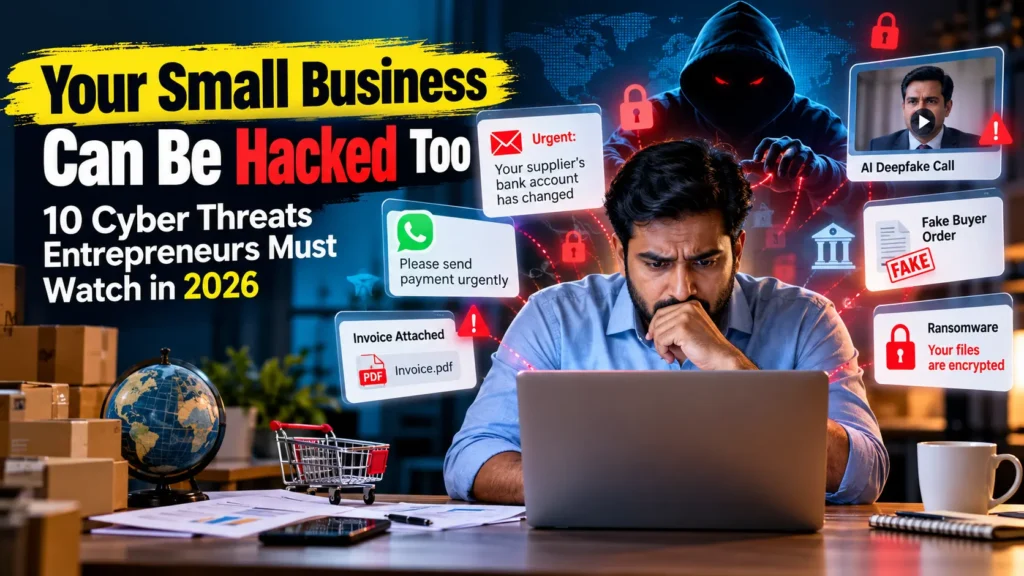
Many small-business owners still think:
“Hackers target big companies. My business is too small.”
That assumption is becoming increasingly risky.
Small businesses now depend on online banking, UPI, email, WhatsApp, cloud software, websites, payment gateways, accounting platforms, AI tools and digital marketplaces.
That creates more opportunities for criminals.
And the threat is changing quickly.
Verizon’s 2026 Data Breach Investigations Report says 31% of breaches now begin with software vulnerabilities, while ransomware is involved in 48% of breaches. The report also says generative AI is being used to strengthen 15% of attack techniques.
Recent global research from Mastercard found that 71% of SMEs consider cyber protection a priority, but only 37% currently use cybersecurity tools.
For entrepreneurs, cybersecurity is therefore no longer just an IT issue.
It is a business continuity issue.
Why Small Businesses Are Becoming Bigger Targets
A small company may not have millions of dollars in revenue.
But it may have:
- Customer databases
- Bank accounts
- UPI/payment access
- GST and financial information
- Supplier details
- Export documents
- Passwords
- Intellectual property
- Business email accounts
- Website administrator access
- Employee information
And many small businesses don’t have a dedicated cybersecurity team.
Recent research from India found that 40% of surveyed SMEs had experienced a cyber incident during the previous 24 months, while 45% identified lack of cybersecurity expertise as their biggest implementation challenge.
That creates an attractive target for criminals.
10 Cyber Threats Small Businesses Should Watch in 2026
1. Phishing: The Fake Email That Looks Real
Phishing remains one of the simplest ways to attack a business.
You may receive an email that appears to come from:
- Your bank
- GST department
- Customer
- Supplier
- Courier company
- Payment gateway
- Government department
- Microsoft or Google
- Your own employee
The message may say:
“Your account requires verification.”
or:
“Please open the attached invoice.”
One click can expose credentials or install malicious software.
BusinessZindagi rule:
Never click first and verify later. Verify first.
Check the sender address, domain and destination link before entering passwords or financial information.
2. Business Email Compromise
This is particularly dangerous for businesses that regularly make supplier or export payments.
Imagine receiving:
“Our bank account has changed. Please use the new account for today’s payment.”
The email may look completely legitimate.
A criminal could have compromised an employee’s email account—or impersonated the supplier.
Create a simple business rule:
Never change a supplier’s bank details based only on email.
Verify the change using a previously known telephone number or another independent communication channel.
For large payments, consider a two-person approval system.
3. AI-Powered Impersonation and Deepfake Scams
AI is making impersonation more convincing.
An attacker could potentially use:
- AI-generated emails
- Voice cloning
- Fake documents
- Deepfake video
- Highly personalized messages
to impersonate an owner, manager, customer or supplier.
The dangerous part is not necessarily sophisticated hacking.
It is making a fraudulent request look believable.
Example
A business owner receives a voice message apparently from a senior employee:
“Please urgently transfer ₹2 lakh to this supplier.”
Instead of trusting the voice, establish a verification procedure.
Urgency should trigger verification—not immediate payment.
4. Fake Customers and Suppliers
This is especially relevant for MSMEs and exporters.
A fraudster may pretend to be:
- An overseas buyer
- An Indian distributor
- A manufacturer
- A sourcing agent
- A supplier
- A large corporate customer
They may send:
- Fake purchase orders
- Fake payment screenshots
- Fake company certificates
- Fake websites
- Fake shipping documents
They may then ask you to provide goods on credit—or pay a supposed registration, courier, inspection or documentation fee.
Before accepting a large order:
Verify the company, website, address, domain, directors/contact details and transaction history.
For international buyers, shipment and trade-data research can provide another layer of due diligence.
5. Ransomware
Ransomware can make business files inaccessible.
Imagine starting work one morning and discovering that you cannot access:
- Invoices
- Accounting records
- Customer database
- Purchase orders
- Product files
- Contracts
- Export documents
An attacker may demand money to restore access.
Verizon’s 2026 DBIR reports ransomware involvement in 48% of breaches.
The simplest defence for a small business:
Maintain backups.
Ideally, don’t keep your only backup permanently connected to the same system.
Test your backups periodically.
A backup that has never been tested may not be a reliable backup.
6. WhatsApp Business Account Takeover
For many small businesses, WhatsApp is practically a business operating system.
It may contain:
- Customer conversations
- Supplier contacts
- Payment discussions
- Quotations
- Documents
- Order information
If an attacker gains control of the account, they may impersonate the business.
Protect it:
- Enable available two-step verification/security features.
- Never share verification codes.
- Be careful with unknown links.
- Review linked devices regularly.
- Remove access from devices that should no longer be connected.
7. Vulnerable Websites, Plugins and Software
Your business doesn’t necessarily need to be attacked directly.
An outdated:
- WordPress plugin
- Website component
- Server
- Cloud application
- Business software
can provide an entry point.
Verizon’s 2026 DBIR found that 31% of breaches began with software vulnerabilities, making software security one of the most important areas for businesses to watch.
For a small business website:
Keep:
WordPress + themes + plugins + hosting software
updated.
But don’t blindly update production systems without backups and compatibility checks.
8. Weak Passwords and Stolen Credentials
One password can sometimes unlock multiple parts of a business.
For example:
Same password
→ Email
→ Cloud storage
→ Website
→ Accounting
→ Marketplace
If one service is compromised, other accounts may become vulnerable.
Better approach:
Use:
- Unique passwords
- Password manager
- Multi-factor authentication
- Separate administrator accounts
- Regular access reviews
Most importantly:
Never reuse your business banking, email and website passwords.
9. Your Employees Can Accidentally Become the Entry Point
A cyberattack doesn’t always begin with an IT vulnerability.
It can begin with:
“Please open this invoice.”
or:
“Please verify this payment.”
or:
“Here’s the new company policy.”
An employee may click because the message looks legitimate.
The OECD’s 2026 SME research highlights cybersecurity as a continuing digitalisation challenge while businesses rapidly adopt AI and other digital tools.
Small-business solution
You don’t need a complicated training programme.
Teach employees five rules:
- Don’t open suspicious attachments.
- Don’t share OTPs/passwords.
- Verify payment requests.
- Don’t install unknown software.
- Report suspicious messages immediately.
10. Your AI Tools Can Create New Risks
AI can help small businesses enormously.
Entrepreneurs are using it for:
- Marketing
- Research
- Customer service
- Accounting assistance
- Content
- Coding
- Data analysis
- Export documentation
- Business planning
But there is another side.
Employees may upload confidential information into AI tools without understanding how that information is handled.
That could include:
- Customer information
- Supplier prices
- Contracts
- Financial statements
- Proprietary formulas
- Unreleased products
- Export documents
The OECD’s 2026 survey found that SME AI adoption is increasing rapidly, but secure and strategic integration remains uneven.
Create an AI rule for your business:
Don’t upload confidential business information into an AI service unless you understand the service’s privacy, security and data-handling terms and your business has approved its use.
The New Problem: AI Can Help Hackers Too
AI isn’t only helping businesses.
It can also help attackers create more convincing:
- Phishing messages
- Social-engineering attacks
- Fake content
- Impersonation
- Malicious code
- Automated attacks
A 2026 scientific study focusing on SME cybersecurity identified phishing and ransomware among the advanced/highly assessed threats and examined the use of generative AI for SME security.
This means entrepreneurs need to think about both sides of AI:
AI for productivity
and
AI-enabled cyber risk.
A 30-Minute Cybersecurity Check for Your Business
You don’t need to become a cybersecurity expert today.
Start with these questions.
🔐 Accounts
- Do your email accounts have MFA/2FA?
- Does your banking account have strong authentication?
- Is WhatsApp Business protected?
- Are administrator accounts limited?
💰 Payments
- Do you independently verify bank-account changes?
- Can one person authorize a large payment?
- Do employees know never to share OTPs?
💾 Data
- Are your accounting files backed up?
- Is your customer database backed up?
- Are backups separated from your main system?
- Have you tested restoring a backup?
🌐 Website
- Is WordPress updated?
- Are plugins and themes updated?
- Do you have a recent backup?
- Do you know who has administrator access?
🤖 AI
- Do employees know what business information they can upload to AI tools?
- Do you have a basic AI usage policy?
👥 Employees
- Have employees received basic phishing training?
- Do former employees still have access to company accounts?
If You Answered “No” Several Times
Don’t panic.
You don’t necessarily need an expensive enterprise cybersecurity system.
Start with the basics:
Priority 1
Turn on MFA/2FA.
Priority 2
Use unique passwords.
Priority 3
Create reliable backups.
Priority 4
Verify financial requests independently.
Priority 5
Update software and plugins.
Priority 6
Train employees.
Priority 7
Create an incident-response plan.
These basic controls can significantly improve a small company’s security posture.
Small Business Cybersecurity: What Should a Small Business Do If It Gets Hacked?
Don’t simply switch everything off and start deleting files.
First:
1. Stop the suspected compromise
Disconnect affected devices or accounts where appropriate.
2. Protect financial accounts
Contact your bank/payment provider quickly if money or payment credentials may be compromised.
3. Change credentials
Start with compromised email and administrator accounts.
4. Preserve evidence
Keep suspicious emails, messages, logs and screenshots where possible.
5. Inform the appropriate authorities/providers
Depending on the country and incident, this may include banks, payment providers, hosting companies, law enforcement or relevant cyber incident reporting authorities.
6. Restore from clean backups
Don’t restore compromised files blindly.
7. Find the root cause
Otherwise the attacker may return.
The Biggest Small Business Cybersecurity Mistake: Thinking “It Won’t Happen to Me”
The latest evidence suggests small businesses should take the opposite approach.
Mastercard’s September 2026 global survey of more than 6,000 SMEs across 18 countries found that cybersecurity is a priority for 71% of respondents, yet only 37% currently use cybersecurity tools.
Indian SME research also shows a similar gap: 84% of surveyed SMEs plan to increase cybersecurity investment, but only 12% reported continuously monitoring their cybersecurity environment.
So the challenge isn’t simply awareness.
It is moving from:
“We know cybersecurity is important.”
to:
“We have actually secured the business.”
Cybersecurity Is Now Part of Business Management
For a modern entrepreneur, cybersecurity belongs alongside:
Cash flow
Working capital
Tax compliance
Insurance
Customer management
Supplier management
Business continuity
It should not be treated as something to think about only after a cyberattack.
Your business may be small.
Your digital footprint isn’t.
Small Business Cybersecurity Risk Checklist
Before your business grows further, make sure you can answer yes to these:
| Area | Basic protection |
|---|---|
| MFA enabled | |
| Banking | Strong authentication |
| Two-step security | |
| Passwords | Unique passwords |
| Website | Updated software |
| Data | Regular backups |
| Payments | Independent verification |
| Employees | Basic cyber training |
| AI | Clear usage rules |
| Recovery | Incident-response plan |
The goal isn’t perfect cybersecurity.
The goal is to make your business harder to trick, harder to compromise and faster to recover.
Final Takeaway
Cybersecurity is no longer only a concern for banks, technology companies and large corporations.
A small manufacturer, exporter, retailer, consultant, startup or online seller can have just as much to lose from a compromised email account, fraudulent payment or locked business database.
And AI is changing both sides of the equation.
It can help a small business become more productive—but it can also make scams and cyberattacks more convincing and scalable.
So the right question for an entrepreneur in 2026 isn’t:
“Am I too small to be hacked?”
It is:
“If someone targets my business tomorrow, how prepared am I?”
Authentic Sources & References
- Verizon 2026 Data Breach Investigations Report — Current global data on ransomware, software vulnerabilities and AI-related cyber threats.
- Mastercard 2026 Global SME Research — SME cybersecurity priorities across 18 countries.
- OECD — Empowering SMEs in the Age of AI — AI adoption and cybersecurity challenges facing SMEs.
- CyberMedia Research — SME Digital Insights 2026 — Recent Indian SME cybersecurity findings.
Useful BusinessZindagi Resources
- BusinessZindagi Tools — Explore calculators and business tools for MSMEs and entrepreneurs.
- BusinessZindagi Business Verification Finder — Useful for adding another layer of due diligence when evaluating businesses and potential counterparties.
- BusinessZindagi Buyer Tracker — Manage and track potential buyers and business leads.
- BusinessZindagi AI Prompt Builder — Create structured prompts for business workflows.
- BusinessZindagi Invoice Payment Tracker — Track outstanding invoices and payment follow-ups.
- BusinessZindagi AI Cashbook — Manage business cash transactions digitally.
Recommended Related Articles
- CGTMSE Guarantee on TReDS: Unlock Working Capital From Unpaid MSME Invoices
- Trading vs Manufacturing Business: Which Is Right for You?
- From ₹207/kg CTC to ₹12,000/kg Specialty Tea: Assam’s New Tea Business Opportunity
- BusinessZindagi Profit Margin Calculator
Authentic Sources & References
Verizon 2026 Data Breach Investigations Report — Current global data on ransomware, software vulnerabilities and AI-related cyber threats. Mastercard 2026 Global SME Research — SME cybersecurity priorities across 18 countries. OECD — Empowering SMEs in the Age of AI — AI adoption and cybersecurity challenges facing SMEs. CyberMedia Research — SME Digital Insights 2026 — Recent Indian SME cybersecurity findings
Editorial Disclaimer
This article is intended for general educational and business-information purposes. Cybersecurity risks vary by business, technology stack, country and circumstances. The recommendations above are basic risk-reduction measures, not a substitute for professional cybersecurity, legal, financial or incident-response advice. In the event of an actual cyber incident, contact the relevant bank, payment provider, technology provider, cybersecurity professional and appropriate authorities as applicable.
AI Disclosure
This article was prepared with AI assistance and reviewed and structured for BusinessZindagi. Current statistics and research cited in the article are attributed to their respective sources. Readers should consult the original reports and official guidance for the latest information before making cybersecurity or business decisions.