
Focus Keyword:
Secondary Keywords: project expense tracker, project cost calculator, project profit calculator, project cost management, project expense tracking, track project expenses, actual project cost, project profitability, project profit tracking, project costing for small business
You Quoted the Project. But Do You Know What It Really Cost You?
Imagine you receive a ₹2 lakh project.
You estimate:
Expected cost: ₹1,50,000
Expected profit: ₹50,000
The project starts.
Then the expenses begin to change.
You purchase some additional material.
Labour costs increase.
Transport costs more than expected.
The customer asks for a modification.
You make a few urgent purchases.
Small expenses keep adding up.
Finally, the project is completed.
You receive your ₹2 lakh.
But did you really make ₹50,000?
Maybe not.
This is why project cost tracking matters.
Estimated Cost Is Not Always the Actual Cost
For many small businesses, especially those handling one-time or customised projects, the final cost is difficult to predict at the beginning.
A project may involve:
- Materials
- Labour
- Transport
- Delivery
- Site expenses
- Repairs
- Wastage
- Additional purchases
- Customer changes
- Miscellaneous expenses
Your original quotation is based on an estimate.
But your actual profit depends on what you really spent.
A simple example
| Expense | Estimated | Actual |
|---|---|---|
| Material | ₹80,000 | ₹91,000 |
| Labour | ₹30,000 | ₹35,000 |
| Transport | ₹10,000 | ₹14,000 |
| Other expenses | ₹5,000 | ₹12,000 |
| Total Cost | ₹1,25,000 | ₹1,52,000 |
If the project revenue is ₹2 lakh:
Expected profit = ₹75,000
But:
Actual profit = ₹2,00,000 − ₹1,52,000 = ₹48,000
That’s a ₹27,000 difference.
And you may not realise it until the project is over.
The Problem With One-Time Projects
A regular business may have fairly predictable monthly expenses.
A one-time project can be completely different.
For example:
Custom fabrication → Interior work → Event → Repair job → Installation → Export order → Construction work
Each project can have its own cost structure.
The problem is that many small businesses calculate the project cost before starting the work and then don’t systematically update it.
Six weeks later, they are trying to remember:
“How much did we actually spend on this project?”
That’s where things can go wrong.
What Is Project Cost Tracking?
Project cost tracking means recording the expenses of a particular project as they happen and continuously calculating the project’s actual cost.
Instead of waiting until the end, you record expenses throughout the project.
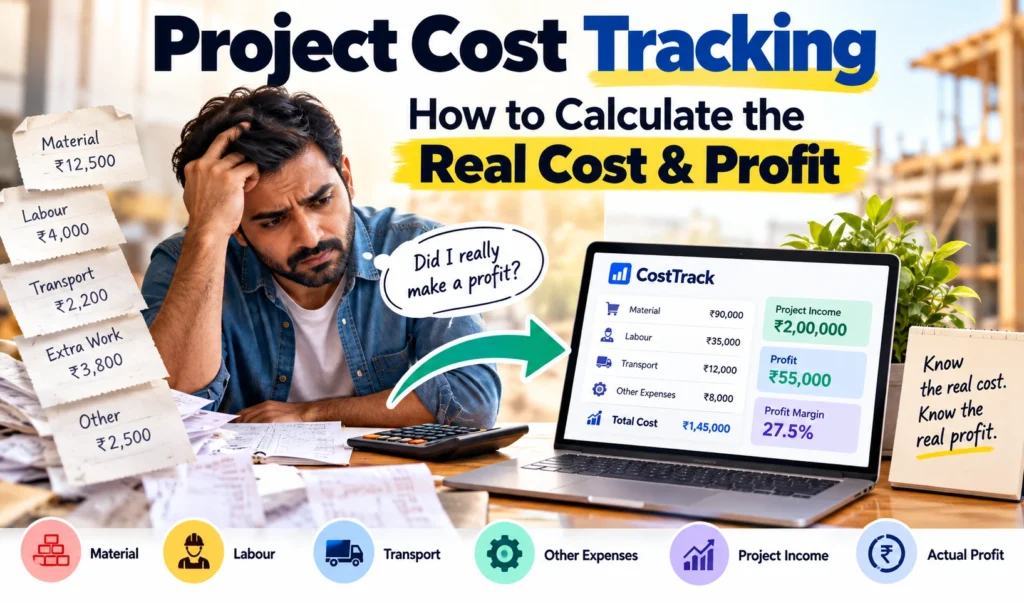
For example:
Monday: Material — ₹12,500
Tuesday: Labour — ₹4,000
Wednesday: Transport — ₹2,200
Friday: Additional material — ₹3,800
Now you know how much the project has actually cost so far.
And you can compare it with the project’s expected revenue.
Don’t Just Track Expenses. Track the Whole Project
A useful project cost system should answer three simple questions:
1. How much have I spent?
Total Project Cost
2. How much am I earning?
Project Income
3. How much did I actually make?
Profit = Income − Actual Cost
And if you want another useful number:
Profit Margin = Profit ÷ Income × 100
This turns a collection of expense entries into useful business information.
What About CostTrack?
This is exactly the problem I wanted CostTrack to solve.
CostTrack is designed around a very simple idea:
You don’t need to know the final cost when you start the project. Just keep adding the expenses as they happen.
Create a project.
Add expenses.
Add income.
CostTrack keeps the numbers together and helps you see the actual project cost and profit.
For example:
Project Income: ₹2,00,000
Material: ₹90,000
Labour: ₹35,000
Transport: ₹12,000
Other Expenses: ₹8,000
CostTrack shows:
Actual Cost: ₹1,45,000
Profit: ₹55,000
Profit Margin: 27.5%
The important part is that you don’t have to maintain a complicated accounting system just to understand the economics of one project.
💡 Your Project Costs Are Changing. Don’t Wait Until the End.
A project rarely follows the original estimate. Material, labour, transport and unexpected expenses can keep changing.
Record them as they happen instead of trying to reconstruct the project cost later.
👉 Try CostTrack on BusinessZindagi →
Create a project, add expenses, add income and see your actual project cost and profit.
Why Saving Old Projects Is So Useful
This is one of the most useful parts of project cost tracking.
Suppose you completed a project today.
You record:
Material → ₹85,000
Labour → ₹30,000
Transport → ₹10,000
Other → ₹8,000
Actual Cost → ₹1,33,000
Six months later, another customer asks for a similar project.
Instead of guessing the cost from memory, you can look at the previous project.
Now you have real historical cost data.
That can help you:
- Prepare better quotations
- Avoid underquoting
- Estimate material requirements
- Understand your margins
- Identify expensive cost areas
- Compare similar projects
- Make better pricing decisions
Your old projects become a reference library for future business decisions.
📊 Your Past Projects Can Become Your Best Cost Reference
Finished a project? Don’t let the numbers disappear into old bills, notebooks and WhatsApp messages.
Save the project’s actual expenses and income in CostTrack.
When a similar customer comes along, you can look back at what the previous project really cost you.
Track today. Quote smarter tomorrow.
An Export Order Can Be a Project Too
Project cost tracking isn’t limited to contractors or construction businesses.
An export order can also be treated as a project.
Suppose you receive an export order worth:
₹5,00,000
Your actual expenses may include:
- Product cost
- Packaging
- Labour
- Local transport
- CHA expenses
- Documentation
- Freight
- Bank charges
- Other export expenses
Instead of trying to reconstruct all these expenses later, record them against that particular export order.
At the end you can see:
Export Revenue − Actual Export Cost = Actual Profit
This gives you a much clearer picture of whether the order was genuinely profitable.
Who Can Benefit From Project Cost Tracking?
You don’t have to be a large company.
Project cost tracking can be useful for:
- Contractors
- Fabricators
- Interior businesses
- Event organisers
- Manufacturers
- Repair businesses
- Installation companies
- Construction businesses
- Freelancers
- Consultants
- Small agencies
- Custom-product businesses
- Exporters
- Service businesses
The common factor is simple:
The final cost can change while the work is being done.
You Don’t Always Need a Complicated ERP
Small businesses often don’t need a huge accounting or ERP system just to track the cost of an individual project.
Sometimes the requirement is much simpler:
Create Project
↓
Add Expense
↓
Add Expense
↓
Add Expense
↓
Add Income
↓
See Actual Cost & Profit
That’s the idea behind CostTrack.
The goal is not to make project costing complicated.
The goal is to make it easy enough that you actually record the expenses.
The Biggest Benefit: Stop Guessing Your Profit
A project can look profitable when you first quote it.
But the real answer comes only after you know what you actually spent.
That’s why:
Estimated Cost ≠ Actual Cost
and:
Expected Profit ≠ Actual Profit
Good project cost tracking helps close that gap.
The simple rule:
Don’t wait until the project is finished to calculate what it cost you. Track the cost while the project is happening.
That way, you know where your money is going, what the project is really costing you and how much profit you are actually making.
Try CostTrack
📚 Authentic Sources & References
The following government sources provide useful background on project costs, project planning and MSME project-related requirements:
- Ministry of MSME — Standard Project Costs — Government of India reference showing standard project-cost estimates for various activities.
- PMEGP — Official Project Cost & Eligibility Information — Ministry of MSME information on admissible project costs and project financing under PMEGP.
- PMEGP Official Portal — Official Government of India PMEGP portal containing project and scheme information.
- MSME Ministry — MSME CHAMPIONS — Government resource containing information and FAQs relevant to MSME projects and business development.
Note: These sources provide official information about project costs and MSME project planning. CostTrack itself is a BusinessZindagi tool for recording actual project expenses and income; it is not an official Government of India application.
🔗 Related BusinessZindagi Resources
If you are planning a business or managing project costs, these BusinessZindagi resources may also be useful:
📊 CostTrack
Track expenses as your project progresses and understand your actual cost and profit.
👉 Open CostTrack on BusinessZindagi →
📈 Export Profit Calculator
For exporters, project costing can include product cost, packaging, freight, documentation, bank charges and other expenses.
👉 Explore the Export Profit Calculator →
💰 BusinessZindagi Tools
Explore BusinessZindagi’s collection of practical tools designed around real-world business calculations and decisions.
👉 Explore BusinessZindagi Tools →
🏭 PMEGP Business Idea Finder
If you are exploring a new business and need to understand possible project ideas and approximate investment levels:
👉 Explore the PMEGP Business Idea Finder →
⚠️ Editorial Disclaimer
This article is intended for general educational and informational purposes for entrepreneurs and small businesses.
Project costs, profitability and business decisions vary from one project and business to another. The examples used in this article are illustrative and should not be treated as financial, accounting, tax or professional advice.
CostTrack is a BusinessZindagi tool designed to help users record and understand their project expenses, income and profitability. It does not replace professional accounting, taxation or financial advice.
Always verify important financial, tax, legal or regulatory matters with a qualified professional and refer to the latest official government requirements where applicable.
BusinessZindagi is not responsible for business decisions made solely on the basis of this article or the calculations recorded in CostTrack.