Focus Keyword:
Secondary Keywords: start a business without a bank loan, grow a business without debt, bootstrap a business, self-funded business, business funding without a loan, business loan risks, customer advance, reinvest business profits, MSME business financing
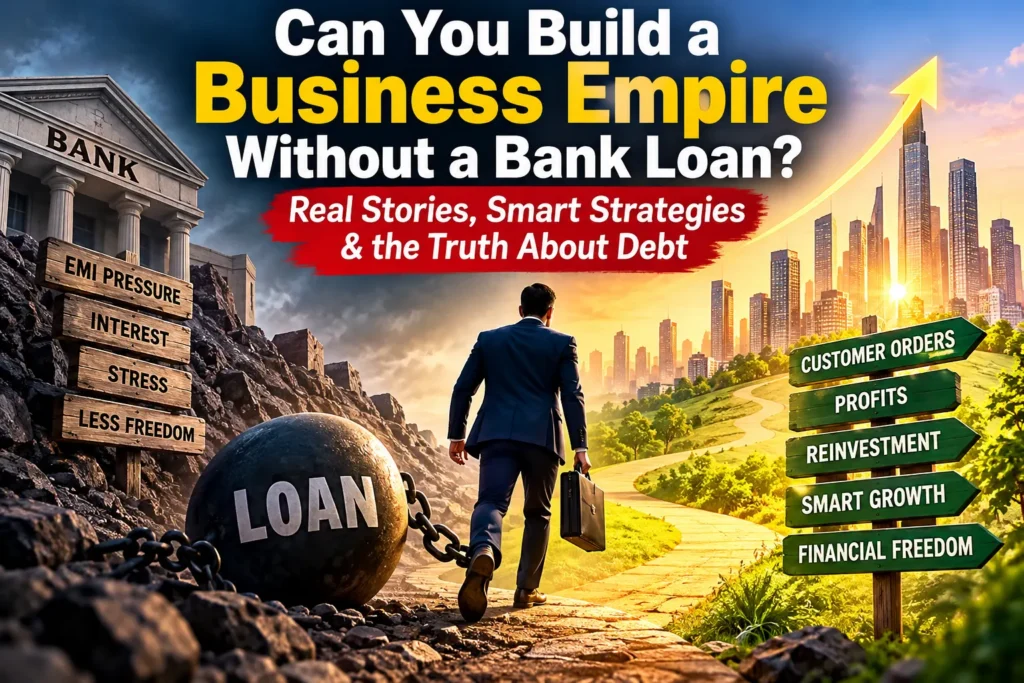
Can You Really Build a Business Without a Bank Loan?
When you don’t have much capital, no wealthy family backing you and no “godfather” to support you, starting and growing a business can feel almost impossible.
The natural question is:
“Where will I get the money?”
And very often, another question follows:
“Should I take a bank loan?”
A business loan can certainly help an entrepreneur buy machinery, purchase inventory, accept a large order or expand faster.
But there is another question that doesn’t get asked often enough:
What if you could build the business without borrowing in the first place?
The answer is yes, it is possible.
But it isn’t easy.
It requires a different approach to growth: starting smaller, controlling expenses, proving demand, generating customer cash flow and reinvesting what the business earns.
And there is another side of this story that I learned personally.
My Own Lesson About Business Debt
I have taken a business loan myself.
At that time, like many entrepreneurs, capital was limited.
When you don’t have substantial personal wealth behind you, a bank loan can look like the obvious solution.
You get the money.
You feel some relief.
You can finally invest, purchase something or pursue an opportunity that previously seemed difficult.
But something unexpected happened only a few months later.
My business suddenly took a sharp turn.
I received an export order.
The customer paid an advance.
And within a relatively short period, the business generated enough cash flow that I had the capacity to repay the entire outstanding debt.
That should have been the perfect moment to become debt-free.
But I didn’t.
Instead, some of the money was spent here and there while the loan remained.
Looking back today, I sometimes think:
If I had not taken that loan, would I have been more disciplined with money?
I can never know the answer.
But the experience taught me something that I believe many entrepreneurs should understand:
A loan doesn’t only give you money. It can also change your behaviour toward money.
When money is scarce, every rupee is carefully considered.
When borrowed money becomes available, some of that pressure disappears.
And sometimes that relief itself can become dangerous.
The Problem Is Not That Every Loan Is Bad
This article is not saying that entrepreneurs should never take loans.
That would be irresponsible advice.
Debt can be extremely useful when used correctly.
Suppose you have confirmed orders worth ₹50 lakh, your customers pay after 60 days, and you need ₹10 lakh of working capital to manufacture and dispatch those orders.
A properly structured loan may make perfect business sense.
Similarly, borrowing to purchase productive machinery may make sense if:
- demand is already proven
- the machinery increases profitable capacity
- cash flow can comfortably service the debt
- the repayment period matches the investment
- you maintain an adequate cash-flow buffer
The problem begins when debt becomes a substitute for a viable business model.
There is a huge difference between:
“I am borrowing to fulfil profitable demand.”
and:
“I am borrowing because I don’t have enough money to keep my business alive.”
So, Can You Build a Business Without a Bank Loan?
Yes.
Many businesses can be started and grown through what entrepreneurs call bootstrapping.
Bootstrapping essentially means building a business using resources such as:
- your own savings
- customer payments
- business profits
- advance payments
- supplier credit
- pre-orders
- strategic partnerships
- reinvested cash flow
Instead of asking:
“How much money can I borrow?”
the entrepreneur asks:
“How can I make the business generate the money required for its next stage of growth?”
That is a completely different mindset.
Real Entrepreneurs Who Built Businesses Through Bootstrapping
Sara Blakely — Spanx
One of the strongest examples is Sara Blakely, founder of Spanx.
According to Forbes, Blakely started Spanx with approximately $5,000 of her own savings. Forbes reported in 2012 that she owned 100% of the company, with zero debt and no outside investment at that time.
Her story is particularly interesting because she didn’t begin with a giant office, a huge team or a massive marketing budget.
She worked on the product, approached manufacturers, pitched retailers and marketed the product herself.
Spanx eventually became a major global brand.
The lesson isn’t that every entrepreneur can build a billion-dollar company with ₹1 lakh.
The lesson is:
You can sometimes start with a small amount of capital, prove demand and let the business itself become the source of future growth.
Mailchimp — A Bootstrapped Company Worth Billions
Another fascinating example is Mailchimp.
The company was founded by Ben Chestnut and Dan Kurzius and became one of the world’s best-known email marketing businesses.
Mailchimp is widely cited as an example of a large bootstrapped technology company. Axios reported that it never took outside funding.
Then came an extraordinary outcome.
In 2021, Intuit announced that it would acquire Mailchimp for approximately $12 billion. Intuit’s subsequent SEC filing records the acquisition at $12 billion.
That doesn’t mean every bootstrapped company will become a multibillion-dollar company.
Far from it.
But Mailchimp demonstrates something important:
A business doesn’t necessarily need traditional outside funding to become extremely valuable.
Don’t Confuse “No Outside Funding” With “No Bank Loan”
This distinction is important.
There are many stories on the internet about “bootstrapped” companies.
But:
No venture capital ≠ no debt
and
No outside investment ≠ never borrowed money.
So when researching entrepreneurial success stories, we should be careful about claiming that a particular founder never took a bank loan unless there is reliable evidence supporting that specific claim.
For this article, Sara Blakely’s Spanx story is particularly strong because Forbes specifically reported zero debt and no outside investment at the time of its profile.
That level of precision matters.
The Hidden Question: Where Does Growth Capital Come From?
This is the real issue.
If you don’t borrow money, growth still needs to be financed somehow.
The money can come from:
Founder capital
↓
Customer revenue
↓
Profit
↓
Reinvestment
↓
Higher capacity
↓
Higher revenue
↓
More reinvestment
This creates a self-funding growth cycle.
It may be slower.
But it can also reduce financial pressure.
The Power of Customer Money
One of the most powerful sources of business capital can actually be the customer.
Think about an export business.
You receive an order.
The buyer agrees to an advance payment.
That advance helps you purchase raw materials, manufacture or pack the goods and prepare the shipment.
The customer isn’t “financing your business” in the traditional sense.
But commercially structured payment terms can significantly reduce how much of your own working capital is required.
This is particularly relevant in export businesses, project businesses, manufacturing and customized products.
Of course, payment terms must be agreed clearly and the seller must be capable of fulfilling the order.
For exporters, payment structures such as advance payment, letters of credit and open-account transactions carry different levels of risk.
Related BusinessZindagi guide:
Payment Risks in Exports: LC, Advance & Open Account Explained
What Happens When You Don’t Have Capital?
This is where entrepreneurship becomes difficult.
It is easy for someone with substantial family wealth, investors or an established business network to say:
“Just start.”
But an entrepreneur without financial backing faces a different reality.
You may have:
- a good idea
- technical knowledge
- a product
- potential customers
but not enough money to execute everything at once.
This can create enormous psychological pressure.
And that pressure can push an entrepreneur toward borrowing.
Sometimes the loan is genuinely necessary.
Sometimes it is simply the fastest available solution.
And sometimes the entrepreneur borrows before fully understanding whether the business can support the debt.
That distinction is critical.
The Psychological Cost of Borrowing
Entrepreneurs normally calculate the financial cost of a loan.
They calculate:
Interest + EMI + processing charges + collateral requirements.
But there is another cost that is rarely discussed.
The psychological cost.
Debt can create constant pressure:
EMI due.
Sales must happen.
Customer payment delayed.
Supplier needs money.
Another EMI approaching.
For an entrepreneur without financial backing, this pressure can become enormous.
But there is another psychological effect too.
When borrowed money enters your bank account, you may temporarily feel richer than you actually are.
That can be dangerous.
Borrowed money is not wealth.
It is money that comes with a future obligation.
The Strange Advantage of Having Less Money
This sounds contradictory, but limited capital can sometimes make an entrepreneur more disciplined.
When money is scarce, you ask:
Do I really need this?
Will this expense generate revenue?
Can I rent instead of buying?
Can I negotiate better terms?
Can I get an advance?
Can I start with 100 units instead of 1,000?
Can I test demand before investing heavily?
These questions force discipline.
And discipline can become a competitive advantage.
But Avoiding Loans Can Also Become a Mistake
There is another trap.
Some entrepreneurs become so afraid of debt that they refuse to borrow even when borrowing makes economic sense.
Imagine this:
You have ₹1 crore of confirmed profitable orders.
But you have only ₹20 lakh of working capital.
A properly structured ₹20 lakh working-capital facility may allow you to fulfil those orders profitably.
In such a situation, refusing all debt simply because:
“Loans are bad.”
could prevent a genuine business opportunity.
Therefore, the goal shouldn’t be:
“Never borrow.”
The better goal is:
“Never borrow without understanding exactly how the borrowed money will come back.”
Debt Should Be a Lever, Not a Lifeline
This is perhaps the simplest way to understand business borrowing.
A lever
helps you move something bigger.
A lifeline
keeps you alive.
Debt can be a powerful business lever.
But if your business needs repeated borrowing simply to survive, the problem may not be a shortage of capital.
It could be:
- weak margins
- poor pricing
- insufficient demand
- excessive expenses
- delayed receivables
- poor inventory management
- an unsustainable business model
Taking another loan doesn’t automatically fix those problems.
Sometimes it simply postpones them.
Before Taking a Business Loan, Ask Yourself These Questions
1. What exactly will I do with the money?
If the answer is vague, stop and rethink.
2. Will this money directly generate revenue or productive capacity?
If not, why borrow?
3. What happens if sales fall by 30%?
Can you still service the EMI?
4. How quickly will the money return?
Match the financing period with the expected cash-flow cycle.
5. Can customer advances reduce my capital requirement?
If yes, explore that option.
6. Can supplier credit reduce my working-capital requirement?
If yes, negotiate responsibly.
7. If I receive a large customer payment tomorrow, will I reduce the debt?
This is the question I personally wish I had asked myself.
What If the Business Has Good Sales but Customers Pay Late?
This is a very common MSME problem.
A business can be profitable on paper but still run out of cash because customers take 30, 60 or 90 days to pay.
That can create a dangerous situation:
Sales increase → receivables increase → cash becomes tight → entrepreneur borrows → interest increases → cash flow becomes tighter.
Before immediately taking another loan, an MSME should examine whether the underlying receivables can be managed better.
One option worth understanding is TReDS, a system designed to help eligible MSMEs obtain early payment against accepted trade receivables. BusinessZindagi has covered how TReDS can help businesses unlock working capital from invoices rather than simply depending on conventional borrowing.
Related BusinessZindagi resource:
TReDS in India: How MSMEs Can Unlock Working Capital
You can also read:
TReDS Registration for MSMEs 2026
Don’t Borrow to Hide a Cash-Flow Problem
Suppose your customers owe you ₹20 lakh.
Instead of recovering that money, you borrow another ₹10 lakh to pay suppliers.
Then another payment gets delayed.
You borrow again.
Eventually:
Loan 1 → Loan 2 → Loan 3 → EMI pressure
This is how a temporary cash-flow problem can become a long-term debt problem.
BusinessZindagi has also covered the dangers of accumulating multiple loans and why easy access to credit does not necessarily mean easy repayment.
Related reading:
MSME Loan for NPA Account: What Entrepreneurs Should Understand
Your Credit History Is Also an Asset
There is another side of the borrowing story.
If you do borrow, repayment discipline matters enormously.
A good credit history can make future financing easier.
A poor repayment record can make it much harder.
BusinessZindagi has previously examined this issue through a real-world MSME experience, including how repayment problems affected access to credit.
Related reading:
Minimum CIBIL Score for MSME Loan: Reality & Requirements
So the lesson isn’t:
“Never borrow.”
It is:
“If you borrow, treat repayment as seriously as sales.”
The Export Example: When Business Capital Can Come From the Order
For an exporter, the difference between having ₹10 lakh and having an export order with a reasonable advance can be enormous.
Imagine:
Buyer order
↓
Advance received
↓
Raw material purchased
↓
Production/packing
↓
Shipment
↓
Balance payment
A well-structured transaction can reduce the amount of capital the exporter needs to put into the transaction personally.
But exporters must also understand payment risks, documentation, bank requirements and cash-flow timing.
If you’re new to exports, BusinessZindagi’s practical guide on executing a first export order covers issues such as the proforma invoice, Customs Broker, shipping bill, port selection and payment terms.
First Export Order: A Practical Playbook for New Exporters
My Biggest Lesson: The Business May Be Capable of Funding Itself
This is perhaps the most important lesson from my own experience.
When I took the loan, I believed that additional capital would help my business.
Then the export order arrived.
The customer paid an advance.
Suddenly, the business itself generated enough cash to potentially clear the debt.
That changed how I think about business capital.
Sometimes entrepreneurs think:
“I need money before I can grow.”
But sometimes the better question is:
“Can I structure the business so that growth itself generates the money required for the next stage?”
That shift in thinking can be powerful.
What If I Had Never Taken the Loan?
This is the question I still think about.
Perhaps the business would have grown more slowly.
Perhaps I would have struggled to take certain opportunities.
Perhaps the loan helped me at an important moment.
Or perhaps the shortage of money would have forced me to become more resourceful and disciplined.
I will never know.
But I do know what happened afterward.
When the export order came and the advance was received, I had the ability to repay the debt.
I didn’t.
And that decision taught me something that no business-school theory could have taught me.
Having money and having capital discipline are two different things.
The Real Cost of Easy Money
Entrepreneurs often focus on the interest rate.
But consider this:
Suppose you borrow ₹5 lakh.
You pay interest.
But because the money is easily available, you also make several expenses that you might not have made if the money wasn’t there.
The real cost becomes:
Interest + unnecessary expenditure + repayment pressure + lost financial flexibility.
This is why sometimes a business owner can look at a loan years later and think:
“The interest wasn’t the biggest problem. The availability of the money changed my spending behaviour.”
That is a lesson worth understanding.
So, Should You Build a Business Without Debt?
If you can grow sustainably without borrowing, there can be major advantages.
You may have:
- less financial pressure
- greater ownership
- more flexibility
- fewer monthly obligations
- greater control over decisions
- less exposure to interest-rate changes
- more freedom during difficult business periods
But debt can also be useful when it is tied to a clear, profitable purpose.
Therefore, the real question isn’t:
Debt or no debt?
It is:
What type of capital does this business actually need, and what will that capital produce?
A Simple Decision Framework
Before borrowing, think about these three situations.
Situation 1: The business is untested
You don’t know whether customers will buy.
Be cautious about debt.
Test the market first.
Situation 2: The business works, but cash is temporarily stuck
You have profitable customers but face delayed payments.
Look at working-capital solutions, receivables management and alternatives such as TReDS where applicable.
Situation 3: The business has proven demand and a clear expansion opportunity
You know what the money will buy, what additional revenue it can generate and how the debt will be repaid.
Strategic borrowing may make sense.
The difference is not simply the size of the loan.
It’s the quality of the underlying business opportunity.
The Best Business Capital May Be Your Customer
Your first customer can sometimes be more valuable than your first investor.
Why?
Because a customer provides:
Revenue
- Market validation
- Feedback
- Potential repeat business
- Cash flow
An investor or lender may provide money.
A customer provides evidence that your business deserves to exist.
That is why entrepreneurs should constantly ask:
“How can I design my business so that customer transactions help finance growth?”
Not every business can do this.
But many can do more of it than they initially realise.
Don’t Try to Look Big Before You Become Big
This is another common entrepreneurial trap.
A business starts making some sales.
Then the owner wants:
- a bigger office
- more employees
- more inventory
- expensive equipment
- a better car
- a premium website
- elaborate branding
None of these things are inherently bad.
But they can become dangerous when they are financed before the business has the cash flow to support them.
Don’t borrow money to look successful.
Borrow, if appropriate, to become more productive and profitable.
There is a huge difference.
The Goal Is Not to Avoid Debt at Any Cost
After everything I’ve experienced, I don’t believe the goal should simply be:
“I will never take a loan.”
The better goal is:
“I want every rupee of capital in my business to have a purpose.”
Sometimes that capital will be:
My own money.
Sometimes:
Customer money.
Sometimes:
Business profits.
Sometimes:
Supplier credit.
And sometimes:
Bank finance.
The entrepreneur’s job is to understand when each one makes sense.
The Final Lesson
Can you build a business empire without a bank loan?
Yes.
Sara Blakely’s Spanx demonstrates that a major company can be built from a relatively small personal investment and grow without debt or outside investment at a particular stage of its journey.
Mailchimp demonstrates that a company can remain bootstrapped and ultimately reach an extraordinary valuation, with Intuit acquiring it for approximately $12 billion.
But these are exceptional stories.
The real lesson for an ordinary MSME entrepreneur isn’t:
“Don’t take loans.”
It is:
“Don’t make borrowing your first answer to every capital problem.”
First understand your customers.
Understand your margins.
Understand your cash flow.
Understand your payment cycle.
Understand your growth opportunity.
Then decide what type of capital makes sense.
Because a bank loan can accelerate a good business.
But it cannot create demand.
It cannot fix bad pricing.
It cannot automatically create profits.
And it certainly cannot replace entrepreneurial discipline.
Sometimes growing slower with your own cash flow may feel frustrating.
But it can give you something borrowed money cannot easily provide:
Freedom.
And perhaps the most important question an entrepreneur can ask is not:
“How much money can I borrow?”
but:
“How much growth can my business finance itself?”
That question can change the way you build a business.
Practical BusinessZindagi Resources
If you’re thinking about business finance, cash flow or exports, these BusinessZindagi guides may be useful:
💰 MSME Loans & Credit
Minimum CIBIL Score for MSME Loan: Reality & Requirements
Understand why credit history matters when you need business finance.
MSME Loan for NPA Account: What Entrepreneurs Should Understand
Useful if financial stress or repayment problems have already affected your business.
📊 Cash Flow & Receivables
TReDS in India: How MSMEs Can Unlock Working Capital
Learn how eligible MSMEs can use invoice discounting to improve cash flow.
TReDS Registration for MSMEs 2026
A practical guide to understanding TReDS and its relevance to MSME receivables.
🌍 Export Business
Payment Risks in Exports: LC, Advance & Open Account Explained
Understand the different payment structures and their risks for exporters.
First Export Order: A Practical Playbook for New Exporters
A practical guide covering the first export order, documentation, Customs Broker, shipping bill and payment terms.
Why Some Exporters Succeed While Others Fail
Lessons from real-world export experience.
Authentic Sources & References
1. Forbes — Sara Blakely and Spanx
Forbes reported that Sara Blakely started Spanx with approximately $5,000 and, at the time of its 2012 profile, owned 100% of the company with zero debt and no outside investment.
Read the Forbes profile on Sara Blakely and Spanx
2. Intuit — Mailchimp Acquisition
Intuit announced its agreement to acquire Mailchimp for approximately $12 billion in cash and stock in 2021.
Read Intuit’s official Mailchimp acquisition announcement
3. Intuit SEC Filing
Intuit’s annual filing records the completed Mailchimp acquisition at approximately $12 billion.
4. BusinessZindagi — Export Payment Risks
BusinessZindagi’s export guide discusses advance payments, letters of credit and open-account payment structures and their respective risks for exporters.
Read the BusinessZindagi export payment guide
About the Author
Tabrez is an entrepreneur, trader and exporter who writes about the realities of building and running a business.
Through BusinessZindagi, he shares practical insights on MSMEs, entrepreneurship, business finance, exports, government schemes and business opportunities.
His approach is based not only on business theory but also on real entrepreneurial experience—including export orders, working-capital challenges, business loans, financial mistakes and lessons learned through experience.
His philosophy is simple:
Business is not only about learning from your successes. Sometimes your biggest lessons come from the decisions you wish you had made differently.
Read more about BusinessZindagi
Disclaimer
This article is intended for general educational and informational purposes only. It does not recommend that entrepreneurs should always avoid business loans or that debt is inherently bad.
Business financing decisions depend on factors including business model, profitability, cash flow, repayment capacity, interest costs, payment cycles, risk tolerance and the purpose for which the money is borrowed.
The author’s personal experience is shared as an entrepreneurial lesson and should not be considered financial advice.
Before taking, restructuring or repaying a business loan, readers should evaluate their individual circumstances and, where appropriate, consult their bank, Chartered Accountant, financial adviser or another qualified professional.
Government schemes, lending rules, interest rates and financial regulations can change. Always verify the latest information with the relevant official authority before making financial decisions.
AI Disclosure: AI tools were used to assist with research, structure and editing. The personal experiences and opinions presented in this article are the author’s own.