Focus Keyword: festive shopping boom in small towns India
Secondary Keywords: small town e-commerce India, festive shopping India 2026, MSME festive sales, Tier 2 Tier 3 cities e-commerce, MSME e-commerce opportunities, small city online shopping, festive season business opportunities, small town consumers India, digital commerce for MSMEs
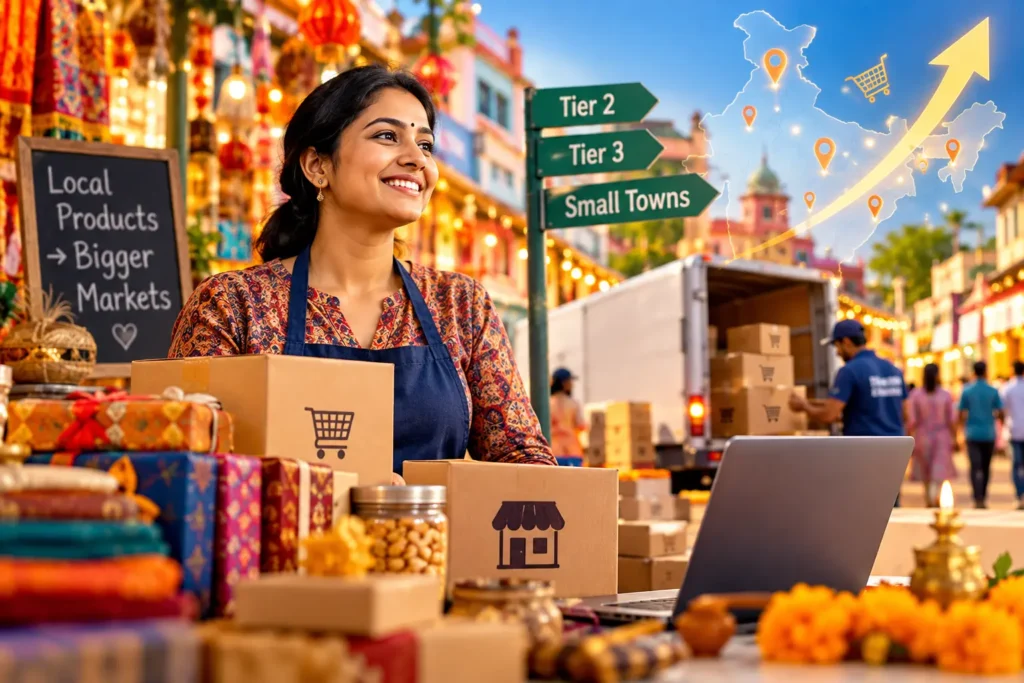
Small-Town India Is Becoming a Major Festive Market
India’s festive shopping story is increasingly moving beyond the metros.
The latest 2026 festive-season data shows strong online demand from smaller cities and towns, creating an important opportunity for Indian MSMEs.
E-commerce order volumes increased 31% year-on-year during the first week of the 2026 festive sales season, according to Unicommerce data. More significantly, Tier-III towns accounted for 42% of overall e-commerce orders during the period analysed. Business Standard — E-commerce order volumes rise 31% in first week of festive sales
Another dataset from CashKaro shows the scale of the festive shopping surge. Between October 7 and 12, 2026, its platform facilitated more than ₹1,000 crore in GMV across 38 lakh orders on major e-commerce platforms. GMV was around 18 times higher than during a comparable six-day business-as-usual period. Economic Times — CashKaro festive shopping data
For MSMEs, the important question is not simply how much Indians are spending.
It is:
How can small businesses use this shift in consumer behaviour to reach new customers and increase festive sales?
Why Small-Town India Matters to MSMEs
For years, India’s online consumption story was heavily associated with Mumbai, Delhi, Bengaluru, Hyderabad and other large cities.
That is changing.
Consumers in Tier-2, Tier-3 and smaller towns are increasingly comfortable with:
- Online shopping
- UPI payments
- Mobile-first purchasing
- Social-media discovery
- Marketplace shopping
- Digital discounts and cashback
- Home delivery
- Regional-language content
A 2026 Bain report highlights the continuing evolution of India’s e-retail market and changing shopper behaviour. Bain & Company — How India Shops Online 2026
KPMG’s Indian retail outlook also highlights Tier-II and Tier-III expansion and digital adoption as important growth drivers. KPMG India — Indian Retail Sector
For an MSME, this means a business does not necessarily need a physical shop in every city to reach customers there.
10 Festive Opportunities for MSMEs
1. Sell Regional Products Beyond Your Local Market
One of the biggest advantages for an MSME is having a product with a strong regional identity.
Examples include:
- Assam tea
- Spices
- Handloom products
- Handicrafts
- Traditional food products
- Regional snacks
- Home décor
- Handmade products
- Ethnic fashion
- Local speciality products
A product that has a limited market locally can potentially find customers across India through digital channels.
For example, an Assam-based tea business can target customers in Kolkata, Delhi, Mumbai, Bengaluru and other markets instead of depending only on local demand.
The same principle applies to hundreds of regional MSME products.
2. Create Festive Bundles Instead of Selling One Product
Festivals provide an opportunity to increase average order value through product combinations.
Instead of selling one product for ₹399, an MSME could create a ₹799 festive combo.
For example:
Tea business
- 2 Assam black teas
- 1 green tea
- Festive packaging
- Greeting card
Food business
- 3 regional snacks
- Gift box
- Festival packaging
Handicraft business
- 2 decorative products
- Gift packaging
- Festival card
The objective is to make the product convenient for gifting while increasing the value of the order.
3. Target Tier-2 and Tier-3 Cities Separately
One common mistake is advertising to “all of India.”
Instead, MSMEs can test specific markets.
For example:
Campaign A: Assam tea for Kolkata customers
Campaign B: Traditional festive gifts for Delhi customers
Campaign C: North-East products for Bengaluru customers
This makes campaigns easier to measure.
Start with a small budget, identify cities generating profitable orders and gradually scale the better-performing markets.
4. Use WhatsApp as a Sales Channel
A small business does not necessarily need an expensive technology stack to start selling digitally.
WhatsApp Business can help with:
- Product catalogues
- Customer enquiries
- Order confirmation
- Repeat-customer communication
- Sharing festive offers
- Product photographs
- Customer support
Businesses should avoid indiscriminate promotional messaging. Build customer lists using appropriate consent and provide relevant communication.
5. Don’t Ignore Your Own Website
Marketplaces can provide reach, but MSMEs should also consider building their own digital presence.
A website can help a business:
- Explain its brand
- Display its product range
- Generate enquiries
- Build customer trust
- Encourage repeat purchases
- Reduce dependence on a single marketplace
The long-term objective should not simply be getting one festive order.
It should be turning that buyer into a repeat customer.
6. Use Regional-Language Marketing
A customer may understand English but still respond better to content in a familiar language.
MSMEs can experiment with:
- Hindi
- Assamese
- Bengali
- Marathi
- Tamil
- Telugu
- Kannada
- Malayalam
- Other regional languages relevant to their target market
This can be particularly useful for product videos, social-media posts, WhatsApp communication and advertisements.
A simple regional-language video showing the product, price, benefits and ordering process can be highly effective without requiring a large advertising budget.
7. Focus on Value, Not Just Discounts
The 2026 festive season is showing an interesting consumer pattern.
Unicommerce reported that e-commerce order volumes rose 31%, while average order value declined 10% during the first week analysed. Business Standard — Festive e-commerce data
This suggests that higher order volumes do not automatically mean customers are willing to spend more on each purchase.
Consumers are increasingly looking for value-for-money products and smaller-ticket purchases.
For MSMEs, the lesson is simple:
Don’t rely only on deep discounts.
Consider:
- Smaller packs
- Combo offers
- Free shipping above a threshold
- Buy-more-save-more offers
- Gift packaging
- Limited festive editions
- Value bundles
Always calculate the actual margin before announcing a discount.
8. Don’t Forget B2B Festive Sales
Festive demand isn’t limited to individual consumers.
MSMEs can also target:
- Corporate gifting
- Offices
- Hotels
- Restaurants
- Retailers
- Distributors
- Institutions
- Event organisers
For example, a tea manufacturer could sell 500 festive tea gift boxes to one company instead of acquiring 500 individual customers.
B2B festive orders can also make inventory and production planning easier because quantities are often known in advance.
9. Improve Packaging
Festive customers often buy products as gifts.
That makes packaging especially important.
Consider:
- Better outer packaging
- Gift boxes
- Thank-you cards
- Product information
- Brand story
- QR code
- Contact details
- Proper shipping protection
For food businesses, all applicable labelling and regulatory requirements should be followed.
10. Turn Festive Buyers Into Repeat Customers
This is one of the biggest opportunities for MSMEs.
Suppose an MSME acquires 1,000 festive customers.
The opportunity doesn’t necessarily end after the festival.
With appropriate customer consent, businesses can develop:
- Repeat-purchase offers
- Subscription models
- Refill reminders
- New-product announcements
- Seasonal offers
- Loyalty programmes
For example:
Festive tea gift → personal tea purchase → monthly tea subscription
A festive order can potentially become a long-term customer relationship.
Digital Commerce Is Becoming More Accessible to MSMEs
The opportunity is not limited to private marketplaces.
The Government’s TEAM Initiative under the RAMP programme is designed to help Micro and Small Enterprises participate in digital commerce through ONDC, including support around onboarding, cataloguing, packaging, logistics and customer management. PIB — Ministry of MSME’s TEAM Initiative
Government data also says that by June 2026, ONDC had more than 20 crore buyers and 5 lakh sellers, with a presence across 1,000 cities. PIB — Digital India, UPI and Digital Commerce factsheet
For MSMEs, this means digital commerce is increasingly becoming accessible beyond traditional large marketplaces.
Festive MSME Checklist
Before the next major festive sales period, check:
☐ Product stock is ready
☐ Supplier capacity is confirmed
☐ Packaging is ready
☐ Product photographs are updated
☐ Website/mobile checkout works
☐ WhatsApp catalogue is updated
☐ UPI/payment options work
☐ Shipping rates are known
☐ Return/refund policy is clear
☐ Customer support is ready
☐ Festive offers have been calculated for profitability
☐ Target cities are selected
☐ Customer data is handled responsibly
☐ Post-festival customer follow-up plan is ready
Useful BusinessZindagi Resources
Calculate your business profit:
BusinessZindagi Export Profit Calculator
Calculate payment gateway charges:
BusinessZindagi Payment Gateway Fee Calculator
Estimate startup and business costs:
BusinessZindagi Startup Cost Calculator
Compare freight options:
BusinessZindagi Freight Mode Comparison Optimizer
Explore international selling opportunities:
The Micro-Multinational: How a 3-Person Indian Business Can Sell to the World
Authentic Sources & References
- Business Standard — E-commerce order volumes rise 31% in first week of festive sales
- Economic Times — CashKaro festive shopping data
- Bain & Company — How India Shops Online 2026
- KPMG India — Indian Retail Sector Q3FY26
- PIB — Ministry of MSME’s TEAM Initiative
- PIB — Digital India, UPI and Digital Commerce factsheet
Editorial Disclaimer
This article is for general informational and educational purposes. Festive sales figures cited above come from industry reports and company/platform data and may not represent the entire Indian retail market. MSMEs should independently evaluate demand, advertising costs, marketplace fees, taxes, logistics, inventory requirements and profitability before making business decisions. Government programmes and digital-commerce initiatives may have eligibility conditions and operational changes; verify the latest information from official government sources before applying or relying on them.