
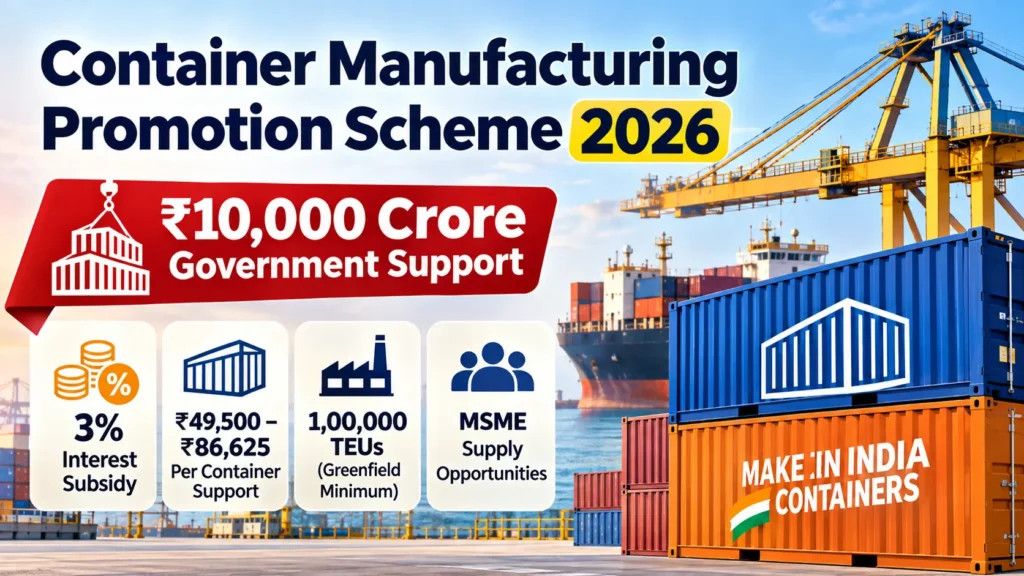
India is preparing for a major expansion of its domestic container manufacturing industry.
On 28 October 2026, the Union Cabinet approved the Container Manufacturing Promotion Scheme (CMPS) with a total budgetary outlay of ₹10,000 crore up to FY 2039-40.
The scheme is designed to establish a globally competitive container manufacturing ecosystem in India, reduce dependence on imported containers and strengthen the country’s maritime and logistics supply chains.
For entrepreneurs and MSMEs, however, one important point needs to be understood: the ₹10,000 crore is not a ₹10,000 crore grant available to every small business. The scheme has specific eligibility conditions, including substantial minimum manufacturing capacities for certain forms of support.
At the same time, the policy could create significant opportunities for Indian MSMEs supplying components, specialised steel, paints, wooden frames and other products and services to the emerging container manufacturing ecosystem.
Container Manufacturing Promotion Scheme 2026: At a Glance
| Particular | Details |
|---|---|
| Scheme | Container Manufacturing Promotion Scheme (CMPS) |
| Total outlay | ₹10,000 crore |
| Scheme period | FY 2027-28 to FY 2039-40 |
| Current annual container manufacturing capacity | About 70,000 TEUs |
| Target capacity | About 7.5 lakh TEUs |
| Interest subvention | 3% per annum |
| Greenfield minimum capacity | 1,00,000 TEUs annually |
| Brownfield minimum additional capacity | 25,000 TEUs annually |
| Estimated direct employment | About 3,000 jobs |
| Estimated indirect employment | More than 50,000 jobs |
| Local-content requirement | 70% initially, rising to 90% |
The figures above are based on the latest official Cabinet and Ministry of Ports, Shipping and Waterways announcements.
What Is the Container Manufacturing Promotion Scheme?
The Container Manufacturing Promotion Scheme is a government programme designed to increase India’s domestic capacity to manufacture shipping containers.
Shipping containers are standardised freight containers used to move cargo by ship, rail and road without repeatedly unloading and repacking the goods.
The government says the scheme aims to:
- Promote domestic container manufacturing
- Reduce import dependence
- Strengthen India’s supply-chain resilience
- Encourage new container manufacturing facilities
- Expand existing manufacturing units
- Build a globally competitive container manufacturing ecosystem
- Create opportunities for related industries
The scheme is part of the broader push under Make in India, Maritime Amrit Kaal Vision 2047 and multimodal logistics development.
Why Does India Need More Container Manufacturing?
India’s international trade is heavily dependent on maritime transport.
According to the Government of India, as of February 2026, India’s maritime sector facilitated approximately 95% of the country’s trade by volume and 70% by value.
The government also says India’s container traffic is projected to increase substantially over the coming decades. Under Maritime Amrit Kaal Vision 2047, container traffic is projected to rise from around 24 million TEUs in 2024 to 175 million TEUs by 2047.
This creates a strategic requirement for India to develop its own container manufacturing capacity rather than remaining heavily dependent on overseas production.
The Container Manufacturing Promotion Scheme is intended to address that gap.
How Much Money Has the Government Allocated for the Container Manufacturing Promotion Scheme 2026?
The total financial outlay under CMPS is ₹10,000 crore.
However, the money is divided among different components rather than being distributed as a single subsidy.
Major components of the scheme
| Component | Allocation |
|---|---|
| Interest Subvention Assistance | ₹859 crore |
| Operational Expenditure Assistance | ₹8,891 crore |
| Testing & Certification Assistance | ₹150 crore |
| Scheme management | ₹100 crore |
| Total | ₹10,000 crore |
The largest component is Operational Expenditure Assistance, with an allocation of ₹8,891 crore.
3% Interest Subsidy for Eligible Container Manufacturers
One of the most important components is Interest Subvention Assistance (ISA).
The government has allocated ₹859 crore for this component.
Eligible container manufacturers can receive an interest subvention of 3% per annum on eligible term loans used for setting up new manufacturing facilities or expanding existing manufacturing capacity.
However, there are significant capacity requirements.
Greenfield container manufacturing project
For a new manufacturing facility, the project must have a minimum annual capacity of:
1,00,000 TEUs
Brownfield expansion
For an existing container manufacturing facility, the expansion must add at least:
25,000 TEUs of annual capacity
The additional capacity must be commissioned within three years of in-principle approval and comply with applicable global container standards.
What does this mean for a small entrepreneur?
This is an important distinction.
A small entrepreneur cannot assume that taking a business loan to establish a small container fabrication unit will automatically qualify for the CMPS interest subsidy.
The 1,00,000-TEU greenfield threshold and 25,000-TEU brownfield expansion requirement are substantial.
Therefore, entrepreneurs should wait for the detailed operational guidelines before committing investment specifically on the assumption that CMPS assistance will be available.
Operational Expenditure Assistance: How Much Support Is Available Per Container?
The second major component is Operational Expenditure Assistance (OEA).
The government has allocated ₹8,891 crore for this component.
The official government backgrounder specifies the following assistance:
| Container type | Assistance per container |
|---|---|
| 20-foot container | ₹49,500 |
| 40-foot container | ₹86,625 |
| 20-foot specialised container | ₹37,125–₹74,250 |
The assistance is intended to help bridge the cost gap between domestically manufactured containers and imported containers and improve the competitiveness of Indian production.
However, this should not be interpreted as a blanket ₹49,500 or ₹86,625 subsidy available to anyone manufacturing a container.
The government specifies that the assistance applies to containers manufactured according to global shipping standards and sold by eligible manufacturers. The detailed operational guidelines will determine the precise conditions and claim process.
Local Content Requirement: 70% Rising to 90%
Another important feature of the scheme is its focus on domestic value addition.
Eligible manufacturers must meet a minimum local-content requirement of:
70% through FY 2031-32
The requirement then rises to:
90% from FY 2032-33.
This requirement is important because the objective is not simply to assemble imported components in India.
The policy is designed to encourage the development of a domestic container manufacturing supply chain.
For Indian component manufacturers and industrial suppliers, this could create new business opportunities.
Can MSMEs Benefit From the Container Manufacturing Scheme?
This is probably the most important question for small businesses.
The answer is yes, but not necessarily in the form of direct CMPS manufacturing assistance.
The direct container-manufacturing incentives have relatively high capacity requirements.
For example, the greenfield interest-subvention route requires a facility with at least 1,00,000 TEUs annual capacity.
That means the scheme is not comparable to a small-business loan or micro-enterprise subsidy such as PMEGP.
Where could MSMEs benefit?
The government itself identifies several ancillary industries that could benefit from the container manufacturing ecosystem, including:
- Corner castings
- Specialised steel
- Wooden frames
- Paints
- Components
- Logistics-related businesses
The government expects the scheme to support a wider industrial ecosystem around container manufacturing.
For an MSME, this may actually be the more realistic opportunity.
Potential MSME Business Opportunities Around Container Manufacturing
The following are potential business opportunities based on the supply-chain requirements identified by the government, rather than businesses for which the government has guaranteed subsidies.
1. Container components
Manufacturers could explore supplying components used in container production.
2. Specialised steel
The government’s local-content requirements could increase demand for Indian suppliers capable of producing or processing suitable grades of steel.
3. Corner castings
Corner castings are critical structural components of shipping containers and are specifically mentioned by the government as an ancillary industry that could benefit.
4. Container flooring and wooden components
Wooden frames and flooring-related products could form another part of the domestic supply chain.
5. Paints and protective coatings
Containers require suitable protective coatings to withstand harsh marine and logistics environments.
6. Fabrication and engineering services
As manufacturing capacity expands, specialised fabrication, welding, machining, maintenance and engineering services could also see demand.
7. Logistics and transportation
A larger domestic container manufacturing ecosystem could generate additional demand for industrial logistics, warehousing and transportation.
For an existing MSME, therefore, the better question may not be:
“Can I get the ₹10,000 crore container subsidy?”
Instead, it may be:
“Can my existing business become a supplier to India’s growing container manufacturing ecosystem?”
India Wants to Increase Container Manufacturing Capacity Tenfold
The scale of the government’s ambition is significant.
India currently has approximately 70,000 TEUs of annual container manufacturing capacity.
Under the new scheme, the government aims to increase domestic capacity to approximately:
7.5 lakh TEUs annually.
That represents roughly a ten-fold increase.
The government expects this expansion to help India develop an internationally competitive manufacturing base and potentially become a global export hub for quality shipping containers.
How Many Jobs Could the Scheme Create?
The government estimates that CMPS could generate:
- Approximately 3,000 direct jobs
- More than 50,000 indirect jobs
The indirect employment opportunity is particularly relevant for MSMEs because much of it could arise through suppliers, component manufacturers, logistics providers and other supporting businesses.
The government also estimates approximately ₹75,000 crore of economic output by FY 2039-40, which it says would be more than seven times the government support under the scheme.
Testing and Certification Support
The scheme also includes ₹150 crore for testing and certification assistance.
The government plans to support common testing facilities, including facilities for dynamic longitudinal impact testing.
This is important because internationally accepted testing and certification are essential if Indian-made containers are to compete in global shipping markets.
Land Support at Major Ports
The detailed government announcement also states that the scheme provides for leasing support for land at major ports at 25% of the notified rate.
This could be relevant for manufacturers considering port-linked manufacturing facilities.
The exact availability and conditions, however, will depend on the applicable scheme guidelines and port arrangements.
Container Manufacturing and India’s Export Opportunity
The scheme isn’t only about making containers for domestic use.
The government wants India to develop a globally competitive container manufacturing industry capable of serving international markets.
This could create opportunities across:
Manufacturing → Components → Containers → Ports → Shipping → Logistics → Exports
The government has also linked expected demand to replacement of the global container fleet, the proposed Bharat Container Shipping Line, and new mega ports including Vadhavan and Galathea Bay.
For exporters, greater domestic container availability could eventually contribute to a stronger and more resilient logistics ecosystem.
If you are already involved in exports, understanding your complete shipment economics becomes increasingly important as freight, inland transportation, port charges and documentation costs can materially affect margins.
BusinessZindagi Resource: Export Profit Calculator
The calculator can help estimate export cost, revenue, profit, profit percentage and the effect of freight and exchange-rate changes.
Bharat Container Shipping Line and the Wider Ecosystem
The Container Manufacturing Promotion Scheme is part of a broader effort to develop an integrated container ecosystem in India.
The government says a Memorandum of Understanding was signed in February 2026 to establish the Bharat Container Shipping Line (BCSL).
The participating organisations include:
- Shipping Corporation of India
- Container Corporation of India
- Jawaharlal Nehru Port Authority
- V.O. Chidambaranar Port Authority
- Chennai Port Authority
- Sagarmala Finance Corporation Limited
The government says the initiative is intended to strengthen India’s container shipping ecosystem and connect major ports with inland markets.
What Does the Scheme Mean for a Small Manufacturing Business?
If you are already running a manufacturing business, there are two different possibilities.
Option 1: Become a container manufacturer
This requires significant capital, manufacturing capacity and compliance with the scheme’s eligibility conditions.
The greenfield threshold of 1,00,000 TEUs per year means this is a large-scale industrial opportunity rather than a typical small factory project.
Option 2: Become a supplier
For many MSMEs, this could be more realistic.
A business could investigate whether it can supply:
- Steel products
- Components
- Corner castings
- Flooring materials
- Paints/coatings
- Fabricated parts
- Engineering services
- Maintenance
- Packaging
- Logistics
Before investing, calculate the actual project cost, working capital requirement, financing cost and expected margin.
BusinessZindagi Resource: Free MSME Business Tools & Calculators
You can use BusinessZindagi’s business-costing and financial tools to assess whether a proposed manufacturing or supply-chain opportunity makes commercial sense before committing capital.
How Can an MSME Prepare for This Opportunity?
If you are interested in supplying the container industry, a practical approach would be:
Step 1: Identify the product
Determine which component or service you can competitively supply.
Step 2: Study technical specifications
Container manufacturing is standards-driven. A supplier should understand the technical and quality requirements applicable to its product.
Step 3: Calculate manufacturing cost
Include:
- Raw materials
- Labour
- Power
- Machinery depreciation
- Packaging
- Transportation
- Financing cost
- Quality testing
- Rejection/wastage
- GST and other applicable costs
Step 4: Identify potential buyers
Potential customers could include container manufacturers, shipping companies, logistics businesses and other industrial buyers.
Step 5: Prepare professional quotations
For businesses supplying internationally or to large manufacturers, a properly structured quotation can be important.
BusinessZindagi Resource: Proforma Invoice Format & Export Guide
For export transactions, the guide explains the important commercial elements including product specifications, price, Incoterms, payment terms and shipping information.
Step 6: Explore government procurement where relevant
If your product or service is purchased by government organisations or PSUs, GeM may also be worth investigating.
BusinessZindagi has an updated guide on GeM Portal Registration and Selling for MSMEs and a recent article covering the latest GeM 2026 changes for MSME suppliers.
Is the ₹10,000 Crore Scheme a ₹10,000 Crore Loan or Grant?
No.
This is one of the most important points to understand.
The ₹10,000 crore figure represents the total budgetary outlay of the scheme.
It includes different forms of support such as:
- Interest subvention
- Operational expenditure assistance
- Testing and certification support
- Scheme administration
It does not mean that every entrepreneur can apply for a ₹10,000 crore loan or receive a portion of the amount as a direct cash grant.
Is the ₹49,500 Per-Container Amount Available to Every Manufacturer?
No.
The ₹49,500 figure is the announced Operational Expenditure Assistance for an eligible 20-foot container.
Similarly, the announced assistance for a 40-foot container is ₹86,625.
The government specifies that eligible manufacturers must meet the applicable conditions, including global shipping standards and local-content requirements.
The final operational rules will determine the exact eligibility and claim mechanism.
When Will Applications Open?
The Cabinet has approved the scheme, but businesses should distinguish between Cabinet approval and the commencement of applications under detailed operational guidelines.
The government has stated that an Inter-Ministerial Steering Committee chaired by the Secretary, Ministry of Ports, Shipping and Waterways will approve the guidelines and sanction assistance.
Therefore, businesses should not assume that applications are already open merely because the Cabinet has approved CMPS.
Entrepreneurs should monitor the official Ministry of Ports, Shipping and Waterways website and future government notifications for the application procedure.
Official source: Ministry of Ports, Shipping and Waterways
Quick Eligibility Check
Before considering a container manufacturing project under CMPS, ask:
Are you planning a new container manufacturing facility?
If yes, check whether the planned capacity can meet the applicable 1,00,000 TEU annual threshold for the greenfield interest-subvention component.
Are you an existing container manufacturer?
If yes, check whether the proposed expansion adds at least 25,000 TEUs of annual capacity.
Can your facility meet global container standards?
This is important for eligibility under the relevant components.
Can you meet the local-content requirement?
The requirement starts at 70% and rises to 90% from FY 2032-33.
Are you considering an ancillary business instead?
If you manufacture components, specialised steel, wooden frames, paints or other relevant products, the expanding ecosystem may provide a potential B2B opportunity.
Final eligibility should be determined only after the detailed CMPS guidelines are issued.
Container Manufacturing Promotion Scheme vs a Typical MSME Subsidy
It is useful to understand the difference.
| CMPS | Typical small-business subsidy |
|---|---|
| Focuses on container manufacturing ecosystem | Often focuses on starting/expanding small businesses |
| ₹10,000 crore total scheme outlay | Varies by scheme |
| Large capacity thresholds for key manufacturing support | Often lower project sizes |
| 3% interest subvention for eligible projects | Subsidy/credit support depends on scheme |
| Production-related assistance | Usually project/loan-linked |
| Strong focus on domestic manufacturing | Depends on the individual scheme |
Therefore, an entrepreneur should not automatically treat CMPS as an alternative to PMEGP, CGTMSE or other MSME financing schemes.
The right scheme depends on the nature, size and purpose of the business.
In a Nutshell
Container Manufacturing Promotion Scheme 2026 = ₹10,000 crore government programme to build India’s domestic container manufacturing ecosystem.
For large manufacturers:
- 3% interest subvention on eligible term loans
- Greenfield capacity requirement of at least 1,00,000 TEUs
- Brownfield expansion requirement of at least 25,000 TEUs
- Production-related assistance for eligible containers
- Testing and certification support
For MSMEs:
- The direct manufacturing incentive may not be suitable for a small factory because of the high capacity requirements.
- The bigger opportunity may be in supplying components, specialised steel, corner castings, wooden products, paints, engineering services and logistics to the expanding industry.
For exporters:
- A stronger domestic container manufacturing ecosystem could support India’s broader maritime and export infrastructure.
Important: The Cabinet has approved the scheme, but businesses should wait for and follow the detailed operational guidelines before assuming eligibility or investing specifically on the basis of CMPS assistance.
Official Government Sources
PIB — Cabinet approves Container Manufacturing Promotion Scheme
https://www.pib.gov.in/PressReleseDetailm.aspx?PRID=2329476
PIB — ₹10,000 Crore Scheme to Make India a Global Container Manufacturing Hub
https://www.pib.gov.in/PressReleasePage.aspx?PRID=2329666
PIB Backgrounder — Container Manufacturing Promotion Scheme
https://www.pib.gov.in/PressReleasePage.aspx?PRID=2329601
Ministry of Ports, Shipping and Waterways
https://shipmin.gov.in/
Union Budget 2026-27 — Government of India
https://www.pib.gov.in/PressReleasePage.aspx?PRID=2221458
BusinessZindagi Resources
Export Profit Calculator — Calculate shipment costs, export pricing and profit before accepting an order.
MSME Business Tools & Calculators — Explore practical tools for costing, finance and business planning.
GeM Portal Guide for MSMEs — Understand government procurement and selling through GeM.
GeM 2026 Changes for MSMEs — Latest changes affecting MSME sellers and government procurement.
Export Proforma Invoice Guide — Useful when preparing quotations and export documentation.
Editorial Disclaimer
This article is intended for general information and educational purposes. The Container Manufacturing Promotion Scheme was approved by the Union Cabinet on 28 October 2026, but detailed operational guidelines, application procedures, approval conditions and implementation requirements may be issued or changed by the Government of India.
The figures and eligibility information in this article are based primarily on official Government of India and PIB publications available at the time of writing. Businesses should verify the latest notification and detailed guidelines from the Ministry of Ports, Shipping and Waterways before making investment, financing or business decisions.
BusinessZindagi does not guarantee eligibility, subsidy approval, loan approval, government orders or any particular business outcome.