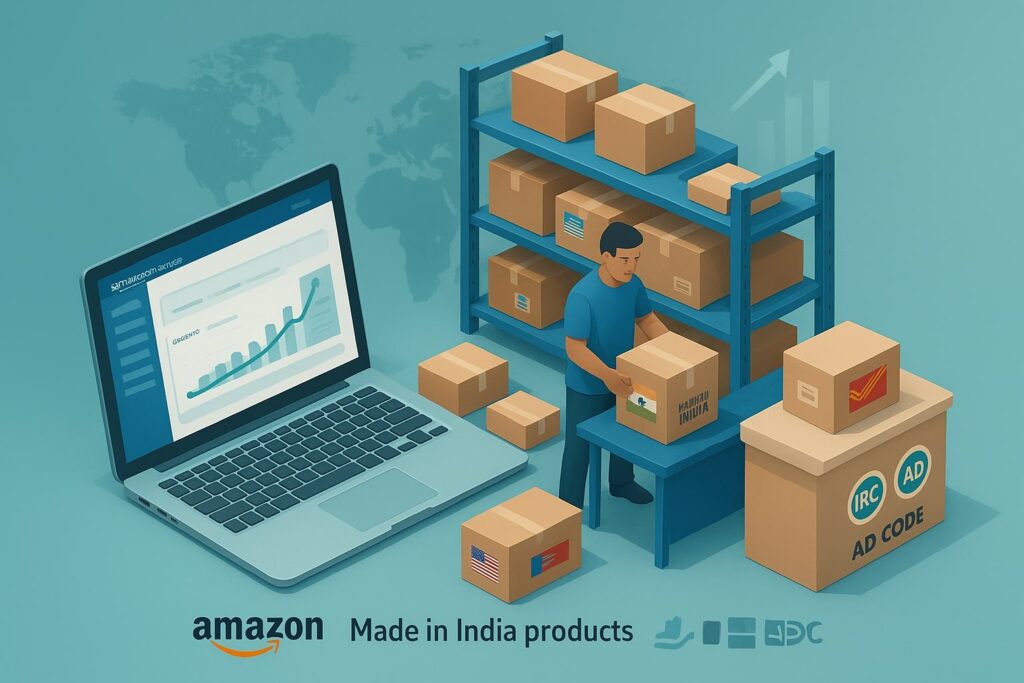
For decades, Indian small businesses and MSMEs relied on traditional exports—trade fairs, distributors, and middlemen—to reach global buyers. But in 2015, Amazon introduced its Amazon Global Selling program, and the game changed.
Today, more than 150,000 Indian exporters are selling directly to customers in the US, Canada, Europe, Australia, the Middle East, and beyond, clocking over $13 billion in cumulative exports. The goal? A massive $80 billion in e-commerce exports by 2030. This isn’t just an opportunity—it’s a revolution in how Indian businesses connect with the world.
You may also like:Exporter’s Dilemma: Should You Send Free Samples to Foreign Buyers?
Where Can Indian Sellers Expand?
Through Amazon Global Selling, Indian entrepreneurs can showcase their products on some of the largest marketplaces in the world:
- North America – Amazon US & Canada
- Europe – Amazon UK, Germany, France, Italy, Spain, Netherlands, Poland, Sweden
- Asia-Pacific – Amazon Japan, Singapore, Australia
- Middle East & Africa – Amazon UAE, Saudi Arabia, Egypt
And the best part? With a single linked account, your professional seller fee is capped at $39.99 per month, no matter how many regions you sell in.
You may also like to read: From Local to Global: How Small Businesses Are Winning with Cross-Border E-Commerce in 2025
What You Need to Start Selling Globally
Here’s a quick checklist for Indian MSMEs:
- Business Documents – PAN, address proof, and a valid bank account.
- IEC (Importer-Exporter Code) – Mandatory for all exports.
- GST Registration – And if you want to export without paying IGST upfront, file a Letter of Undertaking (LUT).
- AD Code – Issued by your bank for customs clearance and foreign remittance.
- Product Readiness – Correct HS codes, barcodes, packaging, and labeling.
- Logistics Choice – Either FBA (Fulfillment by Amazon) for fast delivery or self-ship (MFN) if you want control.
- Compliance – Country-specific rules, certifications, and category restrictions.
The Costs & Profitability Puzzle
Before jumping in, calculate your landed cost carefully:
- Amazon Selling Plan Fee: $39.99/month (capped globally).
- Referral Fee: 8–15% depending on the product category.
- FBA Charges: Per-unit handling, storage, and shipping costs.
- Advertising Costs: Sponsored ads are optional but often necessary for visibility.
Tip: Always run a profitability analysis per SKU. Your final selling price = product cost + packaging + international freight + duties + Amazon fees + ads + a margin buffer.
Success Stories from India
From Jaipur’s textile units to Kerala’s spice exporters, thousands of Indian sellers have scaled their businesses globally through Amazon. Popular categories include home décor, handicrafts, Ayurveda products, jewelry, leather goods, and kitchenware.
What makes them successful?
- Niche selection – Products with global demand but less competition.
- FBA advantage – Faster delivery leads to higher customer trust.
- Optimized listings – SEO-friendly titles, detailed descriptions, and great images.
- Smart ad spend – Targeted campaigns to kickstart sales momentum.
Challenges to Watch Out For
While the opportunity is massive, MSMEs should be prepared for a few hurdles:
- Complicated export compliance (IEC, LUT/IGST refunds, AD code).
- High competition in saturated categories.
- Upfront working capital for FBA shipments.
- Rising ad costs in mature markets.
- Strict customer service & return policies.
A Quick History of E-Commerce Exports from India
- 2015 – Amazon Global Selling launches in India.
- 2016–2020 – MSMEs join in large numbers, especially in textiles, handicrafts, and auto accessories.
- 2024 – Over 150,000 Indian exporters on the platform, with $13B exports achieved.
- 2030 Target – Amazon is working toward $80B e-commerce exports, supported by government initiatives like e-commerce export hubs and India Post partnerships.
Amazon Global Selling vs. India Post Export Program
Many MSMEs ask: Should I choose Amazon Global Selling or ship directly through India Post’s Dak Ghar Niryat Kendra (DNK) program?
🔹 Amazon Global Selling
Pros:
- Ready-made global marketplace with millions of buyers.
- Prime delivery through FBA.
- Marketing & advertising tools.
Cons:
- Higher fees (referral + FBA + ads).
- Intense competition and strict rules.
🔹 India Post Export (DNK & ITPS)
Pros:
- Low-cost shipping for small/lightweight parcels.
- Direct exports possible via post offices.
- Government-backed, increasingly digitized.
Cons:
- No built-in demand—you must generate sales through your own website or social media.
- Slower delivery compared to Amazon FBA.
- Country restrictions and weight limits.
👉 In short: If you want scale and marketplace traffic, Amazon Global Selling is unmatched. If you’re testing the waters with lightweight products and small orders, India Post’s DNK program is a great starting point.
Global Selling vs. Other Platforms
- eBay International Shipping: Good for collectibles and unique items, but weaker demand for everyday goods compared to Amazon.
- Walmart Marketplace: Expanding but has stricter onboarding compared to Amazon.
- Shopify + India Post: Works well if you already have your own D2C brand and customer base.
🛠️ Action Plan for Indian MSMEs
- Pick 5–10 products with export potential.
- Register for IEC, GST, and AD Code.
- Create your Amazon Global Selling account.
- Decide FBA vs. MFN.
- Launch with optimized listings and small test shipments.
- Run ads carefully to gain reviews and traction.
- Expand to more marketplaces once profitable.
✨ Final Thoughts
For Indian MSMEs, Amazon Global Selling is more than just a platform—it’s a passport to global markets. Whether you’re a Jaipur craftsman, a Surat textile manufacturer, or a D2C skincare startup in Bangalore, you can now reach customers worldwide without setting foot outside India.
Pair this with India Post’s export schemes for small parcels, and you have a powerful toolkit to grow your global presence.
✍️ About the Author
Tabrez is a enrepreneur, trader exporter who writes about MSME growth, trade, and smart investing. Through Business Zindagi, he shares real-world lessons and personal experiences to help beginners navigate business and finance with confidence.
AI Disclaimer
This article has been created with the assistance of artificial intelligence to improve clarity, accuracy, and readability. While every effort has been made to ensure the information is based on credible government sources and the latest available updates, readers are advised to verify important details from official portals such as India Post, CBIC, and the Ministry of Commerce before making business or export decisions.