I must admit something right at the start.
As an MSME owner, I had often heard the term carbon credit, but I never paid much attention. I thought it was a concern only for big industrial giants or global corporations.
But once I started learning about it, I realized that carbon credits could become one of the most powerful tools for Indian MSMEs — not just for environmental reasons but also for profit, efficiency, and global competitiveness.
So, let’s understand what carbon credits are, how India’s carbon credit market works, and how small businesses like ours can actually benefit from it.
you may also like to read: Gold Standard Carbon Credits — Why They Matter in Today’s Carbon Market
What Exactly Is a Carbon Credit?
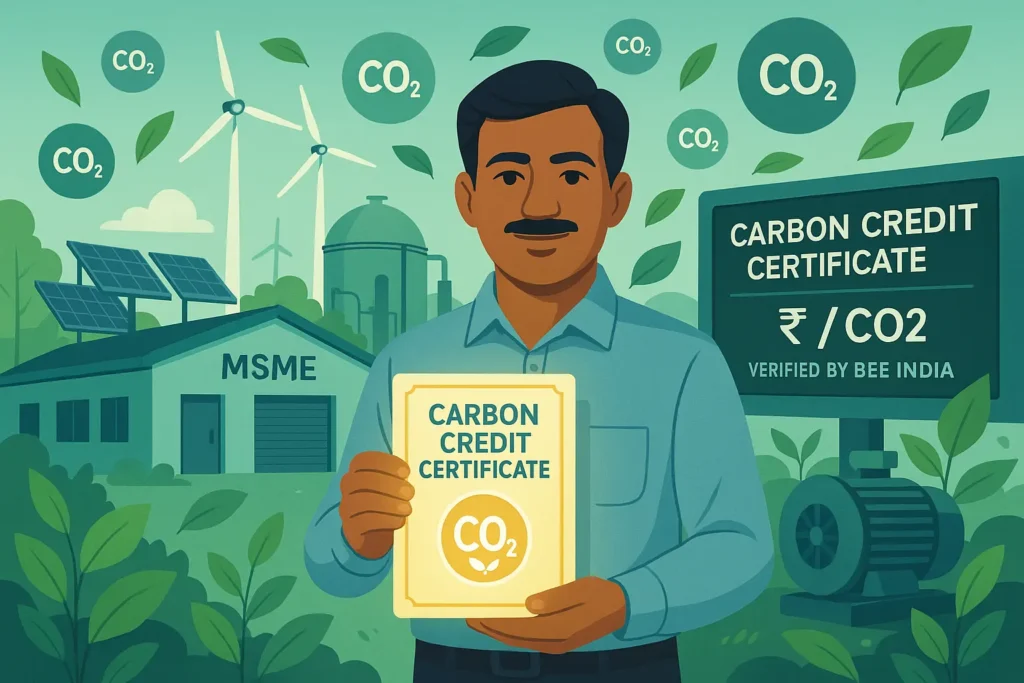
A carbon credit is a certificate that represents the reduction, removal, or avoidance of one tonne of carbon dioxide (CO₂) equivalent from the atmosphere.
When a business takes steps to reduce emissions — for instance, by:
- switching to solar or renewable energy,
- improving energy efficiency,
- recycling or reducing waste, or
- planting trees (afforestation) —
that reduction can be measured, verified, and turned into carbon credits.
These credits can then be sold to other companies that need to offset their emissions.
In simple terms:
reduce emissions → get verified → earn carbon credits → sell them for profit.
You may also like to read: MSME Insurance in India: Essential Policies Every Small Business Should Never Ignore
Why MSMEs Should Care About Carbon Credits
Carbon credits aren’t just for big polluters — they’re for everyone. Here’s why small and medium enterprises should start paying attention:
1. Additional Source of Income
If your MSME undertakes renewable or energy-efficient projects, you can generate carbon offset credits and sell them in the market. It’s a new revenue line that rewards green initiatives.
2. Lower Energy Costs
Efficient equipment, better insulation, and renewable power not only lower bills but also reduce emissions that qualify for credits.
3. Export and Supply Chain Benefits
Global buyers increasingly prefer suppliers with low carbon footprints. Showing verified carbon offset credits can improve your export competitiveness.
4. Access to Green Financing
Banks and investors are giving preference to green MSMEs. Businesses that can prove emission reduction or own carbon credits often get better loan terms.
5. Regulatory Preparedness
India’s new carbon credit market will eventually cover more sectors. Knowing how it works now prepares your business for future compliance and opportunity.
India’s Carbon Credit Ecosystem: What’s Happening
India is developing one of the world’s largest emerging carbon markets. Here’s an overview of key developments:
- The Energy Conservation (Amendment) Act, 2022 laid the legal foundation for a national Carbon Credit Trading Scheme (CCTS).
- The Bureau of Energy Efficiency (BEE), under the Ministry of Power, is the nodal agency managing the system.
- The Indian Carbon Market (ICM) will have two parts:
- Compliance Market: For large, energy-intensive sectors like cement, steel, and fertilizer.
- Voluntary Market: For MSMEs and smaller entities to earn and sell carbon credits from renewable energy, afforestation, or waste reduction projects.
- In 2025, the government approved eight methodologies for voluntary carbon credit projects — covering renewable energy, green hydrogen, mangrove afforestation, and more.
- The Grid Controller of India (GCI) will run the carbon credit registry, while the Central Electricity Regulatory Commission (CERC) will regulate trading.
- The Indian Carbon Market Portal is expected to launch in January 2026, enabling direct registration, credit issuance, and trading.
How MSMEs Can Participate
Here’s a practical roadmap for small business owners who want to benefit from this system:
| Step | Action | What to Do |
|---|---|---|
| 1. Measure your emissions | Estimate energy and fuel usage | Use tools from BEE or SME Climate Hub |
| 2. Improve efficiency | Switch to LEDs, solar panels, or efficient machinery | Lower costs and emissions |
| 3. Choose a project | Rooftop solar, waste recycling, biogas, or tree plantation | Fit projects to your resources |
| 4. Partner with experts | Work with accredited carbon verification agencies | Reduces complexity and costs |
| 5. Register your project | Apply through the upcoming Indian Carbon Market Portal | Keep all documentation ready |
| 6. Earn and sell carbon credits | Trade your credits on approved exchanges | Or sell them voluntarily to offset buyers |
| 7. Track and improve | Monitor energy use every year | Future credits depend on consistent data |
Carbon Credit Prices in India
Carbon credit prices vary widely depending on the type of project, verification standard, and buyer demand:
- Generic voluntary market credits: $5–10 per tonne
- Premium Gold Standard carbon credits: $20–40 per tonne or higher
Even a small-scale renewable project generating a few hundred tonnes of carbon savings annually can create a new, recurring income stream for MSMEs.
Real Examples
- NABARD is running a pilot project in Karnataka helping mango farmers earn carbon credits by managing biomass and planting trees.
- Tirupur textile MSMEs have started shifting to solar and biomass boilers, preparing to monetize emission reductions.
- Many recycling and waste management startups are now registering under global carbon standards like Verra and Gold Standard to access international buyers.
What MSMEs Should Remember
- Verification and registration may require technical support, so start small or partner with others in your cluster.
- Always ensure your credits come from real, measurable, and additional emission reductions — credibility matters.
- Carbon credits should complement, not replace, genuine emission reduction.
- Keep track of government notifications through BEE and PIB websites, as regulations evolve quickly.
Like many small business owners, I once believed carbon credits were only for big corporations. But after understanding how they work, I now see them as a new currency of sustainability — one that can bring both profit and purpose.
As India builds its own carbon credit trading market, MSMEs that act early — by reducing emissions, measuring impact, and registering projects — will be the real winners of this green transition.
So, the question is no longer “Should MSMEs care about carbon credits?”
It’s “How fast can we start earning them?”
- Bureau of Energy Efficiency (BEE) – Indian Carbon Market Overview
https://beeindia.gov.in/carbon-market.php - Energy Conservation (Amendment) Act, 2022 – Ministry of Power
https://pib.gov.in/PressReleasePage.aspx?PRID=1885510 - Carbon Credit Trading Scheme (CCTS) Notification, 2023 – Government of India
https://egazette.nic.in - ICAP Report – Indian Carbon Credit Trading Scheme Summary
https://icapcarbonaction.com/en/ets/indian-carbon-credit-trading-scheme - CEEW Analysis – India’s Carbon Market and Offset Mechanisms
https://www.ceew.in - S&P Global – India’s Carbon Credit Banking and Target Updates (2025)
https://www.spglobal.com/commodity-insights - Press Information Bureau (PIB) – Approval of Credit Methodologies for Voluntary Projects
https://www.pib.gov.in/PressNoteDetails.aspx?ModuleId=3&NoteId=154721 - Times of India – NABARD’s Carbon Credit Pilot in Karnataka
https://timesofindia.indiatimes.com/city/bengaluru/with-a-pilot-nabard-taps-into-carbon-credit-market-in-karnataka/articleshow/122955955.cms - IEFFA – Policy Analysis on Operationalising India’s Carbon Market
https://ieefa.org/resources/crucial-contours-operationalising-indian-carbon-market-need-clarity - Gold Standard Registry – Verified Carbon Credits Framework
https://www.goldstandard.org/