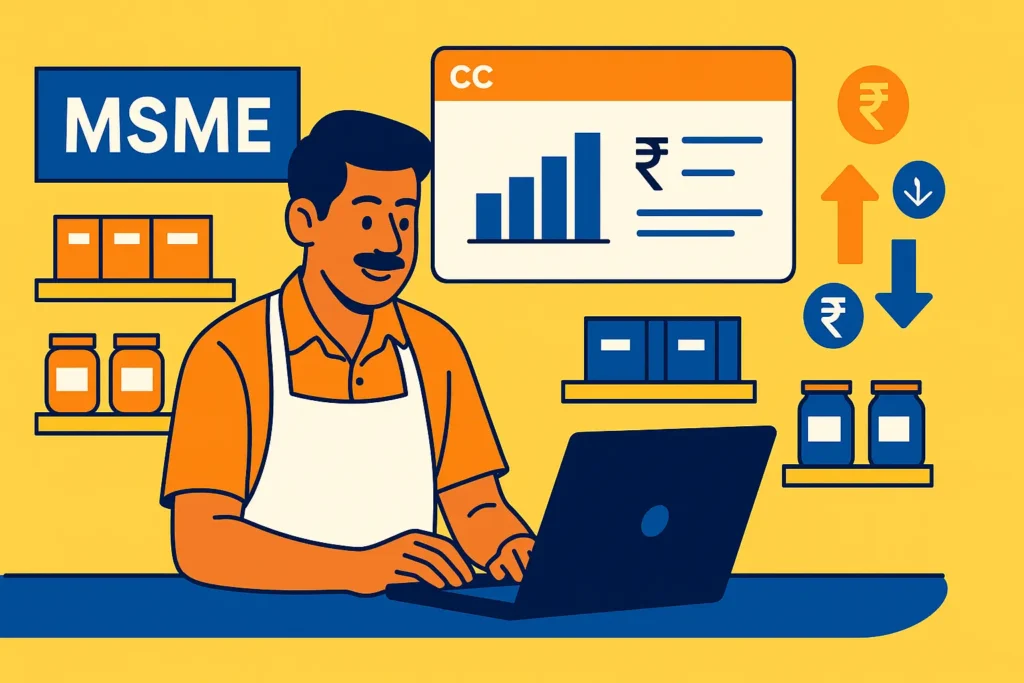
Managing working capital is one of the biggest challenges for MSMEs. To solve this, banks offer a powerful tool called the CC account (Cash Credit Account).
But is it truly beneficial for every business? Or is it an expensive trap if not used correctly?
In this guide, I share how a CC account works, my personal experience, plus real stories of two close friends, and whether you should go for it.
you may also like to read: Loan Against Shares: A Smart Tool — But Dangerous During Market Volatility for MSMEs
What Is CC Account? (Cash Credit Account Explained)
A CC Account, or Cash Credit Account, is a working capital loan where the bank sanctions a limit (say ₹10 lakh), and the business can withdraw money whenever needed, paying interest only on the amount utilized.
Example:
If your limit is ₹10,00,000 and you withdraw ₹2,00,000, interest is charged only on ₹2,00,000.
✔ Key Features
- Flexible usage
- Interest only on utilization
- Requires stock statements & audits
- Reviewed and renewed yearly
- Based on stock, receivables & turnover
you may also like to read: How Managing Working Capital Right Becomes the Lifeline after You Start an MSME
My Real Experience Running a CC Account for My MSME Unit
When I started my MSME unit, I thought having a CC account was essential.
The idea of paying interest only on the used amount sounded perfect.
But over time, I realized:
✔ A CC account is a loan account
It comes with charges, risks, and responsibilities.
✔ If a business has enough internal funds, a CC account may be unnecessary
Compared to a simple current account, a CC account involves:
- High interest rates
- Renewal charges
- Insurance charges
- Stock audit fees
- Penalties for late document submission
✔ Cash flow rotation decides everything
If your sales and receivables are fast, CC works well.
If slow, the interest burden grows, DP reduces, and pressure increases.
For me, the experience was mixed — helpful during cash shortages, stressful during slow months.
Real Example 1: My Friend Closed His CC Account — And Is Happier Now
One of my close friends also had a CC account for his business.
He used it regularly but soon realized:
- Interest charges were adding up
- Renewal and insurance fees were high
- Stock audits were stressful
- DP reduction caused sudden pressure
Eventually, he closed the CC account completely.
Today, he tells me:
“My business runs more peacefully without a CC limit. It was costing more than it helped.”
This example shows that a CC account is not always a blessing — it depends on your business’s nature and cash cycle.
Real Example 2: Another Friend Refuses a CC Limit Offered by His Bank
I have another friend who runs a successful partnership business.
Because of their strong turnover, the bank keeps offering them a CC limit.
But they always decline it.
Why?
- They have stable cash reserves
- They don’t want additional loan obligations
- They prefer a clean current account without monitoring
- They avoid interest and hidden charges
He believes:
“If cash flow is strong, why pay interest unnecessarily?”
This is also true — not every business needs a CC limit even if the bank is offering it.
How Banks Automatically Offer CC Limits If Turnover Is Good
From my experience and from observing others:
👉 If your turnover is strong and your banking is clean, banks automatically approach you with:
- CC limit
- OD facility
- Working capital enhancement
- Business loans
- Pre-approved offers
Banks are eager to lend to businesses with regular inflow and high transaction volume.
So yes — good turnover = higher chances of automatic CC limit offers.
How Does a CC Account Work? (Easy Explanation)
Banks calculate Drawing Power (DP) based on:
- Stock value
- Debtors (receivables)
- Turnover
- GST returns
- Financial statements
Your usable limit = DP
If stock decreases or receivables slow down, DP drops — and the bank may ask for repayment.
CC vs OD Loan: What’s the Difference?
| Feature | CC Account | OD Loan |
|---|---|---|
| Basis | Stock & receivables | Collateral or FDs |
| Documentation | High | Moderate |
| Interest | On used amount | On used amount |
| Best for | Inventory-heavy businesses | Service or collateral-based businesses |
| Renewal | Yearly | Yearly but simpler |
If you don’t maintain stock or want fewer compliances, OD is often better.
How to Get Cash Credit Limit for MSME (Step-by-Step)
1. Prepare Basic Documents
- GST returns
- ITR for 2 years
- Bank statements
- Balance sheet
- Sales & purchase invoices
- KYC
- Udyam Registration
2. Apply to a Bank
SBI, PNB, HDFC, ICICI, Axis, Kotak, and NBFCs offer CC facilities.
3. Financial Assessment
Bank reviews:
- Turnover
- Stock & receivables
- Credit score
- Cash flow
4. Sanction & Documentation
Loan agreement, hypothecation deed, insurance, etc.
5. CC Activation
You can withdraw funds when needed.
Documents Required for CC Account
✔ Business Docs
- Udyam/MSME Certificate
- GST registration
- Partnership deed / Company incorporation docs
✔ Financial Docs
- ITR – 2 years
- GST returns – latest periods
- Balance sheet & P&L
✔ Banking Docs
- 6–12 months statements
✔ Security Docs
- Stock statements
- Insurance papers
- Collateral documents (if secured CC)
Is CC Account Good or Bad? (Honest Verdict)
A CC account is good when:
- You need working capital
- Sales and receivable cycles are fast
- You maintain regular stock
- You want flexibility during cash crunch
A CC account is bad when:
- You have sufficient internal funds
- You want fewer bank obligations
- Your business has slow receivables
- You don’t want stock audits or renewal charges
⭐ Final Verdict
CC account is helpful when necessary, but expensive when unnecessary.
Do not take it just because the bank offers it — take it only if your business truly needs working capital support.
FAQs
1. What is CC account in MSME?
A working capital loan where you pay interest only on the amount you use.
2. Is CC account good or bad?
Good for businesses with fast cash flow; bad for those with slow rotation or enough cash reserves.
3. CC vs OD loan — which to choose?
CC is for stock-based operations.
OD is for collateral or service-based businesses.
4. Do banks offer CC limits automatically?
Yes, if your turnover and account management are good, banks often offer pre-approved CC limits.
5. What documents are needed for a CC account?
ITR, GST returns, financials, stock statements, KYC, bank statements, etc.
About the Author
Tabrez is an MSME entrepreneur and business blogger. With hands-on experience managing a CC account and deep exposure to MSME working capital systems, he writes practical, real-world guides for new entrepreneurs.
Authentic Sources & References
- Reserve Bank of India – MSME Lending Guidelines
- https://rbi.org.in
- SIDBI MSME Financing Norms
- https://sidbi.in
- SBI Cash Credit Working Capital Product Details
- HDFC & ICICI Working Capital Schemes
Disclaimer
This article is for educational purposes only and is based on personal experiences and general financial guidelines. Readers should consult their bank or financial advisor before taking any loan or credit facility.