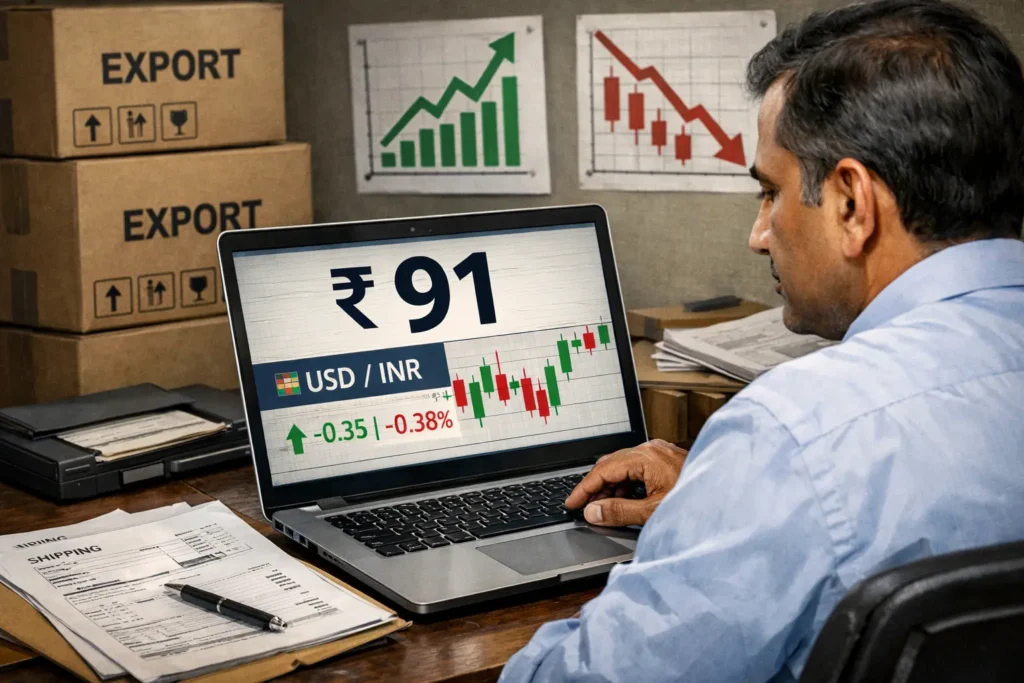
Why This Record Fall Matters for Indian Businesses & Consumers
The dollar rupee exchange rate touching ₹91 has grabbed national attention. Headlines call it a “record low,” social media debates are heated, and many people are asking one simple question:
Is a falling rupee good or bad for India?
The answer isn’t black and white.
For some businesses, especially exporters, a weak rupee can look like an opportunity. For others—importers, MSMEs, and consumers—it can quietly increase costs and risks. Understanding the real impact of the dollar rupee movement is essential, especially for small businesses and entrepreneurs.
you may also like to read: eRupee: The Game-Changing RBI Digital Currency That Could Transform How MSMEs Do Business
Dollar Rupee Exchange Rate at ₹91: What’s Happening?
The dollar rupee exchange rate reflects how many rupees are needed to buy one US dollar. When the rupee falls, it means:
- The US dollar is strengthening
- The Indian rupee is weakening
- Imports become more expensive
- Export earnings convert into higher rupee value
At ₹91 per dollar, the rupee is at one of its weakest levels in history, driven by global and domestic factors working together.
Why Is the Dollar Rupee Falling?
Several forces influence the rupee vs dollar movement:
1️⃣ Strong US Dollar Globally
Higher US interest rates and global uncertainty push investors toward the dollar as a safe haven.
2️⃣ India’s Trade Deficit
India imports more than it exports—especially crude oil, electronics, and machinery—creating continuous demand for dollars.
3️⃣ Foreign Investment Outflows
When foreign investors pull money from Indian markets, they convert rupees to dollars, putting pressure on the rupee.
4️⃣ Global Uncertainty
Geopolitical tensions, slowing global growth, and volatile commodity prices add to currency instability.
My Personal Experience as an Exporter Tracking Dollar Rupee Daily
This topic is not theoretical for me—it’s deeply personal.
When I was actively exporting, tracking the dollar rupee exchange rate became part of my daily routine. Every morning, before even checking emails, I would check the USD-INR rate.
Why?
Because my export payments were in US dollars.
Whenever the dollar strengthened against the rupee, I felt relieved—even happy. The same shipment, the same invoice amount in USD, suddenly converted into more rupees. On paper, my profits looked better without doing anything extra.
There were days when I genuinely hoped:
“If the dollar moves up a little more, I’ll earn more on this shipment.”
That’s the exporter’s psychology—and it’s very real.
But over time, I learned something important:
👉 A weak rupee helps exporters only in the short term.
👉 Long-term instability hurts everyone—including exporters.
Rising input costs, freight charges, packaging material prices, and fuel expenses eventually eat into those “extra” rupees.
Impact of Dollar Rupee at ₹91 on Indian Businesses
✅ 1. Exporters: Short-Term Gain, Long-Term Risk
Pros:
- Higher rupee realization for USD invoices
- Temporary margin improvement
- Better price competitiveness in global markets
Cons:
- Rising raw material and logistics costs
- Currency volatility makes pricing difficult
- Overseas buyers may renegotiate prices later
📌 Lesson from experience:
Exporters should not rely on rupee depreciation as a profit strategy. Strong businesses win on quality, reliability, and efficiency, not currency weakness.
⚠️ 2. Importers & MSMEs: Immediate Pressure
For MSMEs dependent on imports:
- Raw materials become costlier
- Machinery and spare parts prices rise
- Working capital requirements increase
Many small businesses cannot immediately pass higher costs to customers, leading to margin pressure.
🏭 3. Manufacturing & Supply Chains
Sectors affected:
- Electronics
- Pharmaceuticals (imported APIs)
- Auto components
- Packaging and chemicals
Even businesses that don’t import directly feel the impact through higher supplier prices.
How Dollar Rupee Weakness Affects Consumers
A falling rupee doesn’t hit consumers instantly—but it does hit steadily.
🔺 Higher Prices Over Time
- Fuel prices
- Cooking oil
- Imported food items
- Electronics and gadgets
- Travel and foreign education
This eventually fuels inflation, reducing purchasing power.
Is a Weak Rupee Always Bad for the Economy?
Not necessarily.
A controlled, gradual depreciation can:
- Support exports
- Improve trade competitiveness
- Help manage external balances
But sharp or uncontrolled falls—like sudden moves toward ₹91—create uncertainty.
Businesses don’t fear a weak rupee as much as they fear an unpredictable rupee.
What Can Businesses Do to Manage Dollar Rupee Risk?
✅ Practical Steps for MSMEs & Exporters
- Avoid currency speculation
Never base profits purely on exchange rate movements. - Use conservative pricing
Assume volatility when quoting international prices. - Build buffers
Keep margins that can absorb exchange rate shocks. - Track trends, not daily noise
Daily fluctuations cause emotional decisions. - Think long term
Sustainable business beats short-term currency gains.
Role of RBI in Stabilising the Dollar Rupee
The Reserve Bank of India (RBI) regularly intervenes to prevent extreme volatility by:
- Selling dollars from forex reserves
- Managing liquidity
- Sending confidence signals to markets
The goal is stability, not defending a specific number.
What Lies Ahead for the Dollar Rupee?
Predicting exact levels is impossible. What matters more is:
- Global interest rate direction
- India’s export performance
- Inflation control
- Capital flows
For businesses, the right approach is preparation, not prediction.
Final Thoughts: Lessons from the Ground Reality
As someone who has lived through export cycles, currency swings, and profit illusions, my biggest takeaway is this:
A weak rupee may feel good today—but a stable rupee builds stronger businesses tomorrow.
If you are an exporter, importer, MSME owner, or aspiring entrepreneur, understanding the dollar rupee exchange rate is no longer optional. It directly impacts pricing, profitability, and survival.
Frequently Asked Questions (FAQ)
Q1. Is dollar rupee at ₹91 good for exporters?
Short term, yes. Long term, volatility increases costs and uncertainty.
Q2. Does a weak rupee increase inflation?
Yes. Higher import costs eventually push consumer prices up.
Q3. Should small businesses worry about rupee depreciation?
Yes—especially if they depend on imported inputs or thin margins.
Q4. Can RBI stop the rupee from falling?
RBI can reduce volatility, not control global forces.
📚 Authentic Sources & References
The analysis and explanations in this article are supported by publicly available data and expert commentary from trusted financial and economic institutions. Readers are encouraged to explore these sources for deeper understanding:
- Reserve Bank of India (RBI) – Exchange Rate Data & Policy Insights
👉 https://www.rbi.org.in
(Authoritative source for INR-USD data, forex reserves, and monetary policy) - Reuters – India Rupee & Global Currency Coverage
👉 https://www.reuters.com/markets/currencies
(Independent global reporting on rupee movements, capital flows, and RBI actions) - Ministry of Commerce & Industry, Government of India
👉 https://commerce.gov.in
(Official data on exports, imports, and trade balance)
Disclaimer
This article is for educational and informational purposes only. It does not constitute financial or investment advice. Businesses should consult professionals before making currency-related decisions
✍️ About the Author
Tabrez is an entrepreneur, exporter, and founder of BusinessZindagi.com. With hands-on experience in export business and real-time tracking of the dollar rupee exchange rate during shipments, he writes from ground reality—not theory.