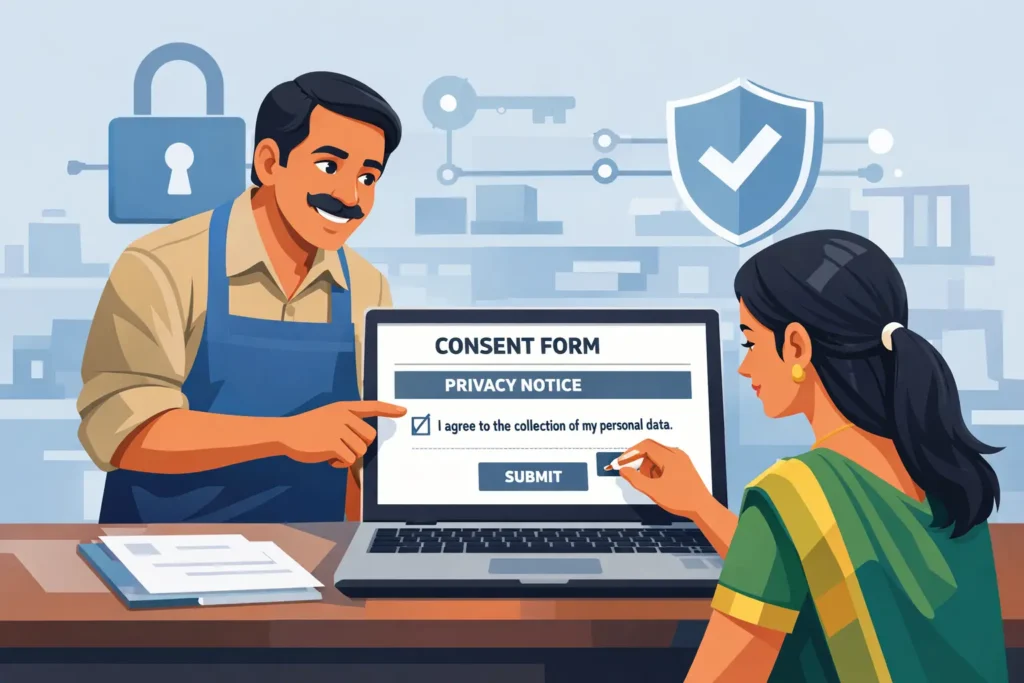
For most Indian MSMEs, customer data is not just information — it is the backbone of sales, repeat business, and growth.
From WhatsApp enquiries and website leads to billing details and loyalty programs, every business today collects some form of personal data.
But with the DPDP Act (Digital Personal Data Protection Act) now shaping India’s data privacy framework, the way MSMEs collect, store, and use customer data must change — not out of fear of penalties, but to build trust, credibility, and long-term brand value.
This guide explains, in simple business language, how MSMEs can collect customer data legally, ethically, and confidently under the DPDP Act.
related post: DPDP Rules 2025 — A Must-Know for MSMEs & Startups (With Insider Alert from Tally MD)
🧩 Understanding Personal Data Under the DPDP Act
Before collecting any information, MSMEs must understand what counts as personal data under the DPDP Act.
Personal data includes any information that can identify a person, such as:
- Name, phone number, email
- Address or location
- Transaction records
- Online identifiers and behaviour
- Customer purchase or enquiry history
Even data collected on paper becomes covered under the DPDP Act once it is digitised.
👉 Good practice for MSMEs
Start by listing:
- What customer data you collect
- Why you collect it
- Where it is stored
- Who has access to it
This simple data-mapping step prevents future compliance issues.
you may also like to read: DPDP Act vs DPDP Rules Difference — A Practical Guide for MSMEs & Startups
✅ DPDP Act Compliance Starts With Lawful & Informed Consent
For most MSMEs, the primary legal basis for collecting customer data under the DPDP Act is consent.
However, consent must be:
- Free and voluntary
- Clear and informed
- Specific to the purpose
- Given through a clear action (e.g., ticking a box)
Pre-ticked boxes or hidden consent in fine print do not qualify.
✔️ What MSMEs Should Mention While Taking Consent
When collecting data, tell customers:
- What data you are collecting
- Why you need it
- How long you will store it
- Whether it will be shared with any third-party service
- How they can withdraw consent later
When customers understand the purpose, they are more willing to share data — and more likely to trust your business.
📝 Use a Simple, Transparent Privacy Notice (DPDP Act Requirement)
Under the DPDP Act, MSMEs must provide customers with a clear privacy notice before collecting data.
Your privacy notice should include:
- Purpose of data collection
- Type of data collected
- Rights of the customer
- Consent withdrawal process
- Grievance contact details
Write it in simple, friendly language — not legal jargon.
A customer should be able to understand it at a glance.
How MSMEs Should Collect Consent in Day-to-Day Business
Whether you collect leads via:
- Website forms
- WhatsApp enquiries
- Store registrations
- CRM or Google Sheets
- Loyalty programs
Make sure:
- The consent checkbox is not pre-selected
- A link to your privacy policy is provided
- Consent records are stored (who, when, why)
Under the DPDP Act, businesses must be able to prove that consent was taken — if ever questioned.
This is especially important for:
- Email marketing
- SMS campaigns
- Promotional messages
Consent is not just a rule — it is a relationship of trust.
DPDP Act Rules for Children’s and Sensitive Personal Data
If your business deals with:
- Students
- Under-18 users
- Learning platforms
- Gaming or hobby communities
You must take verifiable parental or guardian consent under the DPDP Act.
Where children’s data is involved:
- Avoid unnecessary data collection
- Clearly explain the purpose
- Maintain records of guardian approval
Children’s data carries higher compliance responsibility — handle it carefully.
🔄 Consent Withdrawal — A Right Customers Hold Under the DPDP Act
The DPDP Act gives customers the right to:
- Withdraw consent
- Request deletion of their data
- Update or correct information
MSMEs should provide:
- An easy unsubscribe option
- A quick grievance response channel
- A simple request process for deletion or correction
This shows professionalism and strengthens credibility.
📉 Follow the DPDP Act Principle of Data Minimisation
A key idea under the DPDP Act is:
👉 Collect only what you really need
Examples:
- If you only need an email for a newsletter, don’t ask for full address
- If it’s a product enquiry, phone number alone may be sufficient
- Avoid collecting sensitive data unless necessary
Less data =
- Lower risk
- Lower compliance burden
- Higher customer confidence
Store Customer Data Securely — Collection Alone Is Not Enough
Collecting data legally is only step one.
Under the DPDP Act, MSMEs must also ensure:
- Secure storage systems
- Access restricted only to required staff
- Regular backups
- Safe deletion of unnecessary data
Simple steps like:
- Strong passwords
- Limited admin access
- Avoiding open spreadsheets
- Avoiding personal device storage
…go a long way in preventing accidental data leaks.
Data protection isn’t just legal compliance — it reflects business ethics.
Sharing Customer Data? Use Vendor Agreements Under the DPDP Act
If your MSME shares customer data with:
- CRM software
- Email marketing tools
- Cloud platforms
- Payment gateways
- Logistics or service partners
Enter into a data processing agreement.
It ensures:
- Vendors also follow privacy rules
- Your business is protected from liability
- Customer data isn’t misused
Trustworthy partners enhance your compliance posture.
DPDP Act Compliance Is Not a Burden — It’s a Business Advantage
Many MSMEs initially fear the DPDP Act as a legal obligation.
But in reality, it helps you:
- Build stronger customer trust
- Look professional to clients and partners
- Attract enterprise-level buyers
- Improve brand credibility
- Stand apart in a competitive market
Businesses that respect privacy are viewed as:
👉 More ethical, more mature, and more dependable
And that is priceless in today’s digital economy.
DPDP Act Compliance Checklist for MSMEs (Quick Reference)
Use this simple checklist while collecting customer data:
- ☐ Identify what data you collect
- ☐ Collect data only for a valid purpose
- ☐ Take informed, explicit consent
- ☐ Provide a clear privacy notice
- ☐ Record and store consent logs
- ☐ Allow easy consent withdrawal
- ☐ Secure stored data
- ☐ Delete unnecessary data
- ☐ Use agreements when sharing data
Compliance isn’t a one-time task — it’s a business habit.
About the Author
Tabrez is a first-generation entrepreneur, tea trader, exporter, and business writer .Through BusinessZindagi.com, he shares practical business insights, export knowledge, compliance updates, and ground-level perspectives from real Indian entrepreneurs.
📚 Authentic Sources & Reference Links
(Useful for verification, learning & compliance awareness)
- MeitY — Digital Personal Data Protection Act Official Text
https://www.meity.gov.in/ - Press Information Bureau — Highlights of DPDP Act
https://pib.gov.in/ - CERT-In & National Cyber Security Guidelines
https://www.cert-in.org.in/ - RBI & Data Protection Guidance Notes (Relevant to fintech & financial entities)
https://www.rbi.org.in/ - EY India — DPDP Act Analysis & Implications
https://www.ey.com/en_in - NASSCOM — Data Protection Framework Insights
https://www.nasscom.in/
Disclaimer
This article is written for general awareness and educational purposes only. The Digital Personal Data Protection (DPDP) Act and its rules may evolve over time, and practical compliance requirements can differ based on the nature, size, and operations of each business.
This content should not be treated as legal or professional advice. MSMEs, startups, and business owners are encouraged to consult a qualified legal or data privacy professional before implementing any compliance measures or policy decisions related to the DPDP Act.
BusinessZindagi.com and the author shall not be held responsible for any decisions, actions, or outcomes arising from the use of the information provided in this article.