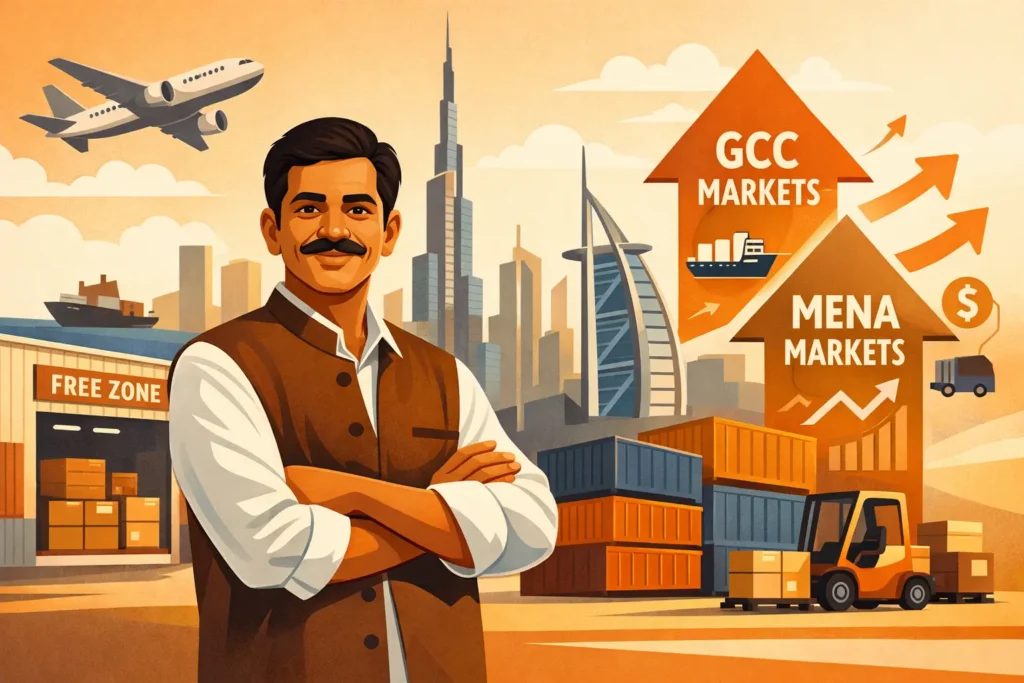
For thousands of growing Indian manufacturers and exporters, setting up a Dubai Freezone Company has become one of the smartest ways to enter GCC, MENA and African markets.
Instead of investing heavily in warehouses and inventory from Day 1, many MSMEs are adopting a lean expansion model:
- Register a Dubai freezone company
- Use it initially as a marketing & representative office
- Export goods directly from India
- Gradually scale into a regional distribution & re-export hub
This approach reduces cost, builds buyer trust, and allows scalable market expansion.
In this guide, you’ll learn:
- Why a Dubai Freezone Company is ideal for Indian MSMEs
- When to upgrade to a General Trading License
- Costs, compliance & documentation
- Practical growth roadmap you can follow
you may also like to read: Why Smart Food Exporters Never Miss Gulf Food Dubai
Why Setting Up a Dubai Freezone Company Makes Business Sense
Dubai is seen globally as a trusted trade and logistics hub. For international buyers, a Dubai business address signals:
- Reliability
- Faster coordination
- Professional presence
- Long-term commitment
For MSMEs, a Dubai Freezone Company offers:
- 100% foreign ownership
- Lower setup costs than mainland
- Simple documentation & process
- Duty-free re-export benefits (in many zones)
- Upgrade flexibility when business grows
And most importantly —
You can start as a lean marketing office and later expand into a full trading & distribution hub.
Dubai Freezone Company — Three-Phase Growth Model for MSMEs
Phase 1 — Marketing & Representative Office Model
In this stage, your Dubai freezone company is used mainly for:
- Business development
- Buyer meetings
- Market outreach
- Customer communication
- Trade exhibitions & networking
Shipments continue as:
India → Directly to the buyer country (Saudi, Oman, Qatar, Africa, etc.)
Your Dubai entity typically earns:
- Marketing fee
- Business development commission
- Consultancy or facilitation income
This phase keeps costs low while building your regional presence.
Phase 2 — Hybrid Model (Partial Stock + Direct Export)
Once demand stabilizes:
- Fast-moving products are stocked in Dubai
- Bulk orders still ship directly from India
This gives you:
- Faster delivery for key buyers
- UAE-issued invoices where preferred
- Better consolidation of small shipments
Many MSMEs upgrade their Dubai Freezone Company to a General Trading License company at this stage, when:
- Multiple products are handled
- Inventory begins moving via Dubai
- Re-exports become frequent
Phase 3 — Full Regional Distribution & Re-Export Hub
In this phase:
- Goods are imported to your Dubai freezone warehouse
- Stock is maintained for multiple buyers
- Re-exports are done to GCC, MENA & Africa
- UAE market sales may also begin (depending on structure)
Here, a General Trading License becomes essential if:
- You trade multiple unrelated product categories
- You handle wholesale & re-export operations
- You maintain a physical stock base in Dubai
This transforms your Dubai entity into a:
- Regional logistics base
- Brand gateway
- Export growth engine
Key Advantages of a Dubai Freezone Company for Indian MSMEs
✔ Stronger buyer trust & credibility
A Dubai presence enhances brand perception globally.
✔ Gateway to GCC, MENA & African markets
Strategic logistics & regional access.
✔ Flexible business growth structure
Start lean → scale smart → expand gradually.
✔ Tax-efficient re-exports in many freezones
Ideal for multi-country distribution.
✔ Lower operational cost vs mainland setup
Perfect for export-oriented MSMEs.
Step-by-Step Guide — How to Set Up a Dubai Freezone Company
Step 1 — Finalize Your Business Model
Choose among:
1️⃣ Marketing office only
2️⃣ Hybrid logistics + direct export
3️⃣ Full trading & distribution hub
The structure can be upgraded over time.
Step 2 — Complete ODI Compliance in India (FEMA / RBI)
Since your Indian MSME will invest abroad, you must follow:
- Overseas Direct Investment (ODI) rules under FEMA
Compliance is normally done through your Authorised Dealer (AD) Bank.
Documents generally include:
- Board resolution
- ODI forms & declarations
- Capital investment details
- Shareholding structure
Always consult an experienced CA / FEMA consultant.
Step 3 — Select the Right Dubai Freezone
Factors to evaluate:
- License cost & renewal fees
- Visa quota
- Warehouse availability
- Bank account acceptance
- Import-export facilities
Popular freezones used by MSMEs include:
- IFZA
- RAKEZ
- DMCC
- JAFZA
- UAQ FTZ
- SAIF Zone
- SHAMS
The best freezone depends on:
- Product type
- Budget
- Expansion plan
Step 4 — Choose the Correct Business Activity
Common structures:
- Dubai Freezone Company — Marketing / Consultancy
- Dubai Freezone Company — Commercial Trading
- Dubai Freezone Company — General Trading License
If you are starting lean:
👉 begin with a service / consultancy license
Later, when you begin stocking or re-exporting:
👉 upgrade to a General Trading License
Step 5 — Company Incorporation & Licensing
Typical documents:
- Passport & photographs
- Indian company KYC
- Shareholder / ownership details
- Proposed activity description
Once approved, you receive:
- Trade License
- Incorporation Certificate
- Memorandum of Association
Step 6 — UAE Bank Account Opening
Banks normally review:
- Business profile
- Trade transactions
- Suppliers & buyers
- Nature of revenue
Strong documentation improves approval success.
Step 7 — Customs Registration (If Importing Stock)
If your Dubai Freezone Company will:
- Import goods
- Maintain warehouse stock
- Re-export shipments
You must obtain:
- Customs Client Code
- Freezone / port access registration
This step is usually needed when you begin operating under a General Trading License.
Estimated Cost — Dubai Freezone Company (Lean MSME Setup)
Costs vary by freezone, package & visa requirements.
| Expense Component | Approx Range |
|---|---|
| License + Registration | AED 10,000 – 30,000 / year |
| Visa (optional) | AED 3,800 – 4,800 per visa |
| Flexi-desk / small office | AED 8,000 – 20,000 |
| Bank min. balance | AED 25,000 – 100,000 (varies) |
A lean startup-stage setup generally ranges:
👉 AED 15,000 – 40,000 in Year 1
Warehouse or distribution expansion can be added later
FAQ❓
Do I need a General Trading License from the beginning?
No.
You can start as:
- Marketing / consultancy company in a freezone
Upgrade to a General Trading License when:
- You begin stocking goods
- You trade multiple product categories
- You operate a re-export hub
❓ Can my Dubai Freezone Company be owned by my Indian MSME?
Yes — through ODI under FEMA / RBI via your AD Bank.
❓ Is a freezone better than mainland for MSMEs?
For export-focused businesses:
👉 Dubai freezone company is more cost-efficient
Choose mainland only if:
- Primary business is inside UAE
- Retail or tender participation is required
❓ Can I export directly from India while using Dubai only for marketing?
Yes — this is the most efficient way to start.
Authentic Sources & Reference Links
UAE Authorities & Trade Resources
- Dubai Customs — https://www.dubaicustoms.gov.ae
- Dubai Trade Portal — https://www.dubaitrade.ae
- JAFZA Free Zone — https://www.jafza.ae
- DMCC Free Zone — https://www.dmcc.ae
- RAKEZ — https://rakez.com
India FEMA / ODI Guidelines
- RBI ODI Overview — https://rbi.org.in
- FEMA Master Directions — https://m.rbi.org.in/Scripts/NotificationUser.aspx
(Refer to licensed professionals before execution.)
👤 About the Author
Tabrez — entrepreneur,exporter and Writer
Covers Indian MSME growth, export expansion, trade policy insights, and practical business strategies for small manufacturers and entrepreneurs.
⚠️ Disclaimer
This article is for educational and informational purposes only.
Business laws, trade rules, and licensing conditions vary by activity and jurisdiction.
Readers should consult:
- A certified UAE business setup advisor
- A qualified CA / FEMA & ODI consultant in India
Some research inputs were compiled with assistance from AI tools including ChatGPT, along with government and public sources.