If you want to grow your export business, you cannot survive on advance payments forever.
Sooner or later, your foreign buyers will ask for 30, 60 or even 90 days credit — and if you say no, they will simply buy from another buyer or another country.
That is the reality of global trade today. Credit is not a privilege… it is a requirement.
And for MSMEs, that creates the biggest export bottleneck of all:
“How do I give credit when I don’t have the cash to wait 90 days?”
That’s exactly why export factoring has become one of the most talked-about tools in MSME finance — immediate cash against export invoices, no collateral, no loan, and no waiting for buyers to pay.
Sounds perfect, right?
Well… yes and no.
You may also like to read? How Factoring Helps MSMEs Grow Without Loans | Cash Flow Fix
Export Factoring: What It Really Does (in 60 seconds)
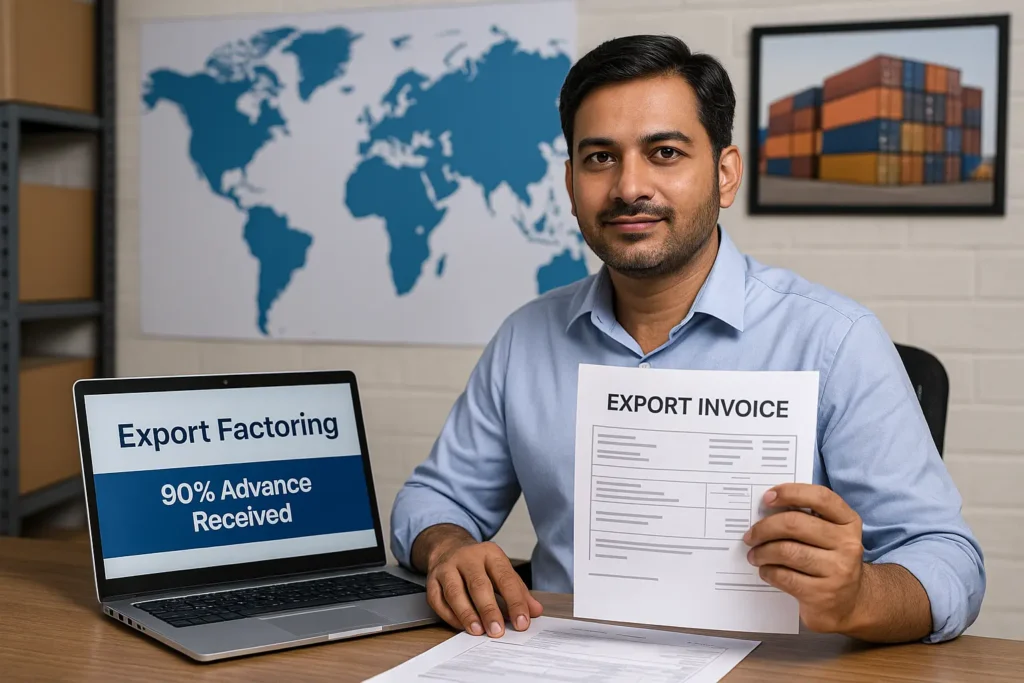
Export factoring allows an exporter to convert invoices into instant working capital instead of waiting months for the overseas buyer to pay.
✅ You ship the goods
✅ Raise the invoice
✅ Submit it to a factoring company
✅ Get 80–90% cash upfront within a few days
✅ The factor collects payment directly from the buyer
✅ You get the balance later (minus fee)
👉 No property mortgage
👉 No bank loan on your balance sheet
👉 Buyer default risk covered (in non-recourse factoring)
It’s not borrowing money. It’s getting your own money early.
Why Export Factoring Is a Game-Changer for MSMEs
| Benefit | Why It Matters |
|---|---|
| Instant cash flow | No working capital freeze after shipment |
| Offers global credit terms | You can compete with China, Vietnam, Turkey |
| No collateral | Your invoice is the only security |
| Factor handles collection | Saves time, stress, and follow-ups |
| Buyer risk protection | Even if buyer doesn’t pay, you’re covered (non-recourse) |
Export factoring can literally turn a 40-day cash crisis into a 4-day cash cycle.
But Here’s the Part Nobody Mentions: It’s Not Easily Accessible for New Exporters
Export factoring is promoted as MSME-friendly, but in reality:
🔸 Many factors ask for minimum turnover
🔸 Some require minimum number of shipments
🔸 Most approve based on buyer limit + exporter track record
🔸 First-time exporters are often rejected, even with genuine buyers
🔍 My own experience proves this.
I approached to a reputable factor to extend 60-day credit to a genuine overseas buyer.
Everything was perfect — until they asked:
“What is your annual export turnover?”
“How many completed shipments in the last year?”
As a first-generation exporter still building volume, I couldn’t qualify.
Result?
❌ Finance denied
❌ Buyer lost
❌ Export order gone
That’s when I understood:
Export factoring works brilliantly — but only once you cross the entry barrier.
Real-World Eligibility Comparison: Who Actually Qualifies?
| Provider | Advance % | Recourse? | Typical Eligibility Requirement |
|---|---|---|---|
| SBI Global Factors | 80–90% | Both | Case-to-case, track record preferred |
| India Factoring (FIMBank Group) | Up to 90% | Non-recourse possible | Buyer credit + exporter history |
| Canbank Factors | 80–90% | Recourse only | Lower barrier than fintechs |
| EXIM Bank Export Factoring | 80–90% | Both | Generally for established exporters |
| Drip Capital (Fintech) | Up to 80% | Recourse | Minimum export turnover + shipment history |
| TReDS (RXIL, M1xchange, Invoicemart) | Market-based | N/A | MSME + 1 year business existence |
✅ Good news: The more established you are, the easier it gets
❌ Bad news: The exporters who need it the most often can’t access it yet
So What Can First-Time Exporters Do?
✅ Start with recourse factoring (easier entry)
✅ Build 2–3 shipments, then reapply for non-recourse
✅ Ask the factor to approve your buyer limit first
✅ Use TReDS domestically to build working capital history
✅ Use ECGC cap or short-term buyer insurance till you qualify
✅ Negotiate 30-day credit first → extend to 60-day later
✅ Keep documents clean: invoice, BL, packing list, SWIFT proof, etc.
What India Still Needs to Fix
If the government wants MSMEs to export more, it must make first-shipment export factoring possible, not just post-success factoring.
🔹 Lower entry thresholds for MSMEs
🔹 Mandatory buyer invoice confirmation norms
🔹 Partial risk-sharing by ECGC / EXIM
🔹 Factoring integrated into GST + ICEGATE + Udyam
🔹 Regional-language onboarding & awareness
Finance should not be a reward for growth. It should be a tool to create growth.
Final Thoughts
Export factoring is not just a financing product — it is a business enabler.
It lets Indian MSMEs compete globally without taking loans, without pledging assets, and without waiting for buyers to remember their due dates.
But we must also accept the truth:
Export factoring in India is still not fully designed for new exporters — yet.
The product is right. The access is the problem.
Once India solves that gap, we won’t just export more goods — we’ll export more MSME success stories.
🔗 References
- SBI Global Factors – Export Factoring
- India Factoring – Buyer-based Finance Model
- Drip Capital – Export Invoice Finance Eligibility
- EXIM Bank – Export Factoring Facility
- TReDS Platform – RXIL
- TReDS Platform – M1xchange
- TReDS Platform – Invoicemart
✍️ About the Author
Tabrez writes about MSME finance, exports, and working-capital tools at BusinessZindagi.com, sharing real stories and practical insights for Indian entrepreneurs who are building global businesses from small factories and big dreams.