
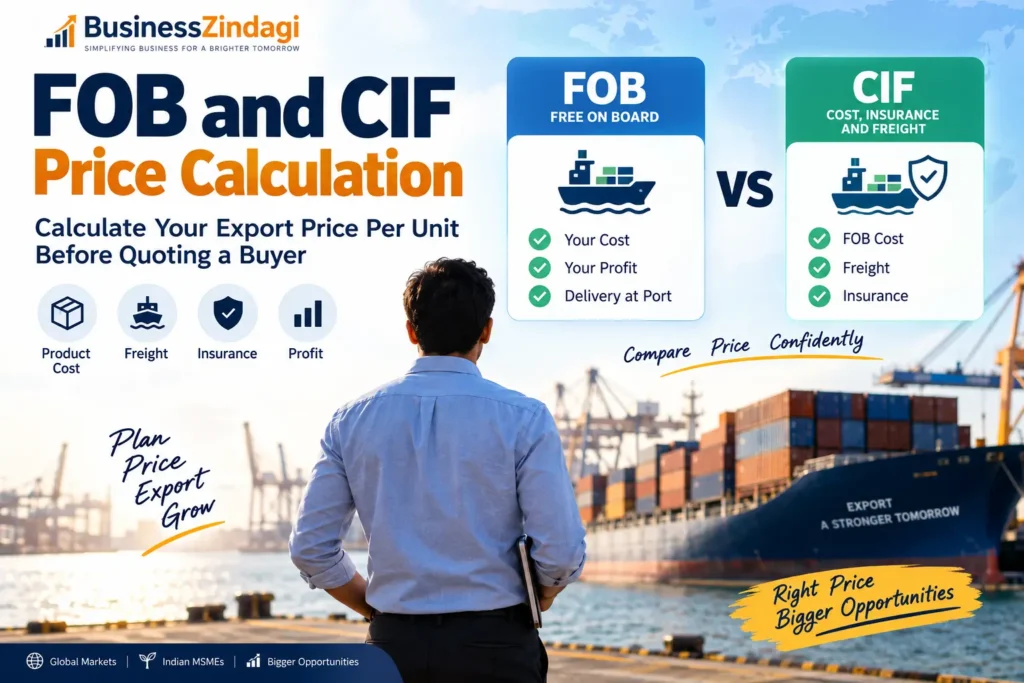
If you export from India or from anywhere in the world , one of the most practical questions you may face before sending a quotation to an overseas buyer is:
“What should I quote — FOB or CIF?”
The answer requires more than simply adding your product cost and profit.
Your export price may include packaging, inland transportation, loading, customs clearance, documentation, port charges, freight, insurance and your desired profit margin.
This is why getting your FOB and CIF price calculation right is important before you send an export quotation.
To make this easier, BusinessZindagi has created a practical FOB vs CIF Calculator that helps you calculate your FOB cost, FOB selling price, CIF price and, most importantly, compare the FOB and CIF price per unit.
Want to know exactly what you should quote your overseas buyer?
Enter your actual export costs below and use the calculator to compare your FOB Quote/Unit and CIF Quote/Unit before sending your quotation.
FOB and CIF Price Calculation Calculator
FOB vs CIF Price Calculator
Build your FOB price, add freight and insurance, and see your CIF quote in seconds.
Enter your export costs
Fill the FOB and CIF inputs, then calculate. The results panel will show the price difference, freight/insurance share and unit economics.
Use the table below to see which party typically handles major cost and logistics activities under FOB and CIF.
Answer these practical questions. The tool will show the factors behind its result — you remain in control of the final Incoterm choice.
Your export price
Buyer vs Seller Responsibilities
| Activity | FOB | CIF |
|---|---|---|
| Product | Seller | Seller |
| Packing | Seller | Seller |
| Transport to port | Seller | Seller |
| Export customs | Seller | Seller |
| Loading on vessel | Seller | Seller |
| Main freight | Buyer | Seller |
| Insurance (main carriage) | Buyer | Seller |
| Import customs | Buyer | Buyer |
| Destination delivery | Buyer | Buyer |
Risk under both FOB and CIF typically transfers when goods are on board at the origin port. Always confirm the Incoterms year and named place in the contract.
FOB Cost Breakdown
FOB vs CIF Price
💡 Smart Insights
🔮 What-If Analysis
What is FOB?
Free On Board — seller delivers goods on board at the named port of shipment. Buyer arranges and pays main carriage and insurance.
What is CIF?
Cost, Insurance and Freight — seller pays cost, minimum insurance and freight to the named destination port. Risk still transfers on loading at origin.
When to Choose FOB
Buyer has better freight rates, seller wants less logistics responsibility, or buyer insists on controlling the carrier.
When to Choose CIF
Buyer wants a simpler all-in price to destination port, or seller has competitive freight rates.
Frequently Asked Questions
What does FOB mean?
Free On Board — seller delivery point is on board the vessel at the origin port.
What does CIF mean?
Cost, Insurance and Freight to the named destination port, paid by the seller.
Does CIF mean seller bears risk until destination?
No. Risk typically transfers on loading at origin.
How is FOB price built?
Product + packing + inland + export clearance + loading + desired profit.
How is CIF price built?
FOB price + main freight + insurance.
Who pays freight under FOB?
The buyer.
Who pays freight under CIF?
The seller (included in CIF price).
Which is better for exporters?
Depends on freight competitiveness and buyer preference.
Can I quote both FOB and CIF?
Yes — many exporters offer both options.
Is CIF insurance full cover?
Standard CIF is minimum cover; buyer may buy more.
Do Incoterms replace the contract?
No — they allocate cost and risk points.
FOB for air freight?
FOB is for sea/inland waterway; FCA is often better for air.
Why name the port?
The named place defines where cost and risk obligations apply.
How does freight volatility affect CIF?
Seller absorbs moves unless the contract allows adjustment.
Common mistake?
Calling a price CIF without including proper freight and insurance.
Who handles export documents?
Generally the seller under both FOB and CIF.
LC and Incoterms?
Letter of credit documents must match the chosen term.
Can students use this tool?
Yes — it maps cost heads and responsibility differences clearly.
Does CIF include import duty?
No — import clearance and duties remain with the buyer.
Should margin sit in FOB or CIF?
Build profit into FOB first, then add freight and insurance for CIF.
Disclaimer: This calculator provides estimated FOB and CIF prices for educational and business planning purposes only. Actual prices depend on commercial negotiations, freight rates, insurance premiums, exchange rates, Incoterms and contractual terms.
The calculator is designed to help exporters perform a practical FOB and CIF price calculation using their own shipment costs instead of relying only on generic examples.
What Is FOB?
FOB means Free On Board.
Under the ICC Incoterms® 2020 rules, FOB means the seller delivers the goods on board the vessel nominated by the buyer at the named port of shipment. Risk of loss or damage transfers when the goods are on board the vessel.
In a simplified export-pricing calculation, your FOB price can include:
Product Cost
- Packaging
- Labelling
- Inland Transportation
- Loading Charges
- Customs/CHA Charges
- Port Charges
- Documentation and other applicable export costs
- Your Profit
= FOB Selling Price
The buyer generally arranges the main carriage after the goods are delivered on board.
Important: FOB is not simply your product cost
Suppose you manufacture or purchase a product for ₹500 per unit.
That does not automatically mean your FOB price is ₹500.
You may have additional costs before the goods are delivered on board.
For example:
- Product cost: ₹500
- Packaging: ₹15
- Inland transport: ₹12
- Documentation: ₹4
- Port/export-related charges: ₹20
- Other costs: ₹9
Your FOB cost is already higher than ₹500.
You then need to determine the selling price that provides your desired profit.
This is the first important part of your FOB and CIF price calculation.
What Is CIF?
CIF means Cost, Insurance and Freight.
Under Incoterms® 2020, CIF is a sea/inland-waterway rule under which the seller arranges and pays for freight to the named destination port and obtains cargo insurance meeting the rule’s requirements.
However, an important point is often misunderstood:
Risk under CIF transfers when the goods are delivered on board at the port of shipment, not when they arrive at the destination.
A simplified CIF price calculation is:
FOB Selling Price
- Freight
- Insurance
= CIF Price
Therefore, your CIF quotation can be based on your FOB selling price plus the applicable freight and insurance costs.
FOB vs CIF: What Is the Difference?
Understanding the difference is essential before performing an FOB and CIF price calculation.
| Item | FOB | CIF |
|---|---|---|
| Product | Seller | Seller |
| Packaging | Seller | Seller |
| Export clearance | Seller | Seller |
| Delivery/loading on board | Seller | Seller |
| Main freight | Buyer | Seller |
| Cargo insurance | Buyer generally arranges | Seller arranges minimum cover under CIF |
| Risk transfer | On board at origin | On board at origin |
| Import clearance | Buyer | Buyer |
| Import duties/taxes | Buyer | Buyer |
| Quoted price | FOB value | CIF value |
The exact allocation of costs depends on the transaction and agreed Incoterms® rule.
Also remember that FOB and CIF are sea and inland-waterway Incoterms® rules. For shipments involving other modes of transport, another rule such as FCA or CIP may be more appropriate depending on the transaction.
How to Calculate FOB Price
A practical FOB price calculation starts with the costs required to deliver the goods under the agreed FOB arrangement.
For example:
| Cost | Amount |
|---|---|
| Product/manufacturing cost | ₹5,00,000 |
| Packaging | ₹15,000 |
| Labelling | ₹5,000 |
| Local transportation | ₹12,000 |
| Loading | ₹8,000 |
| Customs broker | ₹10,000 |
| Port charges | ₹15,000 |
| Documentation | ₹4,000 |
| Other charges | ₹5,000 |
| Total FOB Cost | ₹5,74,000 |
Your actual costs will depend on your product, shipment, port, service providers and transaction.
Step 1: Calculate your FOB cost
In this example:
FOB Cost = ₹5,74,000
Step 2: Add your desired profit
Suppose you want a 15% profit margin on the selling price.
Be careful here.
A 15% profit margin is not the same as simply adding 15% to your cost.
If:
Cost = ₹5,74,000
and desired margin = 15%, then:
Selling Price = Cost ÷ (1 − Margin)
Therefore:
₹5,74,000 ÷ 0.85 = approximately ₹6,75,294
Your calculated FOB selling price would therefore be approximately:
₹6,75,294
This distinction between markup and margin is important when performing an export FOB and CIF price calculation.
How to Calculate CIF Price
Once you have calculated your FOB selling price, you can proceed with the CIF calculation.
For example:
FOB Selling Price: ₹6,75,294
Freight: ₹70,000
Insurance: ₹8,000
Therefore:
CIF Price = ₹6,75,294 + ₹70,000 + ₹8,000
CIF Price = ₹7,53,294
This is a simplified example. Your actual quotation may involve different costs and contractual arrangements.
FOB and CIF Price Calculation Per Unit
This is one of the most useful parts of export pricing.
Suppose your shipment contains:
1,000 units
and your calculated prices are:
FOB Total = ₹6,75,294
CIF Total = ₹7,53,294
Now calculate the price per unit.
FOB Price Per Unit
₹6,75,294 ÷ 1,000
= ₹675.29 per unit
CIF Price Per Unit
₹7,53,294 ÷ 1,000
= ₹753.29 per unit
So your quotation comparison becomes:
| FOB | CIF | |
|---|---|---|
| Total quotation | ₹6,75,294 | ₹7,53,294 |
| Quantity | 1,000 | 1,000 |
| Price per unit | ₹675.29 | ₹753.29 |
This is why calculating the FOB and CIF price per unit can be more useful than looking only at the total shipment value.
A buyer may be comparing suppliers based on:
- USD per piece
- USD per kg
- USD per carton
- USD per box
- USD per metric tonne
Your internal calculation should therefore allow you to understand the quotation at the same unit level.
Use the FOB and CIF Price Calculation Tool Before Sending Your Quotation
If you are preparing an export quotation, don’t calculate your costs manually every time.
Before you send your buyer a price, calculate both options.
Enter your product and export costs, calculate your FOB selling price, add freight and insurance, and compare the FOB and CIF quotation per unit.
FOB vs CIF Price Calculator
Build your FOB price, add freight and insurance, and see your CIF quote in seconds.
Enter your export costs
Fill the FOB and CIF inputs, then calculate. The results panel will show the price difference, freight/insurance share and unit economics.
Use the table below to see which party typically handles major cost and logistics activities under FOB and CIF.
Answer these practical questions. The tool will show the factors behind its result — you remain in control of the final Incoterm choice.
Your export price
Buyer vs Seller Responsibilities
| Activity | FOB | CIF |
|---|---|---|
| Product | Seller | Seller |
| Packing | Seller | Seller |
| Transport to port | Seller | Seller |
| Export customs | Seller | Seller |
| Loading on vessel | Seller | Seller |
| Main freight | Buyer | Seller |
| Insurance (main carriage) | Buyer | Seller |
| Import customs | Buyer | Buyer |
| Destination delivery | Buyer | Buyer |
Risk under both FOB and CIF typically transfers when goods are on board at the origin port. Always confirm the Incoterms year and named place in the contract.
FOB Cost Breakdown
FOB vs CIF Price
💡 Smart Insights
🔮 What-If Analysis
What is FOB?
Free On Board — seller delivers goods on board at the named port of shipment. Buyer arranges and pays main carriage and insurance.
What is CIF?
Cost, Insurance and Freight — seller pays cost, minimum insurance and freight to the named destination port. Risk still transfers on loading at origin.
When to Choose FOB
Buyer has better freight rates, seller wants less logistics responsibility, or buyer insists on controlling the carrier.
When to Choose CIF
Buyer wants a simpler all-in price to destination port, or seller has competitive freight rates.
Frequently Asked Questions
What does FOB mean?
Free On Board — seller delivery point is on board the vessel at the origin port.
What does CIF mean?
Cost, Insurance and Freight to the named destination port, paid by the seller.
Does CIF mean seller bears risk until destination?
No. Risk typically transfers on loading at origin.
How is FOB price built?
Product + packing + inland + export clearance + loading + desired profit.
How is CIF price built?
FOB price + main freight + insurance.
Who pays freight under FOB?
The buyer.
Who pays freight under CIF?
The seller (included in CIF price).
Which is better for exporters?
Depends on freight competitiveness and buyer preference.
Can I quote both FOB and CIF?
Yes — many exporters offer both options.
Is CIF insurance full cover?
Standard CIF is minimum cover; buyer may buy more.
Do Incoterms replace the contract?
No — they allocate cost and risk points.
FOB for air freight?
FOB is for sea/inland waterway; FCA is often better for air.
Why name the port?
The named place defines where cost and risk obligations apply.
How does freight volatility affect CIF?
Seller absorbs moves unless the contract allows adjustment.
Common mistake?
Calling a price CIF without including proper freight and insurance.
Who handles export documents?
Generally the seller under both FOB and CIF.
LC and Incoterms?
Letter of credit documents must match the chosen term.
Can students use this tool?
Yes — it maps cost heads and responsibility differences clearly.
Does CIF include import duty?
No — import clearance and duties remain with the buyer.
Should margin sit in FOB or CIF?
Build profit into FOB first, then add freight and insurance for CIF.
Disclaimer: This calculator provides estimated FOB and CIF prices for educational and business planning purposes only. Actual prices depend on commercial negotiations, freight rates, insurance premiums, exchange rates, Incoterms and contractual terms.
The BusinessZindagi calculator allows you to work with costs such as:
- Product cost
- Packaging
- Labelling
- Local transportation
- Loading charges
- Customs broker charges
- Port charges
- Documentation
- Other applicable charges
- Quantity
- Desired profit margin
- FOB selling price
- Freight
- Insurance
The result helps you understand both the total quotation and the price per unit.
FOB Cost vs FOB Price: Do Not Confuse Them
This is one of the most common mistakes when preparing an export quotation.
FOB Cost
FOB cost represents the costs you incur for delivering the goods under the applicable FOB arrangement.
For example:
FOB Cost = ₹5,74,000
FOB Price
FOB price is the price you quote to your buyer.
For example:
FOB Price = ₹6,75,294
Therefore:
FOB Cost ≠ FOB Selling Price
The difference represents your gross profit based on the assumptions included in your calculation.
This is why your FOB and CIF price calculation should distinguish between cost and selling price.
Why Your CIF Price Can Change Even When Your Product Cost Does Not
Suppose you export the same product every month.
Your product cost remains:
₹5,00,000
But freight changes from:
₹60,000 to ₹75,000
Your CIF quotation will change even though your product cost hasn’t changed.
Similarly, insurance costs, exchange rates and shipment-specific expenses can affect your final quotation.
Therefore, don’t automatically reuse an old CIF price for a new shipment.
Before preparing a new quotation, verify the freight and insurance assumptions being used.
FOB and CIF Price Calculation: What Happens to Risk?
This is an important part of understanding FOB and CIF.
Many people assume:
“Under CIF, the seller is responsible for the goods until they reach the destination port.”
That is not how the CIF Incoterms® 2020 rule works.
Under CIF, the seller pays for the contracted carriage and obtains insurance, but risk transfers when the goods are delivered on board the vessel at the port of shipment.
This is why exporters should understand the difference between:
Who pays for transportation
and
Who bears the risk at a particular point in the shipment.
They are not necessarily the same thing.
Is CIF Insurance Full Insurance?
Not necessarily.
Under CIF Incoterms® 2020, the seller is required to obtain cargo insurance with the minimum cover specified by the rule, unless the parties agree otherwise.
Therefore:
CIF does not automatically mean comprehensive insurance for every possible loss.
If your buyer requires broader insurance coverage, the requirement should be discussed and properly reflected in the sales contract.
Common FOB and CIF Price Calculation Mistakes
1. Using Product Cost as FOB Price
Your product cost is only one component.
Don’t forget the applicable export-related costs.
2. Confusing Markup With Margin
Adding 15% to your cost does not produce a 15% profit margin on the final selling price.
Know the difference before performing your FOB and CIF price calculation.
3. Forgetting Freight When Calculating CIF
A CIF quotation includes the seller’s freight obligation under the applicable rule.
4. Forgetting Insurance
Insurance is part of the seller’s obligation under CIF.
5. Confusing FOB Cost With FOB Price
Your cost and your selling price are two different numbers.
6. Looking Only at Total Shipment Value
Always check the price per unit.
Your buyer may want:
USD/kg
rather than:
USD 20,000 total
7. Assuming CIF Means Risk Stays With the Seller Until Destination
Under CIF, risk transfers when the goods are delivered on board at the port of shipment.
8. Using FOB for Every Shipment
FOB is intended for sea and inland-waterway transport. Depending on the shipment structure, another Incoterms® rule may be more appropriate.
Should You Give Your Buyer Both FOB and CIF Prices?
You can offer both when commercially appropriate.
For example:
FOB Mumbai: USD 8.25 per unit
CIF Dubai: USD 9.18 per unit
This gives the buyer two different purchasing arrangements to consider.
However, your quotation should clearly specify the applicable Incoterms® rule and named place.
Don’t simply write:
FOB – $8.25
or
CIF – $9.18
without properly identifying the agreed delivery term and place.
What Should Be Included in an Export Quotation?
A professional export quotation may include:
- Product description
- Product specification
- Quantity
- Unit price
- Total value
- Currency
- Incoterms® rule and named place
- Packaging details
- Delivery/lead time
- Payment terms
- Quotation validity
- Country of origin where relevant
- Shipping information
- Applicable documents/certifications
- Exclusions and assumptions where necessary
The exact requirements depend on your product, destination, buyer and contract.
FOB and CIF Price Calculation Example for an Indian Exporter
Let’s take a simple example.
Suppose an Indian exporter is preparing an export quotation for 1,000 units.
Export Costs
Product cost: ₹5,00,000
Packaging: ₹15,000
Labelling: ₹5,000
Local transportation: ₹12,000
Loading: ₹8,000
Customs broker: ₹10,000
Port charges: ₹15,000
Documentation: ₹4,000
Other charges: ₹5,000
FOB Cost
₹5,74,000
Assume the exporter wants a 15% margin.
FOB Selling Price
Approximately:
₹6,75,294
Now assume:
Freight = ₹70,000
Insurance = ₹8,000
CIF Price
Approximately:
₹7,53,294
For 1,000 units:
FOB = ₹675.29/unit
CIF = ₹753.29/unit
This gives the exporter a clear side-by-side comparison before preparing the quotation.
Important: This is an illustrative example. Actual export costs and responsibilities can vary depending on the transaction and agreed Incoterms® rule.
What Does the FOB and CIF Price Calculation Tool Help You Decide?
The calculator helps answer three practical questions.
1. What is my FOB cost?
You can identify the costs associated with getting your goods to the applicable FOB delivery point.
2. What FOB selling price should I quote?
You can calculate a selling price based on your desired margin or work with a specific FOB selling price.
3. What would my CIF quotation be?
You can add applicable freight and insurance to understand your CIF quotation.
Most importantly, you can see:
FOB Quote / Unit
versus
CIF Quote / Unit
side by side.
That makes the tool useful for export quotation planning, not just cost calculation.
Related BusinessZindagi Export Tools
If you are serious about export pricing, you may also find these BusinessZindagi tools useful:
- Export Profit Calculator — analyse export costs, selling price, profit and margin.
- Import Landed Cost Calculator — estimate the landed cost of imported goods.
- HS Code Finder — help identify the relevant HS code before checking applicable trade information.
- Container Loading Calculator — estimate how products can be arranged in a shipment.
- Proforma Invoice Generator — prepare a structured export quotation/invoice document.
You can also explore the complete BusinessZindagi Business Tools collection for practical calculators and tools for MSMEs and exporters.
Frequently Asked Questions About FOB and CIF Price Calculation
What is FOB and CIF price calculation?
FOB and CIF price calculation involves determining the export quotation under FOB and CIF terms by considering the relevant product, export, freight and insurance costs and the exporter’s desired selling margin.
FOB generally excludes the main international freight arranged by the buyer, while CIF includes the seller’s obligation for freight and insurance under the applicable CIF rule.
How do I calculate FOB price?
Start with the applicable costs required to deliver the goods under the agreed FOB arrangement and then incorporate your desired profit.
A simplified approach is:
FOB Price = Applicable FOB Costs + Profit
However, the exact calculation depends on your transaction and agreed terms.
How do I calculate CIF price?
A simplified calculation is:
CIF Price = FOB Price + Freight + Insurance
The actual quotation should reflect the agreed transaction and applicable costs.
Does CIF include import duty?
Generally, no.
Under CIF, the seller’s obligations include the applicable export responsibilities, freight and insurance under the rule. The buyer generally handles import clearance and applicable import duties and taxes.
Is FOB cheaper than CIF?
The numerical FOB quotation may be lower because the seller does not include the main freight and seller-arranged insurance included in CIF.
However, FOB and CIF represent different delivery arrangements, so comparing only the headline price can be misleading.
Can I quote FOB and CIF to the same buyer?
Yes, where commercially appropriate.
You can provide both options so the buyer can compare different purchasing arrangements.
Make sure the quotation clearly states the applicable Incoterms® rule and named place.
Can I use FOB for air exports?
FOB is an Incoterms® rule for sea and inland-waterway transport.
For air shipments or certain containerised/multimodal shipments, another rule such as FCA may be more appropriate depending on the transaction.
Does CIF mean the exporter bears transportation risk until the destination?
No.
Under CIF, the seller pays for the contracted carriage and obtains insurance, but risk transfers when the goods are delivered on board at the port of shipment.
Final Takeaway
FOB and CIF price calculation is not simply about choosing between two three-letter abbreviations.
For an exporter, it is about understanding:
What does my shipment actually cost?
What price gives me the margin I need?
What will freight and insurance add?
What will my buyer actually pay per unit?
And most importantly:
What exactly am I agreeing to under the chosen Incoterms® rule?
Before sending your next export quotation:
Calculate your FOB cost → calculate your FOB selling price → add freight and insurance → compare your FOB and CIF price per unit.
Calculate before you quote.
Use the BusinessZindagi FOB and CIF Price Calculation tool to compare your FOB and CIF quotation per unit before sending your price to an overseas buyer.
Official References
- International Chamber of Commerce (ICC) – FOB and CIF Incoterms® 2020: ICC Digital Library – FOB & CIF Incoterms® 2020
- ICC – Incoterms® 2020: ICC Incoterms® 2020
- ICC Academy – CIF Incoterms® 2020: CIF Incoterms® 2020
- ICC – Incoterms® Rules: ICC Digital Library – Incoterms® Rules
AI & Editorial Disclaimer
AI Disclaimer: This article was prepared with the assistance of artificial intelligence and reviewed and structured for BusinessZindagi’s educational content. AI-assisted content can contain errors or omissions. Readers should verify important commercial, legal, customs, tax, insurance and Incoterms® matters against authoritative sources and their specific transaction documents.
Editorial Disclaimer: This article and the BusinessZindagi FOB vs CIF Calculator are provided for general educational and business-planning purposes only. They are not a substitute for professional export, legal, customs, tax, freight-forwarding or insurance advice. Actual export costs, freight rates, insurance premiums, exchange rates, taxes, charges and contractual responsibilities can vary by product, shipment, country, carrier, port and agreement. Always verify the applicable Incoterms® rule, named place, quotation assumptions and contractual terms before finalising an export sale.
Incoterms® and Incoterms® 2020 are trademarks of the International Chamber of Commerce (ICC). BusinessZindagi is not affiliated with or endorsed by the ICC.