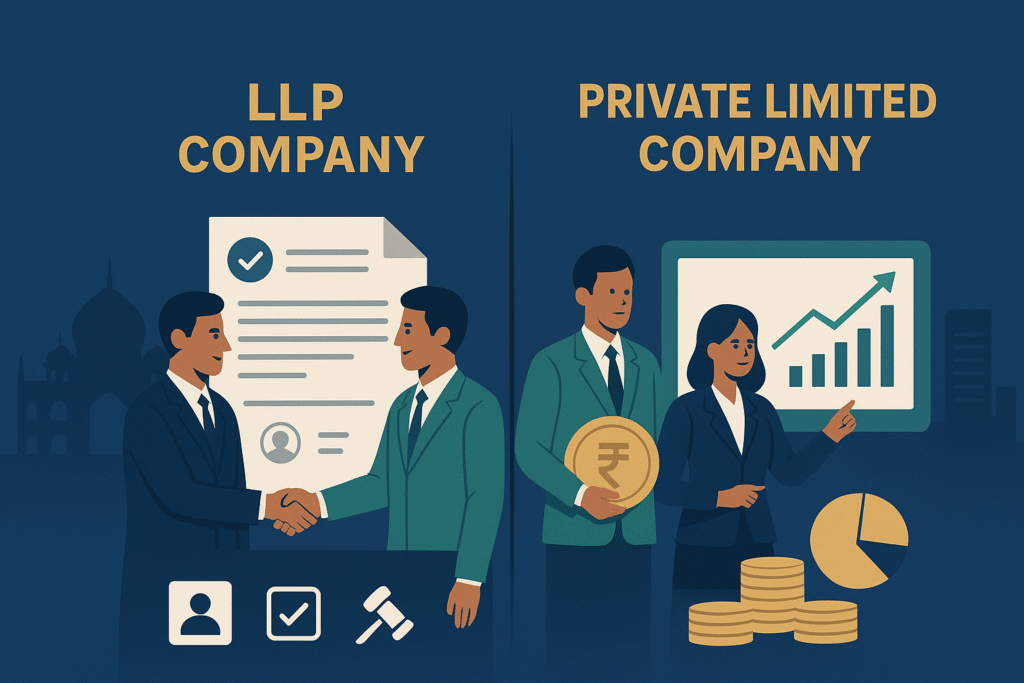
A Limited Liability Partnership (LLP company) has become one of the most popular business structures in India over the past decade. It combines the liability protection of a company with the operational flexibility of a partnership. With increasing registrations every year, more founders are asking: Is an LLP easier to set up? Is it better than a Private Limited company? Let’s break it down.
You may also like to read:India’s MSMEs nse sme,bse sme Stock Exchanges: A New Gateway to Growth for Small Businesses
What is a Limited Liability Partnership (LLP)?
An LLP company in India is a separate legal entity where partners’ liability is limited to their agreed contribution. It needs a minimum of two partners, and management is governed by an internal LLP agreement instead of strict corporate rules.
Why LLP Companies Are Gaining Popularity
- Ease of compliance: No mandatory board meetings or AGMs; only two annual filings.
- Tax treatment: LLPs are taxed at 30% with Alternate Minimum Tax (AMT) at 18.5% where applicable.
- Lower audit burden: Audit required only if turnover exceeds ₹40 lakh or capital contribution exceeds ₹25 lakh.
- Decriminalisation of offences: The LLP Amendment Act, 2021 made compliance more founder-friendly.
- Foreign Direct Investment (FDI): Allowed automatically in certain clean sectors with 100% FDI.
Merits of an LLP Company
- Limited liability for partners.
- Flexible profit-sharing arrangements.
- Easy compliance compared to Private Limited.
- No dividend distribution tax.
- Better suited for professional firms and family businesses.
Demerits of an LLP Company
- Not investor-friendly (no shares, CCPS, or ESOPs).
- Private equity and venture capital rarely fund LLPs.
- Tax rate (30%) higher than the concessional 22% available to many companies.
- Late filing attracts heavy penalties.
- Minimum two partners required—no single-founder option.
LLP vs Private Limited Company: Which Should You Choose?
- Choose LLP: If you run a small or medium-sized professional service firm (consulting, law, IT, family-owned partnership) with no immediate plans for external investors.
- Choose Private Limited: If you want to raise venture funding, issue employee stock options, or scale aggressively toward acquisitions and IPO.
Will LLP Replace Private Limited Companies?
No. Both structures serve different purposes. LLPs work best for partnership-style businesses, while Private Limited companies remain the preferred route for fundraising, scaling, and global recognition.
Final Thoughts
A Limited Liability Partnership company is ideal for entrepreneurs who want a simple, compliance-light structure with liability protection. But if growth, investors, and scale are your goals, a Private Limited company still wins.
❓ Frequently Asked Questions (FAQ) on LLP Companies in India
1. What is a Limited Liability Partnership (LLP) company?
A Limited Liability Partnership (LLP company) is a legal business structure that combines the benefits of a partnership with limited liability protection for its partners. It is a separate legal entity, meaning the business can own property, enter into contracts, and sue or be sued in its own name.
2. How is an LLP different from a Private Limited Company?
- LLP: Flexible internal management, fewer compliance requirements, no share capital, and partners share profits directly.
- Private Limited: Structured governance, higher compliance, supports shareholding, ESOPs, and external investments.
The choice depends on whether you want simplicity (LLP) or scalability and fundraising options (Pvt Ltd).
3. Is an LLP easier to set up than a Private Limited company?
Yes, in most cases. LLP registration requires fewer steps, lighter documentation, and lower ongoing compliance. Private Limited companies require board meetings, annual general meetings, auditor appointments, and stricter filings.
4. What is the minimum requirement to start an LLP company in India?
- At least two partners (with at least two designated partners).
- A registered office address in India.
- An LLP agreement filed within 30 days of incorporation.
- Digital Signature Certificates (DSC) and Designated Partner Identification Numbers (DPIN).
5. What are the advantages of forming an LLP?
- Limited liability protection.
- Lower compliance and audit requirements.
- No dividend distribution tax.
- Flexible profit-sharing among partners.
- Suitable for professional firms, startups with stable revenues, and family businesses.
6. What are the disadvantages of an LLP company?
- Not attractive for investors (no shares or ESOPs).
- Higher effective tax rate compared to concessional corporate tax.
- Hefty late filing penalties.
- Minimum two partners required (not suitable for solo founders).
7. Who should choose an LLP over a Private Limited company?
Entrepreneurs running consulting firms, legal/accounting practices, IT services, or small family businesses who want liability protection with minimal compliance should choose an LLP. If external funding, ESOPs, or global expansion are priorities, a Private Limited company is better.
8. Can foreign investors invest in LLP companies in India?
Yes, but only in sectors where 100% FDI is allowed through the automatic route and where there are no FDI-linked performance conditions.
9. What taxes apply to LLPs in India?
- Flat tax rate of 30% on profits.
- Alternate Minimum Tax (AMT) of 18.5% where applicable.
- No dividend distribution tax—profits can be distributed directly to partners.
10. Can an LLP company be converted into a Private Limited company?
Yes, subject to certain conditions. Many LLPs that scale beyond their initial scope choose to convert into a Private Limited to raise funding and issue shares.
✒️ About the Author
Tabrez Khan is the founder and writer of Business Zindagi, a blog dedicated to simplifying business, MSME growth, entrepreneurship, and digital opportunities for Indian small businesses. With years of hands-on experience in running and managing businesses, he focuses on translating complex laws, compliance updates, and financial topics into clear, actionable guidance for entrepreneurs.
🔗 Authentic Sources & References (Clickable Links)
These links point ONLY to official government or statutory authority pages:
📘 MCA (Ministry of Corporate Affairs) – Official Resources
- LLP (Limited Liability Partnership) Overview – MCA
https://www.mca.gov.in/content/mca/global/en/acts-rules/llp-act-2008.html - LLP Forms & Compliance Requirements (MCA)
https://www.mca.gov.in/content/mca/global/en/llp/llp-e-filing.html - Private Limited Company Incorporation – MCA
https://www.mca.gov.in/content/mca/global/en/company-forms/incorporation.html - SPICe+ Form for Company Registration – MCA
https://www.mca.gov.in/content/mca/global/en/mca/foportal/spic-eplus.html
📘 LLP Act & Rules
- Limited Liability Partnership Act, 2008 (Bare Act PDF)
https://www.mca.gov.in/bin/dms/getdocument?mds=FJxTv6ofpDz7x3p8X2hWyA%253D%253D&type=download - LLP Rules, 2009 (MCA)
https://www.mca.gov.in/bin/dms/getdocument?mds=l2epr9dT0l6S7E9FsK2PZA%253D%253D&type=download
📘 Companies Act, 2013
- Companies Act, 2013 (Bare Act – MCA)
https://www.mca.gov.in/content/mca/global/en/acts-rules/companies-act/companies-act-2013.html
📘 Income Tax Department – Taxation for LLP & Pvt Ltd
- LLP Taxation (Income Tax India)
https://incometaxindia.gov.in/pages/tax-information-services/limited-liability-partnership.aspx - Corporate Tax – Private Limited Company
https://incometaxindia.gov.in/pages/tax-information-services/company.aspx