What Is Microfinance and Why It Matters
Microfinance refers to the range of small-scale financial services — including micro credit, savings, insurance, and remittance — designed for individuals and very small businesses that lack access to traditional banking systems.
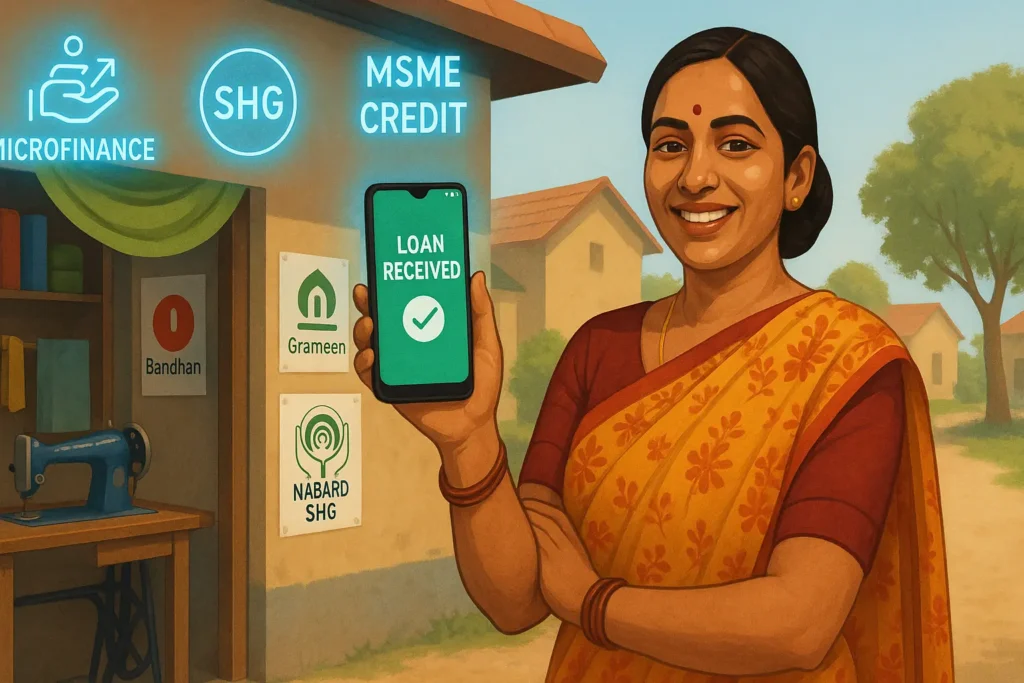
In simple terms, it’s the bridge between financial exclusion and economic empowerment. Through microfinance institutions (MFIs), NGOs, or self-help groups (SHGs), even a tiny loan of ₹5,000–₹50,000 can help a street vendor buy stock, a weaver buy yarn, or a woman start a small grocery or tailoring business.
In developing and poor countries like India, where millions of people still live outside the formal banking net, microfinance plays a critical role in promoting financial inclusion, self-employment, and sustainable livelihoods.
You may also like to read: Shishu, Kishor, and Tarun: Which MUDRA Loan Category Fits Your MSME GST Loan Explained: My MSME Experience, GST Loan Eligibility & CC Loan
Secured vs Unsecured Business Loans: Which One Is Right for Your Small Business?
The Role of Micro Credit in Sustaining Very Small Businesses
Micro credit — the most common tool of microfinance — provides small, collateral-free loans to individuals or groups. For micro-entrepreneurs, these funds are often the first and only source of business capital.
How It Helps Micro Businesses
- Working Capital Support: Enables small businesses to buy raw materials, tools, or stock.
- Asset Building: Encourages long-term investments in livestock, machinery, or stalls.
- Women Empowerment: Over 90% of micro credit borrowers in India are women, leading to higher family incomes and better education for children.
- Financial Discipline: Encourages saving habits and credit repayment discipline.
In short, microfinance gives the smallest entrepreneurs a financial identity — helping them move from survival to stability.
An Engine of Rural Entrepreneurship
India has one of the largest microfinance ecosystems in the world. The industry serves over 60 million low-income customers, mostly women in rural and semi-urban areas.
Major Models in India’s Microfinance Landscape
- Self-Help Group (SHG) – Bank Linkage Programme (BLP):
A NABARD initiative connecting community-based groups (SHGs) with formal banks. It has empowered millions of rural women by combining savings with bank credit. - (MFIs) and NBFC-MFIs:
Non-banking financial companies like Bandhan, Spandana, Ujjivan, and SKS (now Bharat Financial) provide group-based micro loans for small business needs. - Government Schemes for MSME Credit:
Programs like PMEGP, Mudra Yojana, and Stand-Up India complement microfinance by extending formal credit to nano and micro enterprises.
Together, these programs have created a powerful grassroots credit ecosystem that supports tiny business owners — from papad-makers and tailors to street food sellers and weavers.
Global Success Stories in Microfinance
1. Grameen Bank, Bangladesh – The Pioneer
Founded by Professor Muhammad Yunus, the Grameen Bank introduced the world to micro credit. By lending tiny amounts to poor rural women without any collateral, Grameen proved that the poor are bankable and creditworthy.
The Grameen model inspired thousands of MFIs globally, including India’s own Bandhan Bank. It remains a symbol of social entrepreneurship and inclusive finance.
2. BRAC (Bangladesh) – The Integrated Approach
BRAC combined microfinance with education, healthcare, and business training. This holistic model helped millions of families move out of poverty by not just lending money, but by building business capacity.
3. NABARD’s SHG–Bank Linkage Programme (India)
Started in the 1990s, NABARD’s SHG-BLP linked over 13 million Self-Help Groups to formal banks, creating one of the world’s largest community-based financial systems.
It has been pivotal in women’s empowerment, micro enterprise growth, and rural financial inclusion.
Read: NABARD SHG–Bank Linkage
4. Bandhan Bank (India)
What began as a small microfinance NGO in 2001 evolved into a full-fledged bank in 2015. Bandhan now serves millions of low-income customers and MSMEs, showing how microfinance can scale into mainstream banking.
Official site: Bandhan Bank
Effectiveness: Evidence and Impact
Research by the World Bank, IFC, and scholars like Abhijit Banerjee and Esther Duflo shows that microfinance:
- Improves business investment and income stability for micro-entrepreneurs.
- Helps households accumulate productive assets and manage shocks.
- Strengthens social capital and financial literacy in low-income communities.
However, experts also note that microfinance alone isn’t a magic solution for poverty. When combined with training, market access, and digital tools, it becomes a powerful catalyst for long-term growth.
Challenges and the Way Forward
Key Challenges
- Over-indebtedness in some regions due to multiple borrowings.
- High operating costs for MFIs.
- Need for better borrower education and digital literacy.
Microfinance as a Pillar of Inclusive Growth
Microfinance is more than a financial tool — it’s a movement of empowerment.
By giving small entrepreneurs access to credit, savings, and dignity, micro finance is helping reshape the future of small businesses and local economies.
In a developing country like India, where micro and small enterprises form the backbone of employment and rural growth, microfinance stands as a pillar of self-reliance and sustainability.
Whether through an SHG in Assam, a Bandhan branch in Bihar, or a Grameen group in Bangladesh, the message remains clear — when small entrepreneurs grow, the nation prospers.
References
- Grameen Bank – Official Website
- NABARD – SHG Bank Linkage Programme
- BRAC Microfinance
- Bandhan Bank
- Banerjee, A. et al., The Miracle of Microfinance? Evidence from a Randomized Evaluation
- World Bank – Microfinance Overview
Disclaimer
This article is for informational purposes only. BusinessZindagi.com does not provide financial advice. Readers are advised to verify information and consult official program sources before applying for any loan or financial service.