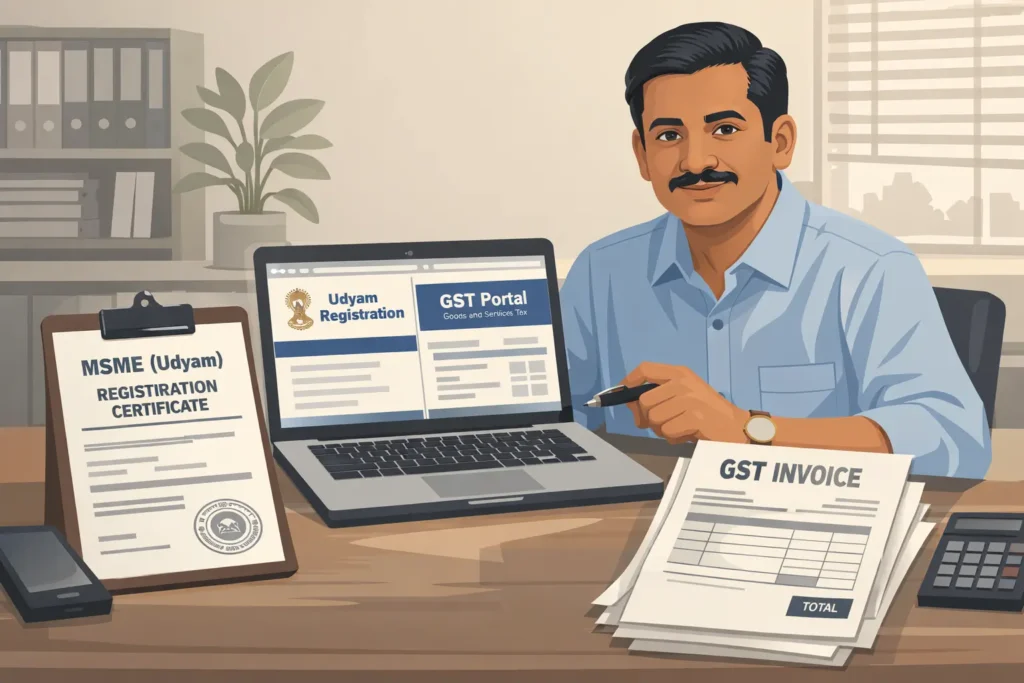
Many small business owners don’t fail because their idea is weak or their effort is lacking. They fail quietly because of basic misunderstandings about compliance. One of the most common—and most costly—confusions is between MSME (Udyam) registration and GST registration. At first glance, both look like routine government formalities. In reality, mixing them up can lead to lost benefits, rejected loan applications, delayed payments, and unnecessary stress. Understanding the difference early is not paperwork—it’s business survival.
you may also like to read: Udyam Registration: The Ultimate Identity Proof Every MSME Must Secure in India
Two registrations are often mixed up:
- MSME (Udyam) registration
- GST registration
They sound official. They both come from the government.
But they serve completely different purposes.
Understanding this difference early can save your business years of trouble.
What exactly is MSME registration (Udyam)?
MSME registration, officially called Udyam registration, is about recognition — not taxation.
When you register on the Udyam portal, the government officially recognises your business as:
- Micro
- Small
- or Medium enterprise
Why msme registration actually matters
Udyam registration helps you:
- Access MSME schemes and subsidies
- Get preference in government tenders
- Improve eligibility for collateral-free or priority loans
- Establish credibility with banks and buyers
👉 Important:
MSME registration does NOT give you a GST number.
It only recognises your business category.
What is GST registration really about?
GST registration has nothing to do with recognition or benefits.
GST exists for one reason:
👉 Tax collection and compliance
You register under GST to:
- Charge GST on invoices
- Collect tax from customers
- Claim input tax credit (ITC)
- File regular GST returns
GST is mandatory when your business crosses prescribed turnover limits or does inter-state supply.
The 7 biggest mistakes small business owners make
1. “I did MSME registration, so GST is automatic”
❌ Wrong.
MSME and GST are separate portals, separate laws, separate purposes.
2. “GST is only for big companies”
❌ Wrong.
Many small traders and service providers hit GST limits faster than expected — especially if selling inter-state.
3. “MSME registration is only for factories”
❌ Wrong.
Traders, service providers, exporters, freelancers — all are eligible for msme registration.
4. “Udyam registration needs heavy paperwork”
❌ Wrong.
Udyam is designed as a simple, Aadhaar-based self-declaration system.
5. “I have GST, so I’ll get MSME benefits”
❌ Wrong.
GST compliance does not give you MSME scheme access unless you also complete msme registration.
6. “I’ll register only when someone asks”
❌ Risky thinking.
Banks, tender portals, and government departments often ask for Udyam details suddenly.
7. “Registration means guaranteed subsidies”
❌ Not true.
Registration makes you eligible, not automatically approved.
MSME registration vs GST registration (simple comparison)
| Aspect | MSME Registration | GST Registration |
|---|---|---|
| Purpose | Government recognition | Tax compliance |
| Focus | Benefits, schemes, loans | Tax collection & ITC |
| Mandatory? | No (but strongly recommended) | Yes, based on rules |
| Cost | Free | Free (compliance costs apply) |
| Portal | Udyam | GST Portal |
When do you actually need MSME registration?
You should strongly consider msme registration if:
- You plan to apply for business loans
- You want government tenders or schemes
- You want long-term credibility as a small business
- You are an exporter, trader, or service provider
👉 Smart move: Register early, even if business is small.
When is GST registration compulsory?
GST registration becomes necessary if:
- Your turnover crosses prescribed limits
- You sell goods or services across states
- Your buyers demand GST invoices
- You want to claim input tax credit
When should you do BOTH?
Most growing businesses eventually need both:
- MSME registration → to access benefits and recognition
- GST registration → to stay tax compliant and competitive
This combination makes your business visible, credible, and scalable.
A practical reality check (from experience)
Many small businesses stay informal too long.
Later, when:
- A bank asks for Udyam details
- A buyer asks for GST invoice
- A department sends a notice
They rush — and mistakes happen.
Early registration avoids:
- Panic decisions
- Missed opportunities
- Compliance stress
Frequently Asked Questions (FAQ)
Is MSME registration mandatory?
No, but it is highly recommended for any serious small business.
Can I do MSME registration without GST?
Yes. Many small businesses register under Udyam even before GST becomes applicable.
Does MSME registration protect me from tax notices?
No. Tax compliance is separate and handled under GST laws.
Can a freelancer or service provider apply for MSME registration?
Yes. Services are fully covered under msme registration.
Authentic sources & references (clickable)
- Udyam Registration Portal (Official): https://udyamregistration.gov.in
- Ministry of MSME: https://msme.gov.in
- GST Portal (CBIC): https://www.gst.gov.in
- GST Registration Threshold Guide: https://razorpay.com/learn/gst-registration-limit/
About the author
Tabrez is an entrepreneur, exporter, and the voice behind BusinessZindagi.com. With real experience in exports, MSME compliance, and small-business.
Disclaimer
This article is published for general informational and educational purposes only. The content reflects practical understanding of MSME registration and GST registration based on publicly available government guidelines and real-world small business experience. It does not constitute legal, tax, or professional advice.
Registration requirements, thresholds, benefits, and compliance obligations may vary based on the nature of business, turnover, location, and changes in government policy. Readers are advised to verify the latest rules on official government portals or consult a qualified Chartered Accountant, tax professional, or legal advisor before making compliance or registration decisions.
BusinessZindagi.com shall not be held responsible for any loss, penalty, or decision taken based on the information provided in this article.