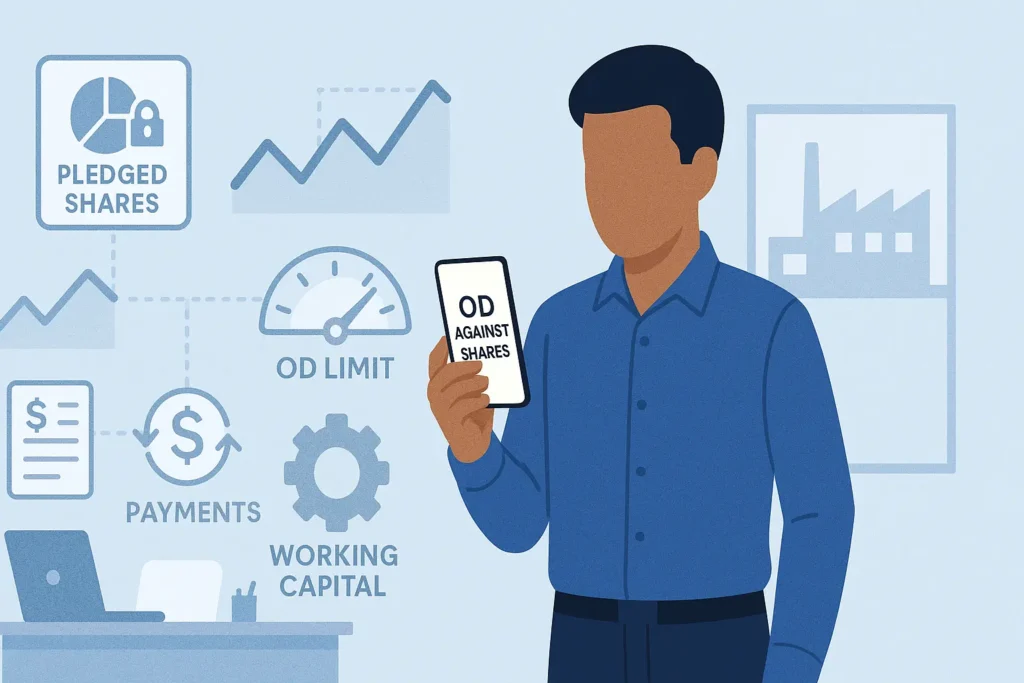
If you run an MSME or a small business in India, you already know this:
Sales don’t stop. Expenses don’t stop. But cash flow? It always comes late.
Every MSME owner faces the same situation — payments stuck with clients, sudden bulk orders, unexpected raw-material price hikes, seasonal fluctuations, GST deadlines, salary pressure, and the never-ending cycle of finding working capital.
In moments like these, most business owners either:
- Swipe a credit card (36–42% interest)
- Take a personal loan (11–18% interest)
- Borrow from the market (costly + risky)
- Or even worse… sell their long-term investment portfolio
But what if you could access instant funds without selling your shares, without paying high interest, and without EMI pressure?
That solution is called OD Against Shares — a surprisingly powerful financial tool that 90% of MSMEs are still not using.
Let’s decode it in a simple, practical, MSME-friendly way.
related post: Loan Against Shares: A Smart Tool — But Dangerous During Market Volatility for MSMEs
What Is OD Against Shares? (Simple MSME Explanation)
(Focus Keyword: OD Against Shares)
OD Against Shares is an overdraft facility where a bank gives you a credit limit by taking your shares, mutual funds, ETFs, or bonds as collateral.
The best part?
✔ You keep ownership of your shares.
✔ You don’t have to sell them.
✔ You withdraw money anytime.
✔ You pay interest only on the amount you actually use.
✔ And there’s no fixed EMI burden.
For MSMEs, this is a lifesaver because:
- Cash flow is unpredictable
- Payments often come late
- Working capital is always required
- Emergencies appear without warning
With OD Against Shares, your investment portfolio becomes your emergency working capital partner.
Real-Life Example for MSMEs
Imagine you run a manufacturing unit.
You secured a good order worth ₹18 lakhs.
Great news!
But the customer will pay after delivery…
And suppliers want 50% advance now.
Instead of taking a personal loan or selling shares:
- You pledge shares worth ₹10 lakh
- Bank gives you around ₹6 lakh OD limit (approx. 60% LTV)
- You withdraw only ₹3 lakh
- You pay interest only on ₹3 lakh, not on the whole limit
- Once the client pays, you repay your OD and use it again anytime
- Your shares remain invested for long-term growth
This flexibility is exactly why OD Against Shares is becoming the secret tool of smart MSME owners.
Why OD Against Shares Is Perfect for MSMEs
Here’s why more small businesses are shifting to this model:
1. Perfect for Cash Flow Gaps
Client payments delayed? Use OD.
Supplier is calling? Use OD.
GST deadline? Use OD.
2. No EMI burden
During slower months, you simply don’t use the limit — no usage means no interest.
3. Cheaper than other loans
- Credit card: 36–42%
- Market interest: 24–36%
- Personal loan: 11–18%
- OD Against Shares: 9–13%
4. Your long-term investment stays untouched
You don’t miss out on compounding.
5. Reusable limit
Withdraw → Repay → Withdraw → Repay
Repeat as many times as you want.
How OD Against Shares Works for Small Business Owners
Here’s the MSME-friendly breakdown:
- You apply for OD Against Shares with a bank/NBFC
- You pledge your shares digitally via NSDL/CDSL
- Bank evaluates your portfolio and sets a credit limit
- You get an overdraft account
- Withdraw funds anytime
- Pay interest only on the amount you draw
- Repay when you want
- Reuse the limit indefinitely
Your shares remain in your demat — only marked as “pledged.”
What MSMEs Can Pledge for OD Limit
Most banks accept:
- Listed equity shares
- Equity & hybrid mutual funds
- ETFs
- Debt funds
- SGBs
- Select bonds
Unlisted shares are not accepted.
Interest Rates for OD Against Shares (2025 MSME Guide)
Typical range:
9% — 13% per annum
Lower for debt funds/SGBs
Higher for equity shares
Compared to other MSME financing options, it’s one of the lowest-cost facilities.
Loan Limit (LTV Ratio) for OD Against Shares
Banks usually offer:
- 50–65% of equity shares
- 60–75% of mutual funds
- 70–80% of debt funds/SGBs
Example
Shares value = ₹20 lakh
LTV = 60%
OD limit = ₹12 lakh
Best Features of OD Against Shares for MSMEs
✔ Flexible working capital
Use it for inventory, salaries, emergency orders.
✔ Pay interest only on amount used
No unnecessary cost.
✔ Instant disbursement
Most banks approve within hours.
✔ Digital process
No paperwork headache.
✔ No foreclosure charges
Repay anytime.
Risks MSME Owners Must Understand
Even though OD Against Shares is powerful, it comes with responsibilities.
1. Market volatility can reduce your limit
If your shares fall in value, the bank may ask you to add:
- More shares
- Or partial repayment
This is called a margin call.
2. Bank may sell your shares
If you ignore the margin call, the bank can sell shares to protect its money.
3. You must be disciplined
Because OD is flexible, careless use can lead to over-borrowing.
Eligibility for OD Against Shares (MSME-Friendly)
- Indian resident
- Active demat account
- Approved securities
- PAN + Aadhaar
- Clean financial track record
Companies, partnership firms, proprietorships, and HUFs can all apply.
Documents Required
Personal KYC + Demat details
Business PAN
GST (if applicable)
Bank statements
Simple, minimal paperwork depending on bank.
Best Banks for OD Against Shares (2025 MSME List)
| Bank | Why MSMEs Like It | Typical Interest |
|---|---|---|
| HDFC Bank | Fast processing, digital pledge | 10–12% |
| ICICI Bank | OD + LAS, good online portal | 9.5–12.5% |
| Axis Bank | High LTV ratios | 10–12% |
| Kotak Mahindra Bank | Strong MF acceptance | 9–12% |
| SBI | Good for govt-backed securities | 9–11.5% |
| Bajaj Finance | App-based instant access | 10–13% |
How MSMEs Can Use OD Against Shares (Practical Scenarios)
✔ Seasonal Business Cycles
Garment exports, trading, manufacturing, FMCG distribution.
✔ Sudden Bulk Orders
Use OD to buy raw materials instantly.
✔ Slow Receivables
Client payments always come late. OD fills the gap.
✔ Emergency Expenses
Machine breakdown, urgent repairs, employee salaries.
✔ Expanding Operations
Short-term capital needs during growth phase.
Is OD Against Shares Better Than a Business Loan?
OD Against Shares Advantages
- Lower interest
- No collateral like property required
- Zero EMI pressure
- Quick processing
- Flexible usage
Business Loan Advantages
- No need to pledge investments
But if you have a decent portfolio, OD Against Shares is far more efficient.
Tax Benefits for MSMEs
If the overdraft amount is used for business purposes:
✔ Interest can be shown as a business expense
This reduces taxable income.
✔ Shares remain unsold
No capital gains tax.
FAQ: OD Against Shares for MSMEs & Small Businesses
1. Can MSMEs get OD Against Shares easily?
Yes. Banks prefer LAS because it’s fully secured.
2. What if the share value crashes?
The bank issues a margin call. Add more shares or repay.
3. Can I withdraw anytime?
Yes. It works like a credit line.
4. Can OD limit be increased?
Yes. If your portfolio grows, you can request a higher limit.
5. Can I pledge mutual funds?
Yes, equity and hybrid funds are widely accepted.
6. Will banks check my credit score?
Yes, but the collateral matters more.
7. Can MSMEs claim interest as an expense?
Yes, if loan is used for business
OD Against Shares vs Loan Against Shares: What’s the Difference for MSMEs?
Most small business owners get confused between OD Against Shares and Loan Against Shares (LAS).
Both involve pledging shares or mutual funds, but they work very differently — especially when it comes to cash flow, interest cost, and flexibility, which matter the most for MSMEs.
Here’s the simplest breakdown:
1. Nature of the Facility
OD Against Shares
A revolving overdraft limit — like a credit line.
You use funds when needed and repay anytime.
Loan Against Shares
A fixed-term loan — like a standard loan with EMIs.
You get the full amount at once.
2. Interest Calculation
OD Against Shares
You pay interest only on the amount used, not the entire limit.
Example:
Limit ₹10 lakh → You use only ₹2 lakh → Interest charged on ₹2 lakh only.
Loan Against Shares
Interest starts from day one on the entire sanctioned amount, even if you don’t use all of it.
3. Repayment Flexibility
OD Against Shares
- No EMIs
- You repay when cash flow improves
- Perfect for businesses with irregular income
Loan Against Shares
- Fixed EMIs every month
- Missed EMIs lead to penalties
- Better only if you need a lump sum
4. Ideal Use Cases
OD Against Shares
Best for working capital, supplier advances, salary payout, seasonal cash crunch, and urgent business needs.
Loan Against Shares
Better for one-time expenses, like buying machinery, bulk inventory, or planned expansion.
5. Commitment Period
OD Against Shares
Usually 1 year, but renewable every year.
Loan Against Shares
Fixed tenure: 12–36 months.
6. Cost & Charges
OD Against Shares
Typically has:
- Lower usage cost
- Interest only on withdrawals
- No prepayment penalty
Loan Against Shares
May include:
- Processing fees
- Prepayment charges
- EMI bounce penalties
7. Impact on MSME Cash Flow
OD Against Shares
✔ Zero EMI pressure
✔ Pay only when you actually use money
✔ Can withdraw → repay → withdraw again
✔ Perfect for unpredictable MSME cycles
Loan Against Shares
✘ EMIs continue irrespective of business sales
✘ Less flexibility
✘ Suitable only if you have stable monthly cash inflow
Side-by-Side Comparison (Quick Table)
| Feature | OD Against Shares | Loan Against Shares (LAS) |
|---|---|---|
| Type | Overdraft | Term Loan |
| Funds Usage | Withdraw as needed | One-time lump sum |
| Interest | Only on used amount | On full loan amount |
| Repayment | Flexible, no EMI | Fixed EMIs |
| Best For | Working capital | Planned expenses |
| Tenure | 1 year (renewable) | 1–3 years |
| Ideal For MSMEs | ✔✔✔ High fit | ✔ Medium fit |
Which One Should MSMEs Choose?
If your business has irregular cash flow, seasonal income, or frequent working capital gaps, then:
⭐ OD Against Shares is almost always the better choice.
It is flexible, cheaper during low-usage periods, and allows you to manage cash flow intelligently.
If you need a big lump sum for a specific purpose, like buying machinery or executing a large order, then:
⭐ Loan Against Shares can be better.
About the Author
Tabrez, founder of BusinessZindagi.com, writes practical, experience-based content to help MSMEs grow. Having navigated cash flow issues, exports, and business finance himself, he simplifies complex financial tools so small businesses can make smarter decisions and scale without stress.
Authentic Links & References
- RBI – https://www.rbi.org.in
- SEBI – https://www.sebi.gov.in
- NSDL Pledge Rules – https://nsdl.co.in
- CDSL Pledge Process – https://www.cdslindia.com
- HDFC LAS – https://www.hdfcbank.com
- ICICI LAS – https://www.icicibank.com
Disclaimer
This article is for educational purposes only. Interest rates and policies change. OD Against Shares involves market risks. Always verify with your bank and consult a financial advisor for personalised advice