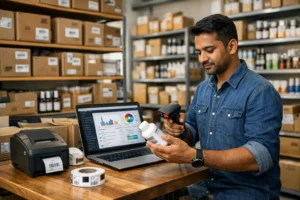
For years, barcodes were treated as a boring but necessary part of business — a technical requirement to sell products in retail stores or on e-commerce platforms.
In 2026, that perception is changing fast.
Today, smart barcodes combined with Artificial Intelligence (AI) are helping startups do much more than just identify products. They are helping founders reduce losses, understand customers, improve supply chains, and scale faster with limited capital.
In the Startup India era, where efficiency, transparency, and data-driven decisions matter more than ever, barcodes are quietly becoming powerful growth tools.
This article explains how.
you may also like to read: Unlock business growth:The ultimate UPC Barcode Guide for Indian MSMEs
From Black Lines to Business Intelligence: The Evolution of Barcodes
Traditional barcodes were designed for one purpose only — identification. A barcode stored a product number, which a scanner read at checkout. That was the end of the story.
Smart barcodes are different.
Modern formats such as QR codes, Data Matrix codes, and GS1 Digital Link barcodes are connected to cloud systems. When scanned, they can display live product information, verify authenticity, track movement, and generate valuable data.
For startups, this shift is important because it transforms a static label into a dynamic digital gateway.
Every product becomes:
- Traceable
- Measurable
- Interactive
- Data-generating
Where Artificial Intelligence Fits into Barcodes
Barcodes by themselves create data.
AI is what turns that data into business intelligence.
Each barcode scan can capture:
- Location
- Time
- Frequency
- Batch details
- Consumer interaction patterns
AI systems analyze this information to:
- Predict future demand
- Detect unusual sales or supply issues
- Optimize inventory planning
- Understand customer behavior automatically
Instead of guessing what might sell next month, startups can plan using real signals from the market.
How Startups Are Using Smart Barcodes as Growth Engines
1. Smarter Inventory & Supply Chain Management
Inventory mismanagement is one of the biggest reasons startups struggle with cash flow.
Smart barcodes help by:
- Providing real-time stock visibility
- Automatically updating inventory levels
- Tracking batch movement across locations
AI then predicts:
- Which products will be in demand
- When restocking is required
- Where losses or delays are happening
Result: less capital locked in inventory, fewer stockouts, and smoother scaling.
2. Turning Offline Products into Digital Experiences
Smart barcodes allow startups to engage customers even after the sale.
A single scan can show:
- Product origin and authenticity
- Usage instructions or demo videos
- Sustainability or quality certifications
- Personalized offers or loyalty rewards
AI analyzes scan behavior to identify:
- High-engagement products
- Regional preferences
- Content that converts better
This builds trust, transparency, and repeat purchases — especially important for D2C brands.
3. Affordable Marketing Intelligence for Small Teams
Most startups cannot afford expensive market research.
Smart barcodes act as built-in research tools:
- Which cities are scanning more?
- Which batch underperformed?
- Which campaign increased engagement?
AI dashboards convert this into:
- Heat maps
- Performance insights
- Clear action points
Marketing decisions become data-backed instead of assumption-based.
you may also like to read: Why Barcode is Essential for MSME Product Packaging: Benefits, Types & Government Subsidy
Industry-Wise Impact of Smart Barcodes in India
FMCG & D2C Startups
- Product authentication
- Batch-level quality tracking
- Consumer feedback through scans
- Faster product improvements using AI insights
Pharma & Healthcare Startups
- Anti-counterfeiting
- Expiry and recall management
- Compliance-ready traceability
- Improved patient safety
Agri & Food Processing Startups
- Farm-to-fork transparency
- Export compliance
- Reduced wastage
- Trust-building in global markets
Logistics & E-commerce Sellers
- Faster scanning and fewer errors
- Delivery tracking
- AI-powered route optimization
- Better seller ratings and customer satisfaction
Smart Barcodes and Startup India Vision 2026
Smart barcode adoption aligns closely with:
- Digital India
- Ease of Doing Business
- Export readiness
- Transparent supply chains
Modern retail chains, marketplaces, and international buyers increasingly expect standardized, traceable products.
For startups, barcodes are no longer just compliance tools — they are credibility signals.
Cost, Accessibility & ROI: Clearing the Biggest Myth
A common misconception is that smart barcodes and AI are expensive.
In reality:
- Cloud-based tools are affordable
- Many platforms offer pay-as-you-scale pricing
- No heavy infrastructure is required
Startups often recover the cost through:
- Reduced wastage
- Better inventory planning
- Higher customer trust
- Faster scaling
In many cases, the ROI is higher than traditional marketing spends.
How Startups Can Start Using Smart Barcodes (Step-by-Step)
- Identify the main business problem (inventory, trust, marketing)
- Choose the right barcode format
- Register standardized product codes
- Connect barcode data to digital tools
- Use AI analytics gradually
- Train the team
- Scale usage with business growth
Starting small is key. Intelligence can grow with the company.
Common Mistakes Startups Should Avoid
- Treating barcodes as a one-time compliance task
- Ignoring scan data
- Poor system integration
- Offering no customer-facing value
- Overcomplicating implementation early
The solution is simple: start smart, learn fast, scale steadily.
The Future: From Smart Barcodes to Intelligent Products
The next phase includes:
- AI-driven predictive supply chains
- Barcode + blockchain for trust
- IoT-connected products
- Digital product passports
In the future, products will not just be sold — they will communicate, learn, and guide business decisions.
Conclusion: Every Scan Is an Opportunity
In 2026, barcodes are no longer about black lines on packaging.
They are about data, intelligence, growth, and trust.
For Indian startups, the real question is not:
“Do we need barcodes?”
It is:
“Are we using our barcodes intelligently enough?”
❓ Frequently Asked Questions (FAQ)
1. What is a smart barcode?
A smart barcode is an advanced barcode (such as QR code, Data Matrix, or GS1 Digital Link) that connects products to digital data like product information, traceability records, customer engagement content, and analytics platforms.
2. How is AI used with barcodes?
AI analyzes barcode scan data to identify patterns, predict demand, optimize inventory, detect fraud, and understand customer behavior — helping startups make data-driven decisions.
3. Are smart barcodes mandatory for startups in India?
Smart barcodes are not legally mandatory, but standard barcodes are required by e-commerce platforms, modern retail chains, and export buyers. Smart barcodes offer additional strategic and operational benefits beyond compliance.
4. Is barcode registration expensive for early-stage startups?
No. Barcode registration and digital tools are relatively affordable, and many startups recover the cost quickly through better inventory control, reduced losses, and improved market access.
5. Which startups benefit most from smart barcodes?
FMCG, D2C brands, pharma, food processing, agri-exports, logistics, and e-commerce sellers benefit the most due to traceability, compliance, and customer trust requirements.
6. Can small startups use AI without technical teams?
Yes. Many modern barcode and analytics platforms offer no-code or low-code dashboards, making AI insights accessible even to non-technical founders.
About the Author
Tabrez is the founder and editor of BusinessZindagi.com, a business knowledge platform focused on startups, MSMEs, exports, and entrepreneurship in India.
He writes practical, research-backed articles that simplify complex business topics like compliance, technology adoption, finance, and growth strategy for founders and small business owners. His work focuses on helping Indian entrepreneurs make informed decisions in a rapidly changing digital economy.
🔗 Sources & References
- GS1 India – Barcode Standards & Digital Link
https://www.gs1india.org - GS1 Global – Digital Link & Smart Barcodes
https://www.gs1.org/standards/gs1-digital-link - McKinsey & Company – AI in Supply Chain & Analytics
https://www.mckinsey.com/capabilities/operations/our-insights - World Economic Forum – Traceability & Digital Product Passports
https://www.weforum.org - Startup India – Digital & Compliance Ecosystem
https://www.startupindia.gov.in - IBM – AI & Intelligent Supply Chains
https://www.ibm.com/topics/supply-chain-analytics