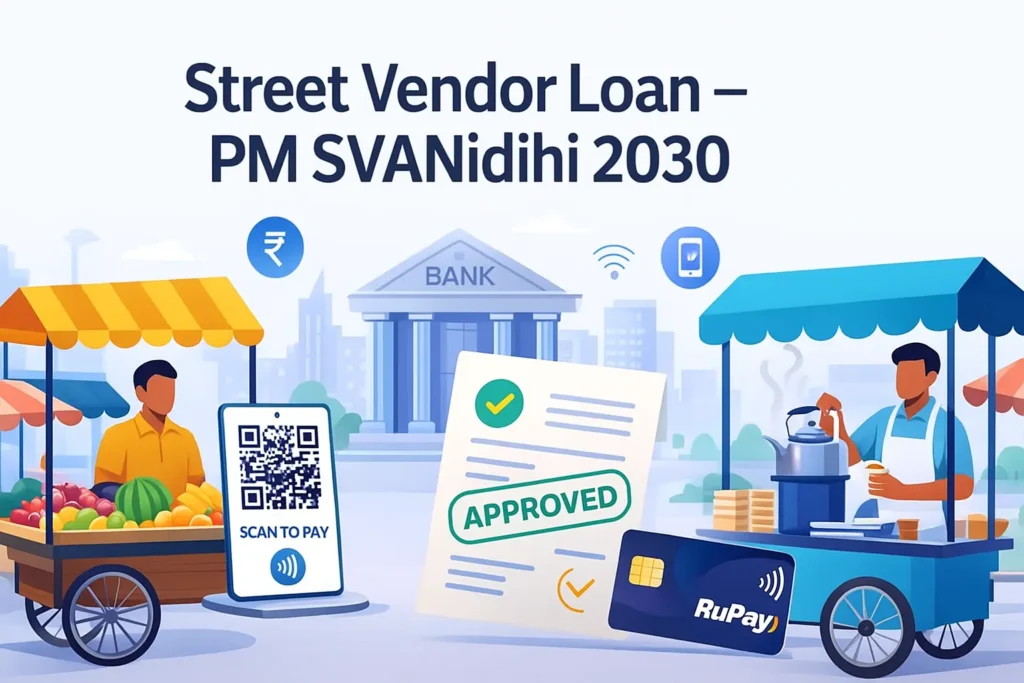
Walk through any Indian market — Guwahati’s Fancy Bazar, Delhi’s Chandni Chowk, Kolkata’s Gariahat, or Mumbai’s Dadar — and you’ll instantly see India’s real economic backbone: street vendors.
They sell vegetables, fruits, tea, momos, clothes, snacks, toys, flowers, and hundreds of daily-use items.
They work long hours, keep cities alive, and run tiny but powerful micro-businesses.
Yet for decades, they faced the same barriers without any meaningful Street Vendor Loan.
- No access to formal loans
- Zero credit history
- High dependence on moneylenders
- No financial identity
- No support to upgrade
To solve this, the government launched the PM SVANidhi scheme, giving street vendors easy working capital loans. And now, in a major policy booster, the scheme has been extended till March 2030, with higher loan limits, better digital features, and a wider beneficiary base.
This extension has turned a good scheme into a long-term micro-entrepreneurship engine.
Let’s break it down.
you may also like to read: Shishu, Kishor, and Tarun: Which MUDRA Loan Category Fits Your MSME?
What Is the Street Vendor Loan Under the PM SVANidhi Scheme?
The street vendor loan is a collateral-free working capital loan offered under the PM SVANidhi scheme (Prime Minister Street Vendor’s AtmaNirbhar Nidhi).
It helps vendors expand inventory, restart businesses, and build financial stability.
Updated Loan Structure After 2030 Extension
- ₹15,000 – First-cycle loan (earlier ₹10,000)
- ₹25,000 – Second-cycle loan (earlier ₹20,000)
- ₹50,000 – Third-cycle loan
- 7% interest subsidy
- UPI-linked RuPay Credit Card for good borrowers (new)
- Cashback on digital payments (up to ₹1,600/year)
- Coverage expanded to more towns
- Target: 1.15 crore vendors
- Total outlay: ₹7,332 crore
This is now one of India’s most significant financial inclusion programs.
Why This Extension Matters
Earlier, vendors had limited time to apply, upgrade, or repay.
Now with the scheme extended to 2030, they have:
- More time to enter the system
- More time to upgrade loans
- More flexibility to scale at their own pace
- A decade-long growth roadmap
This long window supports both immediate survival and long-term micro-enterprise development.
How the Street Vendor Loan Is Changing Lives
1. Higher Loan Amounts = More Stability
Starting with ₹15,000 itself boosts stock, improves sales, and provides predictability.
Second- and third-cycle loans allow vendors to upgrade carts, add product categories, and manage seasonal demand.
2. Digital Payments → More Income + Trust
With QR codes and cashback incentives:
- Customers pay faster
- Vendors get extra incentives
- Less risk of cash loss
- Digital history builds creditworthiness
A vendor with a QR code looks and earns like a modern micro-entrepreneur.
3. RuPay Credit Card = Next Step in Financial Empowerment
This feature allows good borrowers to:
- Manage short-term cash gaps
- Buy inventory instantly
- Build a credit history
- Reduce dependence on high-interest lenders
This is the beginning of “formal micro-credit culture” among street vendors.
Critical Evaluation: Is Less Than ₹1 Lakh Enough in Today’s High-Inflation Economy?
The PM SVANidhi scheme is impactful — but let’s be realistic.
1. Inflation Has Made Micro-Business Setup Expensive
Even a basic cart today costs ₹60,000 to ₹2 lakh.
A maximum loan cycle of ₹15k → ₹25k → ₹50k is excellent for working capital, but not enough to start a new, meaningful micro-business from scratch.
2. Great for Existing Vendors, Limited for New Ones
Already-operating vendors benefit a lot.
But new entrepreneurs find the amount too small to start strong.
3. Helps Survival, Not Serious Expansion
The loan can upgrade a cart —
but cannot fund:
- branded food carts
- cold storage
- premium kiosks
- micro-shop transitions
- delivery or online expansion
4. Frees Vendors From Moneylenders — But Growth Capital Is Missing
It solves exploitation, yes.
But India still needs a bigger micro-business credit system for true entrepreneurship upliftment.
BusinessZindagi’s Perspective: What Should Be Improved?
- Combine PM SVANidhi with MUDRA loans for higher capital
- Introduce a fourth cycle loan of ₹1–₹2 lakh
- Automatically increase limits for responsible borrowers
- Provide vendor-friendly vending zones to reduce setup costs
Bottom line:
PM SVANidhi is powerful — but in today’s high-inflation economy, it is a stability booster, not a full-scale growth engine.
Who Can Apply for the Street Vendor Loan?
Perfect for vendors selling:
- fruits, vegetables, flowers
- tea, snacks, momos, juice
- garments, toys, household items
- repair services
- handicrafts
- daily-use products
If someone earns income in public vending spaces, this scheme is for them.
How to Apply (Updated Guide)
1. PM SVANidhi Portal
Apply online → Upload documents → Bank verification.
2. Banks
All major PSU + private banks.
3. Common Service Centres (CSCs)
Helpful for digital support.
4. Urban Local Bodies (ULBs)
For vendor certificates.
Documents: Aadhaar, mobile number, bank passbook, vendor certificate.
Real Story: A Vendor’s Growth Journey
A vegetable vendor in Guwahati:
- Started with ₹10,000 (old scheme)
- Grew sales
- Repaid in time
- Now eligible for ₹15,000 + ₹25,000 + ₹50,000 cycle
- Planning to upgrade cart and diversify products
- Will soon get RuPay credit card access
This is real, on-ground transformation.
Conclusion: A Decade-Long Ladder for Micro Entrepreneurs
The street vendor loan under the extended PM SVANidhi scheme is not charity — it is a structured pathway to:
- financial stability
- digital empowerment
- credit identity
- micro-business growth
With the 2030 extension, India has committed to supporting its smallest entrepreneurs with consistency and dignity.
This is the kind of change BusinessZindagi stands for — real opportunities that lift real people.
Frequently Asked Questions (FAQ)
1. What is the PM SVANidhi street vendor loan?
It is a collateral-free working capital loan provided by the Government of India to help street vendors restart, expand, and digitalize their businesses. The scheme now offers loans of ₹15,000, ₹25,000, and ₹50,000 in three cycles.
2. Is the PM SVANidhi scheme extended?
Yes. The Union Cabinet has extended and restructured the scheme till March 2030, increasing the loan amounts and adding new features like a UPI-linked RuPay credit card.
3. Who can apply for the street vendor loan?
Any street vendor working in urban, peri-urban, or small-town areas who sells goods or provides services in public places is eligible. A vendor certificate or provisional certificate from the urban local body is required.
4. Can new entrepreneurs apply for the loan?
Yes, but the scheme is designed mainly as working capital, not a full start-up loan. New entrepreneurs may require additional support through MUDRA loans or state programs.
5. How much maximum loan can a vendor get under PM SVANidhi?
A vendor can get a maximum of ₹50,000 at one time in the third cycle. Across all cycles, the total benefit is under ₹1 lakh.
6. Is the loan completely free?
No. It is a loan with a 7% interest subsidy for timely repayment. However, vendors also get digital transaction cashback incentives.
7. How long does it take to get the loan approved?
Typically 15–30 days, depending on the bank, city verification process, and documentation.
8. What documents are required for PM SVANidhi?
- Aadhaar card
- Mobile number
- Bank account
- Vendor certificate/provisional certificate
- Passport-size photo (in some cases)
9. Is there any penalty for early repayment?
No. Early repayment actually helps the vendor become eligible for the next cycle faster.
10. Can I apply without a vendor certificate?
Yes. You can request a Provisional Certificate of Vending (PCV) from your urban local body and then apply.
✍️ Author Bio (BusinessZindagi Style)
Tabrez Khan is an entrepreneur and exporter who writes about real business experiences, MSME insights, and small business growth. He simplifies government schemes and startup topics for everyday entrepreneurs. Through BusinessZindagi.com, he shares practical guidance and updates to help others build and grow their ventures.
🔗 Authentic Links & References
Below are credible government and authoritative sources related to the PM SVANidhi scheme and its extension:
- Press Information Bureau (PIB) – Union Cabinet approves PM SVANidhi restructuring and extension
https://pib.gov.in/PressReleasePage.aspx?PRID=2161157 - PIB Press Release (Earlier Overview & Scheme Details)
https://pib.gov.in/PressReleasePage.aspx?PRID=1625180 - PM SVANidhi Official Portal
https://pmsvanidhi.mohua.gov.in/ - Ministry of Housing & Urban Affairs (MoHUA) – Scheme Implementing Authority
https://mohua.gov.in/ - UMANG Portal – PM SVANidhi Service Page
https://web.umang.gov.in/landing/department/pm-svanidhi.html - Economic Times – Report on Scheme Extension
https://economictimes.indiatimes.com/news/economy/policy/union-cabinet-approves-restructuring-extension-of-pm-svanidhi-scheme/ - NewsonAir – Cabinet Approval Coverage
https://newsonair.gov.in/union-cabinet-approves-restructuring-of-pm-svanidhi-scheme/ - RBI Notification & Inclusion of Scheme in Priority Lending
https://www.rbi.org.in/