
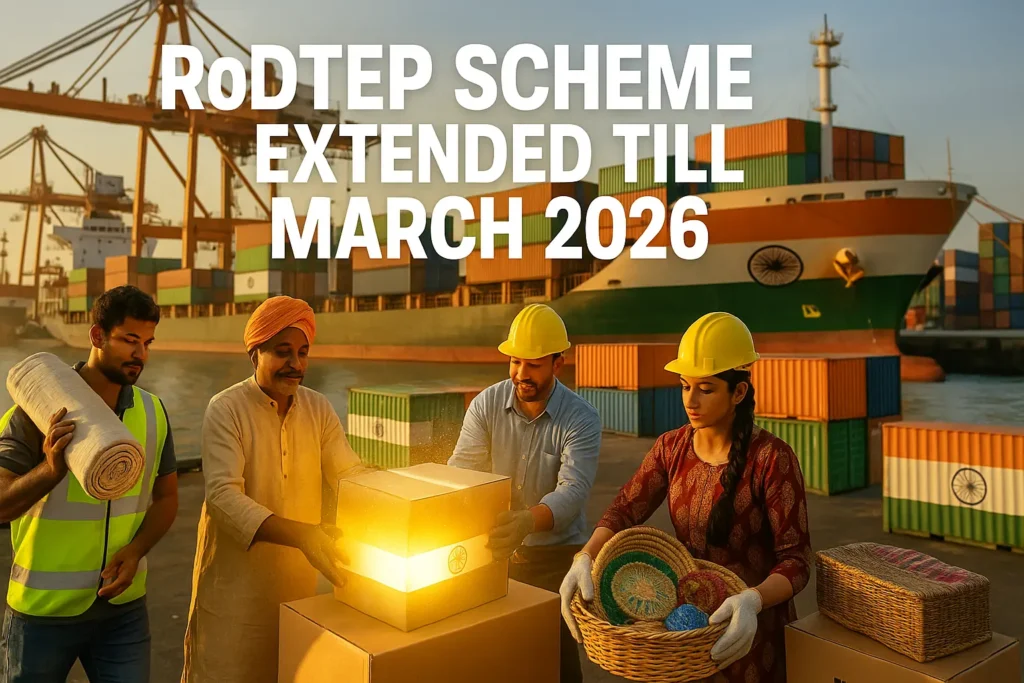
🔴 Latest Update: RoDTEP Extended Till December 31, 2026
The Government of India has extended the Remission of Duties and Taxes on Exported Products (RoDTEP) Scheme until December 31, 2026.
According to the latest government announcement, the extension covers eligible exports made by Domestic Tariff Area (DTA) units, Advance Authorisation holders, Special Economic Zones (SEZs) and Export Oriented Units (EOUs).
Importantly, the existing RoDTEP rates and value caps applicable as of September 30, 2026, will continue during the extended period.
The extension provides exporters with greater certainty for shipments made during the October–December 2026 period.
Source: Government of India / Press Information Bureau
What is the RoDTEP Scheme?
The RoDTEP Scheme is essentially a tax refund mechanism. It ensures that exported goods are not overburdened with unrefunded local duties, taxes, and levies, making Indian exports more competitive in the global market.
It replaced the older MEIS (Merchandise Exports from India Scheme) and is WTO-compliant — which means it avoids international trade disputes while still supporting Indian exporters.
For MSMEs, this matters because:
- Even small hidden costs can wipe out profits.
- RoDTEP refunds provide liquidity and breathing room.
- It levels the playing field against competitors from countries offering heavy subsidies.
You may also like to read: How US Tariffs Affects Indian MSMEs and US Small Businesses
RoDTEP scheme Extension Timeline: What Changed After October 2026?
The RoDTEP deadline has changed more than once, so exporters should be careful when reading older articles and social-media posts about the scheme.
September 2025
The government extended RoDTEP for eligible exports up to March 31, 2026.
April–September 2026
The scheme continued beyond March 31, 2026, with the current framework continuing through September 30, 2026.
October 2026
The government has extended RoDTEP scheme for exporters beyond September 30, 2026. This is an important development for exporters.
RoDTEP Extension Does Not Mean Rates Have Increased
One important point for exporters is that the October 2026 announcement is an extension of the scheme, not a general increase in RoDTEP rates.
The Government has specifically stated that the existing rates and value caps applicable on 30 September 2026 will continue unchanged through 31 December 2026.
Therefore, exporters should not assume that their RoDTEP percentage has increased simply because the scheme has been extended. Always verify the applicable HS code and rate before calculating the expected benefit.
What should exporters do?
If you are exporting now, do not wait for the proposed five-year decision before understanding your current RoDTEP eligibility and applicable rate. Check the latest DGFT provisions and the applicable HS-code-specific rate for your shipment.
Why This Extension Matters Right Now
The timing of this extension is crucial, and here’s why:
- U.S.–India Tariff Tensions
The U.S. has recently slapped higher tariffs on Indian exports — particularly textiles, pharma, and handicrafts. These industries are dominated by MSMEs. RoDTEP helps cushion the blow by reducing effective export costs. - Policy Stability
Exporters thrive on predictability. Knowing RoDTEP is in place till March 2026 allows businesses to plan contracts, pricing, and long-term strategies with confidence. - Boosting Cash Flow
By refunding hidden costs, RoDTEP enhances liquidity — critical for MSMEs who often struggle with working capital. - Strengthening India’s Export Mission
India aims to hit ambitious export targets as part of its $2 trillion economy roadmap. Extending RoDTEP supports this by keeping exports competitive globally. - Protecting Jobs in MSME Sector
MSMEs are the backbone of India’s exports, employing millions
🌍 How MSMEs Benefit from RoDTEP
- Competitive Pricing: Makes Indian goods cheaper overseas without lowering quality.
- Sectoral Support: Especially useful for MSME-heavy sectors like textiles, handicrafts, gems & jewelry, agriculture, and pharma.
- Encourages Market Diversification: Helps small exporters expand into new markets beyond the U.S. and EU.
- Supports “Make in India” Vision: By easing export pressures, RoDTEP keeps manufacturing alive and growing domestically.
- Trade Analysts say the extension signals India’s seriousness in protecting its exporters from global shocks.
- MSME Associations view RoDTEP as a lifeline, particularly for businesses unable to absorb tariff shocks.
- Policy Experts highlight that being WTO-compliant ensures the scheme will not face international disputes, unlike past incentive programs.
The extension of the RoDTEP Scheme till March 2026 is not just a policy tweak — it’s a strategic shield for India’s exporters, especially MSMEs.
At a time when global tariff wars threaten to squeeze small businesses, this move provides stability, liquidity, and confidence. For India’s MSMEs, it means one thing: they can continue to dream bigger, export wider, and compete stronger on the world stage
Is RoDTEP Automatically Available to Every Exporter?
No. The existence of the RoDTEP scheme does not mean that every exported product automatically receives the same benefit.
RoDTEP eligibility and the applicable benefit depend on the relevant product classification, notified rates, value caps and other conditions under the scheme.
The rate is linked to the applicable 8-digit HS code, and exporters should verify the latest notified rate before calculating the expected benefit.
Certain categories of exports are also excluded under the scheme. The Foreign Trade Policy, for example, identifies categories such as certain exports of imported goods, trans-shipment exports and products subject to minimum export price or export duty among the ineligible categories, subject to the detailed provisions applicable at the time.
Important: Do not calculate your export price by simply assuming a particular RoDTEP percentage. Always verify the current rate applicable to your exact HS code.
❓ FAQs on RoDTEP Scheme
Q1. What is the RoDTEP Scheme in simple words?
The RoDTEP Scheme refunds hidden duties and taxes that exporters pay but cannot otherwise claim back, making Indian exports cheaper in global markets.
Q2. Who can benefit from RoDTEP?
Any eligible Indian exporter, including MSMEs, large manufacturers, and traders, can benefit. MSMEs gain the most since margins are tight.
Q3. How is RoDTEP different from MEIS?
MEIS offered incentives but faced WTO challenges. RoDTEP is WTO-compliant, ensuring it can continue without disputes while still giving refunds.
Q4. Till when will the RoDTEP Scheme run?
The current continuation is through September 30, 2026.
Q5. Why is RoDTEP important for MSMEs?
Because MSMEs often lack cash flow and cannot absorb extra export costs. RoDTEP refunds improve liquidity and help them stay competitive internationally.
Q6. Which sectors benefit the most?
Textiles, handicrafts, pharma, agriculture, leather, and gems & jewelry — all of which have heavy MSME participation.