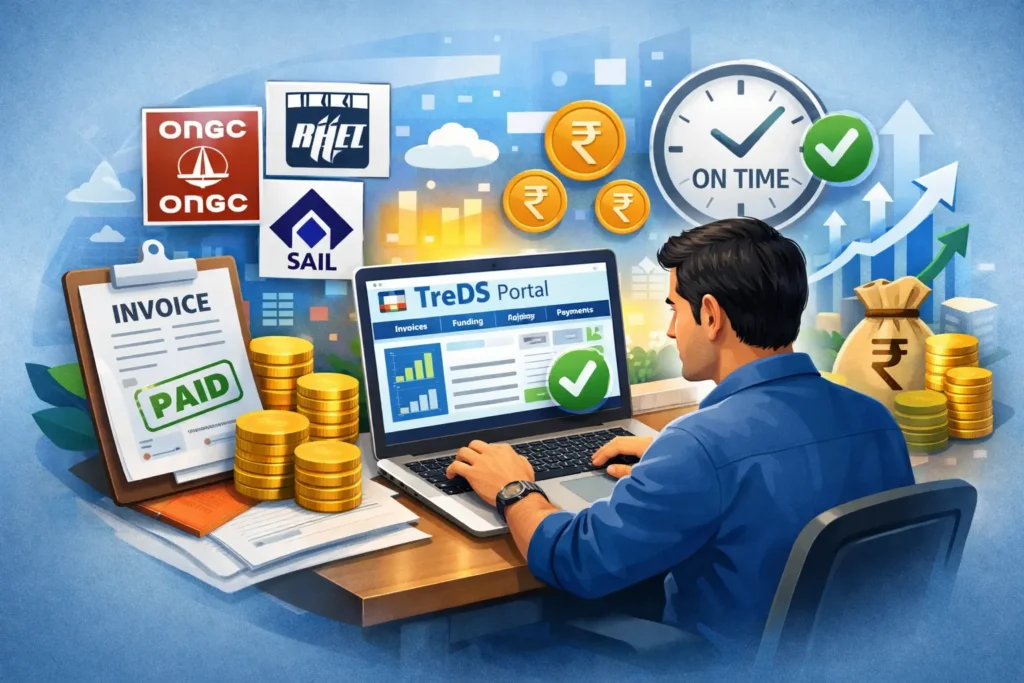
TReDS is becoming a more important part of India’s strategy to tackle delayed MSME payments. Here’s what the 2026 changes mean for MSME suppliers, CPSE purchases, invoice financing and working capital.
In a landmark move to alleviate the liquidity crunch faced by Micro, Small, and Medium Enterprises (MSMEs), the Indian government has mandated the use of the Trade Receivables Discounting System (TReDS) portal for all Central Public Sector Enterprises (CPSEs) when procuring goods and services from MSMEs. This directive, announced in the Union Budget 2026, aims to unlock approximately ₹8.1 lakh crore in delayed payments, thereby enhancing cash flows and fostering growth within the MSME sector.
🔔 TReDS Latest Update — August 2026
TReDS has moved into a new phase in 2026 as the government seeks to make the platform a more important channel for MSME receivables and working-capital support.
In the Union Budget 2026-27, the government proposed making TReDS the transaction-settlement platform for purchases from MSMEs by Central Public Sector Enterprises (CPSEs). The Budget also proposed CGTMSE-backed credit guarantee support for invoice discounting on TReDS and integration between GeM and TReDS to help financiers access information about government MSME purchases.
There has also been a significant legislative development: Parliament passed the MSMED Amendment Bill, 2026, which aims to strengthen the framework around timely payments to MSMEs.
For MSMEs, the message is clear: TReDS is becoming increasingly important as a tool for converting business receivables into working capital instead of waiting for long payment cycles.
Understanding the TReDS Portal
The TReDS portal is an electronic platform designed to facilitate the financing of trade receivables of MSMEs through multiple financiers. By enabling MSMEs to discount their invoices and receive prompt payments, TReDS addresses the critical issue of delayed payments, which often hampers the operational efficiency and growth prospects of small enterprises.
What Changed for TReDS in 2026?
The biggest development came with the Union Budget 2026-27, which proposed four measures aimed at using TReDS more effectively for MSME liquidity.
The four important changes are:
1. TReDS for CPSE purchases from MSMEs
TReDS is to be mandated as the transaction-settlement platform for purchases from MSMEs by Central Public Sector Enterprises. The government said this would also serve as a benchmark for other corporates.
2. CGTMSE-backed support for invoice discounting
The Budget proposed a credit-guarantee mechanism through CGTMSE to support invoice discounting on TReDS. The objective is to encourage greater participation by financiers and improve access to liquidity for MSMEs.
3. GeM–TReDS integration
The government proposed integrating the Government e-Marketplace (GeM) with TReDS so that relevant information about government purchases from MSMEs can be shared with financiers. This could make invoice financing faster and potentially cheaper.
4. Greater use of receivables as a financing asset
The Budget’s broader TReDS reforms are intended to deepen the receivables-financing market and increase the amount of working capital available to MSMEs.
Important: These Budget announcements should not automatically be interpreted as meaning that every MSME invoice in India is now automatically financed through TReDS. Actual implementation depends on the applicable rules, participating buyers, invoices and financing process.
How Much Financing Has TReDS Already Enabled?
The scale of TReDS has also increased significantly.
In the Union Budget 2026-27, the Finance Minister said that more than ₹7 lakh crore has been made available to MSMEs through TReDS. The government is now seeking to expand the platform further through mandatory CPSE settlement, CGTMSE-backed support and GeM integration.
This is important because it shows that TReDS is no longer a small niche financing mechanism. It is becoming an increasingly important part of India’s MSME working-capital ecosystem.
The Liquidity Challenge for MSMEs
MSMEs contribute significantly to India’s economy, accounting for nearly 30% of the GDP and about 45% of exports. Despite their importance, these enterprises often grapple with liquidity issues, primarily due to delayed payments from buyers, including government entities. According to the Economic Survey 2025-26, delayed payments amounting to ₹8.1 lakh crore are currently stuck, choking working capital and raising borrowing costs for MSMEs.
What Is a Factoring Unit on TReDS?
A Factoring Unit (FU) is the electronic representation of an invoice or bill of exchange on the TReDS platform.
Once the receivable is accepted by the buyer, financiers can participate in the financing process by submitting bids.
The MSME can then choose an appropriate financing offer and receive funds before the original payment due date.
In simple terms:
Invoice → Factoring Unit → Buyer acceptance → Financier bids → MSME gets early payment
This is one of the key mechanisms through which TReDS converts an unpaid business receivable into working capital.
Government’s Mandate and Its Implications
The Union Budget 2026 has made it mandatory for all CPSEs to use the TReDS platform for settling payments with MSMEs. This move is expected to:
- Accelerate Receivables Realization: By ensuring timely payments, MSMEs can maintain healthy cash flows.
- Lower Financing Costs: Access to immediate funds through invoice discounting reduces the need for high-interest loans.
- Enhance Transparency: An electronic platform ensures clear tracking of transactions, reducing disputes and ambiguities.
Since its inception, TReDS has facilitated financing of over ₹5 lakh crore of receivables, with volumes rising 69% year-on-year to ₹2.33 lakh crore in FY25. As of October 2025, the platform had nearly 1.72 lakh registered MSME sellers and over 10,000 buyers.
🔗 Integration with Other Initiatives
To further bolster the effectiveness of the TReDS portal, the government plans to:
- Introduce Credit Guarantee Support: Through the Credit Guarantee Fund Trust for Micro and Small Enterprises (CGTMSE), invoice discounting will be backed, encouraging more financiers to participate.
- Integrate with Government e-Marketplace (GeM): This will streamline information flow between government buyers and financiers, facilitating faster and more cost-effective financing for MSMEs supplying to public entities.
- Recognize TReDS Receivables as Asset-Backed Securities: This move is expected to optimize banks’ regulatory capital and free up lending capacity.
Potential Impact on MSMEs
The mandatory adoption of the TReDS portal by CPSEs is poised to:
- Improve Liquidity: Timely payments will ensure that MSMEs have the necessary funds to manage operations and invest in growth.
- Enhance Creditworthiness: Regular cash flows and transparent transactions can improve the credit profiles of MSMEs, making it easier to secure loans.
- Stimulate Economic Growth: A robust MSME sector contributes to job creation, innovation, and overall economic development.
📝 Steps for MSMEs to Leverage TReDS
- Register on the TReDS Platform: MSMEs should enroll with any of the three licensed TReDS platforms: RXIL, M1Xchange, or Invoicemart.
- Engage with CPSEs: Ensure that your enterprise is listed as a supplier with CPSEs and that transactions are routed through TReDS.
- Maintain Accurate Records: Timely and precise invoicing will facilitate smoother transactions on the platform.
- Monitor Transactions: Regularly check the status of invoices and payments on the TReDS portal to address any discrepancies promptly.
📚 References
- Economic Times: Union Budget 2026 measures could unlock Rs 8.1 lakh cr stuck MSME capital
- Economic Times: Rs 8.1 lakh crore stuck in delayed MSME payments: Eco Survey 2026
- Livemint: Budget Highlights 2026: Finance Minister Sitharaman makes big announcements on STT, tourism, manufacturing, MSMEs
- KNN India: Budget 2026-27: Govt To Mandate TReDS For CPSE Purchases
🔍 Frequently Asked Questions (FAQs)
Q1: What is the TReDS portal?
A1: The Trade Receivables Discounting System (TReDS) is an electronic platform that facilitates the financing of trade receivables of MSMEs through multiple financiers, ensuring timely payments and improved liquidity.
Q2: Why has the government mandated CPSEs to use TReDS?
A2: To address the issue of delayed payments to MSMEs, the government has made it mandatory for CPSEs to settle transactions with MSMEs through the TReDS platform, aiming to unlock ₹8.1 lakh crore in stuck payments.
Q3: How can an MSME register on the TReDS platform?
A3: MSMEs can register with any of the three licensed TReDS platforms: RXIL (www.rxil.in), M1Xchange (www.m1exchange.com), or Invoicemart (www.invoicemart.com), by providing necessary business and financial details.
Q4: What are the benefits of using TReDS for MSMEs?
A4: Benefits include improved cash flows through timely payments, reduced dependence on high-interest loans, enhanced creditworthiness, and access to a broader network of financiers.
🔗 Suggested Internal Links
- New to TReDS? → TReDS Guide for MSMEs
- Facing delayed payments? → MSME SAMADHAAN 2.0 Guide
- Need MSME registration? → Udyam Registration Guide
- Looking for MSME finance? → MSME Loan & CIBIL Guide
✍️ About the Author
Tabrez Khan
Tabrez Khan is a entrepreneur ,exporter and the founder of BusinessZindagi.com. With over a decade of experience covering MSMEs, startups, and exports, Tabrez is dedicated to providing insightful and actionable information to empower entrepreneurs and small business owners across India.
📢 Disclaimer
The information provided in this article is for general informational purposes only. While we strive to keep the information up to date and accurate, BusinessZindagi.com makes no representations or warranties of any kind, express or implied, about the completeness, accuracy, reliability, suitability, or availability concerning the article or the information, products, services, or related graphics contained in the article for any purpose. Any reliance you place on such information is therefore strictly at your own risk.
AI Disclaimer
This article was generated with the assistance of AI tools and has been reviewed and edited by our editorial team to ensure accuracy and relevance.