

The signing of the India UK FTA (CETA), officially called the Comprehensive Economic and Trade Agreement (CETA), is being hailed as a turning point in India’s trade relations. By removing duties on key export products, simplifying trade rules, and strengthening service linkages, this deal promises to reshape the future of Indian exporters — particularly MSMEs.
I had attended an awareness meeting organized by FIEO (Federation of Indian Export Organisations) in Guwahati, where industry stakeholders came together to understand how this deal will work in practice. The discussions highlighted that India’s Micro, Small, and Medium Enterprises (MSMEs) stand to gain significantly, especially in regions like Northeast India with its untapped potential in agri-products, handicrafts, and services.
Latest Update (15 July 2026): India–UK CETA is Now Officially in Force
The India–UK Comprehensive Economic and Trade Agreement (CETA) officially came into force on 15 July 2026. Indian exporters can now start claiming the agreement’s tariff benefits, and the DGFT has enabled electronic issuance of Preferential Certificates of Origin to simplify exports. Customs procedures and Rules of Origin provisions are now operational, making the agreement fully effective for eligible businesses.
What the India UK FTA Really Means for MSMEs
Until now, Indian exporters often faced high UK import duties, which reduced price competitiveness compared to Bangladesh and Pakistan, who already had duty-free access. MSMEs in textiles, leather, or handicrafts found it especially difficult to compete in the UK market.
The India UK CETA changes this by:
- Eliminating tariffs on thousands of Indian products, immediately making them cheaper in the UK.
- Creating parity with Pakistan and Bangladesh in sectors like garments, leather, and seafood.
- Boosting MSME exports by lowering entry barriers, improving profitability, and making even small shipments competitive.
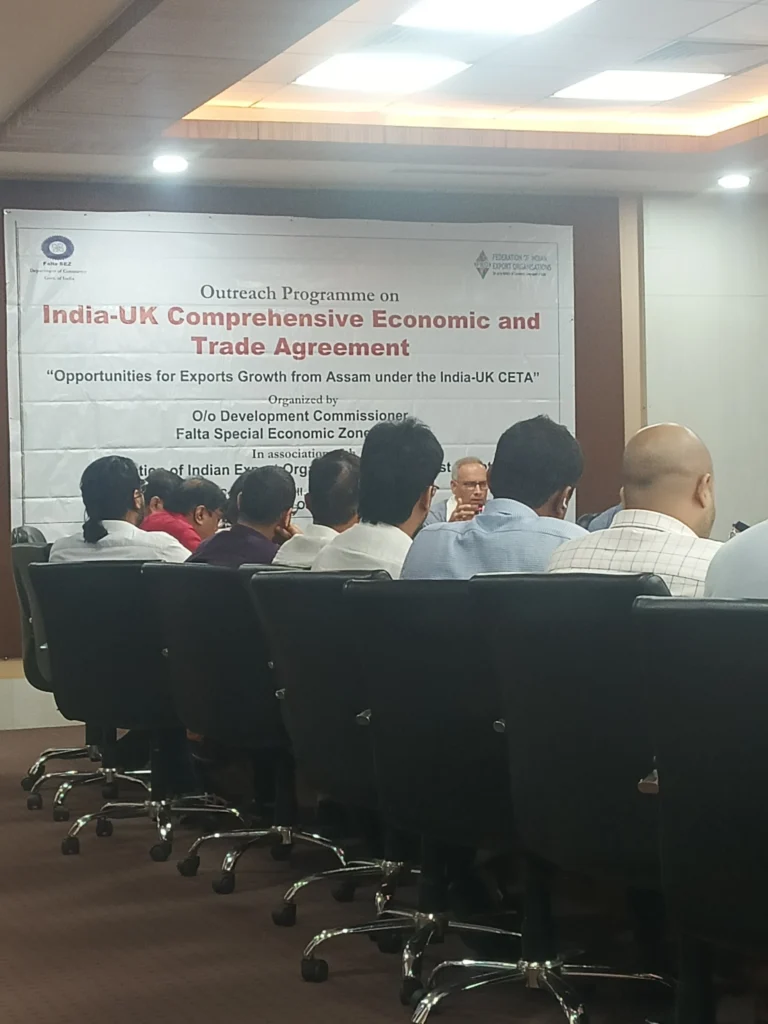
India UK FTA Benefits for MSME Exporters in Northeast India
The FIEO Guwahati meeting stressed that the Northeast region — known for its natural resources and skilled artisans — is particularly well-positioned to benefit. For MSMEs, this means:
- Tea & Organic Products: Assam’s world-famous tea and organic spices can now enter the UK at 0% duty, giving smaller growers and processors better margins.
- Handlooms & Handicrafts: Traditional weavers and bamboo artisans will find global buyers more willing to source due to competitive pricing.
- Agro-processing MSMEs: Startups making packaged foods, herbal products, or bamboo-based goods can now access the health-conscious UK market more easily.
- Services Sector: MSMEs in IT, edtech, and healthcare from the region can leverage smoother digital trade provisions in the FTA.
Products That Will See 0% Duty Under the India UK FTA
| Product / Sector | Earlier UK Import Duty | New Duty Under CETA | Impact for MSMEs |
|---|---|---|---|
| Textiles & Apparel | 8–12% | 0% | Garment MSMEs can now compete equally with Bangladesh exporters |
| Marine Products (shrimp, tuna, fishmeal) | 4–8.5% | 0% | Boost for small seafood processors & exporters |
| Leather & Footwear | 8%+ | 0% | Leather MSMEs gain new UK buyers |
| Engineering Goods & Auto Parts | Up to 18% | 0% | Small component manufacturers gain cost advantage |
| Chemicals & Plastics | ~10%+ | 0% | Specialty chemical MSMEs projected to grow exports 30–40% |
| Gems & Jewellery | Duties earlier applied | 0% | Jewelry artisans and small manufacturers benefit |
| Sports Goods, Toys, Handicrafts | Varies | 0% | Traditional MSME units get duty-free entry to UK |
Leveling the Field with Pakistan & Bangladesh
For decades, Indian exporters, particularly MSMEs, suffered because Pakistan and Bangladesh enjoyed preferential duty-free access in the UK. For a small garment exporter or handicraft unit, this meant Indian products often cost more than those from these neighbors, despite equal or better quality.
Now, the India UK FTA benefits ensure:
- Indian MSMEs in textiles, apparel, and leather can finally compete on equal terms.
- Marine product exporters no longer carry a tariff disadvantage.
- Buyers in the UK can choose Indian goods without cost bias, expanding opportunities for smaller exporters.
This creates not just parity but also an opportunity for India to outperform with its reputation for quality and reliability.
Impact of the India UK Trade Deal on MSMEs
The broader impact of the India UK trade deal goes beyond trade numbers:
- Increased Export Orders – MSMEs can now attract small-volume orders from UK buyers who were earlier hesitant due to tariffs.
- More Jobs in Local Economies – Growth in textiles, handicrafts, and agro-processing will create employment in rural and semi-urban India.
- Boost to Regional MSMEs – States like Assam, Manipur, and Meghalaya can convert their unique products into global success stories.
- Encouragement for Startups – Young entrepreneurs in food, crafts, and digital services will find it easier to expand to the UK.
A Turning Point for Indian MSMEs
The India UK CETA is not just another free trade agreement. It is a gateway of opportunity, especially for MSMEs who form the backbone of India’s export ecosystem.
As emphasized in the FIEO Guwahati meeting, the key for MSMEs is to act quickly:
- Identify products in the 0% duty list,
- Upgrade certifications and packaging,
- Explore partnerships in the UK,
- And leverage this deal to enter the market before competitors do.
With tariffs removed and a level playing field achieved, Indian MSMEs can finally step onto the global stage with confidence. The impact of the India UK trade deal will be felt in every workshop, weaving cluster, and agri-processing unit that dares to dream bigger.
🚨 Latest Update (15 July 2026): India–UK CETA is Now Officially in Force
Update: The India–UK Comprehensive Economic and Trade Agreement (CETA) officially came into force on 15 July 2026, marking a significant milestone in trade relations between India and the United Kingdom.
With the agreement now operational, eligible Indian exporters can start availing tariff concessions and preferential market access under the treaty. The implementation is expected to benefit thousands of Indian MSMEs, manufacturers, exporters and service providers by making Indian products more competitive in the UK market.
For businesses planning to export to the UK, this is no longer just a future opportunity—the agreement is now in effect, and eligible exports can benefit from its provisions.
What’s New After India–UK CETA Came Into Force?
The implementation of the agreement brings several important developments for Indian businesses:
✅ India–UK CETA is Now Operational
After completing all legal and administrative formalities, both India and the UK have officially implemented the trade agreement from 15 July 2026.
✅ Preferential Tariff Benefits Begin
Eligible Indian exporters can now claim reduced or zero customs duty on qualifying products exported to the UK, depending on the tariff schedule under the agreement.
✅ Electronic Certificate of Origin Available
The Directorate General of Foreign Trade (DGFT) has enabled the electronic issuance of Preferential Certificates of Origin, making it easier for exporters to claim CETA benefits while exporting to the UK.
✅ Customs Procedures Activated
Indian Customs and UK authorities have put the necessary implementation procedures in place so that eligible shipments can receive preferential treatment under the agreement.
✅ Double Contribution Convention (DCC) Also Comes into Effect
Along with CETA, the Double Contribution Convention (DCC) has also become operational. Under this arrangement, eligible Indian professionals temporarily working in the UK may be exempt from making social security contributions in both countries for the specified period, reducing costs for businesses and employees.
What Should Indian MSMEs and Exporters Do Now?
💡 Find Genuine UK Buyers Faster
Looking for verified importers in the UK?
Instead of relying on random online directories, you can use Volza Import Export Data to identify active UK importers, view shipment records, analyze competitors, and discover companies already importing products from India.
👉 Check UK import data with Volza and start finding genuine buyers today. ( START A FREE TRAIL)
Now that the agreement is in force, Indian businesses should start preparing to make the most of the new opportunities.
✔ Check Whether Your Products Qualify
Verify whether your export products are covered under the India–UK CETA tariff schedule and understand the applicable duty benefits.
✔ Understand Rules of Origin
To claim preferential tariff benefits, your products must satisfy the Rules of Origin prescribed under the agreement. Exporters should carefully review these requirements before shipping.
✔ Apply for a Preferential Certificate of Origin
Obtain the required Certificate of Origin through the DGFT-authorised electronic system before exporting eligible goods.
✔ Improve Packaging and Labelling
Ensure that your products comply with UK packaging, labelling and quality standards. Better branding and compliance can improve acceptance in international markets.
✔ Identify UK Buyers
This is an excellent time to connect with importers, distributors and wholesalers in the UK. Businesses can use export promotion councils, trade fairs, B2B platforms and verified import-export databases to find genuine buyers.
✔ Consult Your CHA or Freight Forwarder
Before shipping under CETA, discuss documentation requirements, customs procedures and tariff claims with your Customs House Agent (CHA) or freight forwarder.
Business Zindagi’s Take
The implementation of the India–UK CETA is an important milestone, but signing a trade agreement alone does not guarantee export success.
Businesses that invest in product quality, international compliance, competitive pricing, strong branding and buyer development will be in the best position to benefit from this historic agreement.
For Indian MSMEs, manufacturers and first-time exporters, this is the right time to explore the UK market and build long-term export relationships
📌 Quick Action Checklist for Exporters
- ✅ Check whether your product is covered under India–UK CETA.
- ✅ Understand the Rules of Origin requirements.
- ✅ Apply for a Preferential Certificate of Origin through DGFT.
- ✅ Ensure your product meets UK quality, packaging and labelling standards.
- ✅ Connect with genuine UK importers and distributors.
- ✅ Review export documentation with your CHA or freight forwarder.
- ✅ Stay updated with future DGFT and CBIC notifications related to CETA.
📚 Suggested Articles
If you found this article helpful, you may also like these practical guides on BusinessZindagi.com:
- 📦 Best Free Import Export Databases to Find Global Buyers
- 🔍 How to Find Genuine Overseas Buyers for Your Products
- 🛡️ ECGC Export Credit Insurance: Benefits, Eligibility & Application Process
- 💰 Collateral-Free Working Capital Loan for MSMEs: Complete Guide
- How to Use Global Trade Data to Find Verified International Buyers (2026 Guide)
✍️ About the Author
Tabrez is the founder of BusinessZindagi.com and an entrepreneur from Assam with practical experience in MSMEs, tea exports, import-export business, and government schemes. Through Business Zindagi, he shares practical business knowledge, real-world experiences, and the latest updates to help entrepreneurs, exporters, startups, and small business owners make informed decisions and grow their businesses.
🤖 AI Transparency
This article was researched and written with the assistance of Artificial Intelligence (AI) and has been carefully reviewed, fact-checked, and edited by the Business Zindagi editorial team using official government notifications and trusted news sources to ensure accuracy and usefulness.
💼 Affiliate Disclosure
Some links on this page may be affiliate links. If you purchase a product or service through these links, Business Zindagi may earn a small commission at no additional cost to you. We recommend only those tools and services that we believe can genuinely help entrepreneurs, MSMEs, and exporters.
Sources & References
- Press Information Bureau (PIB) – India–UK Comprehensive Economic and Trade Agreement (CETA)
- News On AIR – India–UK CETA Comes into Force on 15 July 2026
- The Economic Times – India–UK FTA Comes into Effect Today: Unlocking Duty-Free Access for Indian Exports