
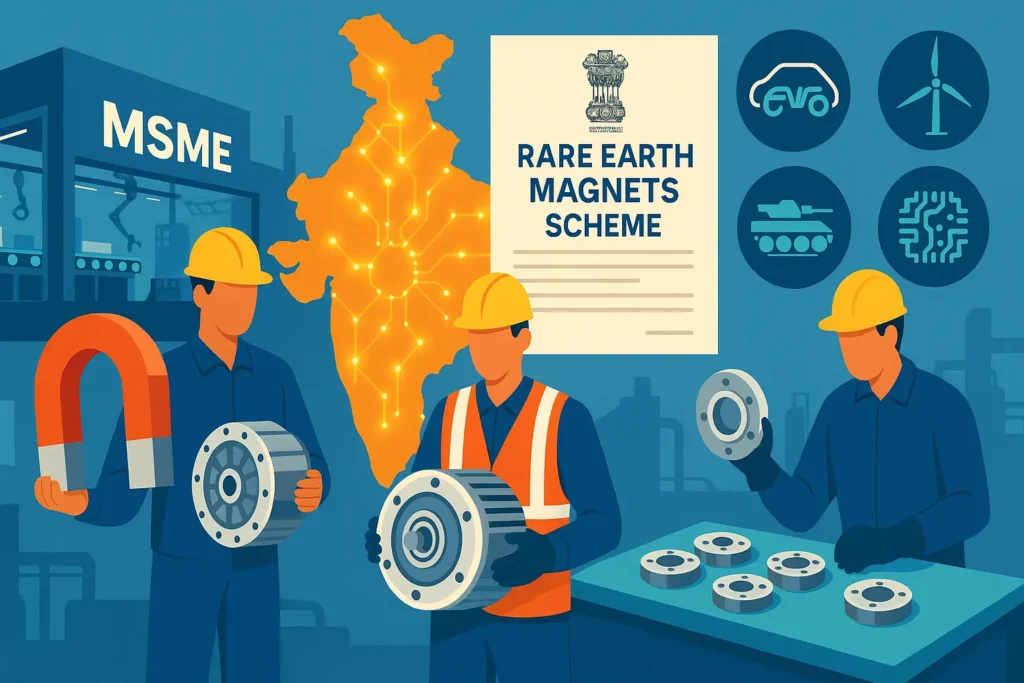
India has officially greenlit the ₹7,280-crore Rare Earth Magnets Scheme, but this approval represents far more than a policy decision — it marks the beginning of a new industrial strategy.
For the first time, India is attempting to build a full-stack magnet manufacturing ecosystem, from raw materials to finished permanent magnets, breaking free from China’s overwhelming dominance.
This time, the story isn’t just about “making magnets in India.”
It’s about reshaping supply chains, lowering industrial vulnerability, and creating pathways for MSMEs to enter sectors that were once out of reach.
related post: Rare Earth Magnets Manufacturing Scheme: What It Means for Indian MSMEs and Small Businesses
Why the Rare Earth Magnets Scheme Is More Important NOW Than When First Announced
When the scheme was initially proposed earlier this year, India’s goal was import reduction.
Now, with China tightening export restrictions and global geopolitical tensions rising, the scheme has become a strategic necessity.
In other words:
Earlier → “We should make magnets in India.”
Now → “If we don’t produce them here, core industries will suffer.”
This shift in urgency creates new opportunities and new responsibilities, especially for small and medium enterprises.
What’s New in the Approved Rare Earth Magnets Scheme
Most people only saw the headline numbers. But the final approved version includes several subtle but important shifts compared to earlier drafts:
✅ 1. Clearer Focus on Integrated Value Chains
Instead of scattered production, the scheme pushes for 5 integrated facilities that will handle:
- Rare earth oxide processing
- Metal conversion
- Alloy production
- Magnet manufacturing
For MSMEs, this means large anchor factories will create clusters, increasing opportunities for vendors, suppliers, and services.
✅ 2. Stronger Emphasis on Strategic Sectors
The approval document mentions explicit support for:
- Electric mobility
- Defence production
- Renewable energy
- Industrial automation
- Electronics manufacturing
MSMEs in these sectors — even indirect suppliers — will see long-term stability in costs and sourcing.
✅ 3. Competitive Bidding Will Create Collaboration Pathways
The scheme will use a global competitive bidding model, meaning:
- Indian firms may partner with Japanese/Korean magnet specialists
- MSMEs may become part of joint ventures
- Startups may enter niche parts of the value chain (coatings, precision magnets, prototyping)
This opens doors for technology transfer that were not possible earlier.
How the Rare Earth Magnets Scheme can Change India’s Tech Manufacturing Roadmap
🔹 1. India Moves From “Assembly Economy” to “Core Component Maker”
Today, India assembles EVs, wind turbines, appliances, drones, and electronics — but imports key components.
With domestic magnet manufacturing, India moves a step closer to becoming a foundation-level manufacturer, not just a final assembler.
This is similar to what happened in:
- Solar sector (cells → modules → plants)
- Pharma sector (APIs → formulation → global leadership)
Magnets could be the next such transformation.
🔹 2. MSMEs Will Form the “Invisible Backbone” of This Ecosystem
Though large companies will make the magnets, MSMEs will supply:
- Furnace components
- CNC machining
- Heat treatment
- Surface finishing
- Packaging materials
- Inspection and testing equipment
- Magnet recycling services
These are high-margin MSME niche segments rarely discussed but extremely profitable.
🔹 3. New Magnet-Dependent Industries Will Take Birth
Local magnets mean:
- Cheaper BLDC motors
- Affordable EV kits
- New drone startups
- Advanced robotics units
- Compact wind power products
- Smart home and IoT manufacturing
Startups and innovators can experiment more now because the cost barrier drops.
Rare Earth Magnets Scheme: Expanded Benefits for MSMEs
1. Cluster Creation = Local Business Boom
New REPM clusters will bring:
- Vendor parks
- Tool rooms
- Training centres
- Ancillary units
- Industrial services
Expect states like Gujarat, Tamil Nadu, Karnataka, Odisha, and Andhra Pradesh to compete for magnet clusters.
2. High-Value Jobs in Tier-2 & Tier-3 Cities
Magnet factories demand:
- Metallurgists
- Electric motor engineers
- Material scientists
- CNC programmers
- Coating specialists
MSME training institutes can seize this as a new market.
3. Export Capability for Niche Components
Instead of exporting low-value products, MSMEs can export:
- Small motors
- Medical devices requiring precision magnets
- Custom magnet assemblies
- Drone propulsion systems
- Magnet-based sensors
This shifts India upward in the global value chain.
Challenges MSMEs Must Prepare For (New Insights)
1. High Precision Requirements
REPM components have extremely tight tolerances.
MSMEs must invest in:
- Laser measurement tools
- Quality labs
- CNC upgrades
- Heat-treatment accuracy
2. Recycling Will Become a Goldmine
China already makes money from recycling magnet scrap.
Indian MSMEs can build early advantage in:
- Scrap recovery
- Magnet reprocessing
- Rare earth extraction
3. Global Competition Won’t Wait
Japan, Vietnam, and South Korea are rapidly expanding magnet capacity.
India must focus on:
- R&D
- Reliability
- Certifications
to stay competitive.
The Big Picture: India’s Self-Reliant Strategy Takes Shape
The Rare Earth Magnets Scheme is not an isolated policy — it is part of a larger blueprint:
- PLI for electronics
- EV manufacturing push
- Green hydrogen mission
- Defence indigenisation
Rare earth magnets sit at the intersection of all these missions.
Conclusion: A New Industrial Era Begins — and MSMEs Must Not Miss It
The approval of the Rare Earth Magnets Scheme marks a turning point.
India is moving away from depending on imported critical components and towards building high-tech capabilities at home.
For MSMEs and startups:
👉 The opportunities are new.
👉 The entry barriers are lower.
👉 The demand is long-term.
👉 And early movers will benefit the most.
This is more than a policy.
It is a once-in-a-decade industrial shift, and MSMEs have a chance to lead it — not follow it.
FAQs on the Rare Earth Magnets Scheme
1. What sectors will benefit the most?
EVs, defence, wind energy, electronics, drones, motors, and automation.
2. Can small businesses directly apply for incentives?
They can collaborate with larger manufacturers or become certified suppliers.
3. Will magnet prices fall after domestic production starts?
Yes — local production will reduce import duties, freight costs, and delays.
4. Which MSMEs have the highest immediate opportunity?
Those in machining, heat treatment, coatings, testing, and lightweight motor manufacturing.
5. How soon will the scheme’s impact be visible?
Cluster development and bidding are expected to begin within months of approval.
About the Author
Tabrez — Founder, BusinessZindagi.com
An entrepreneur writing real-world insights on MSME challenges, finance, exports, government schemes, and manufacturing opportunities.
Focused on simplifying complex policies so India’s small businesses can grow with clarity.
Authentic Source Links
Reuters Report
https://www.reuters.com/world/india/india-approves-816-mln-rare-earth-permanent-magnets-manufacturing-programme-2025-11-26/
Financial Express
https://www.financialexpress.com/policy/economy-govt-clears-rs-7280-crore-scheme-to-boost-rare-earth-magnet-manufacturing-4056521/