
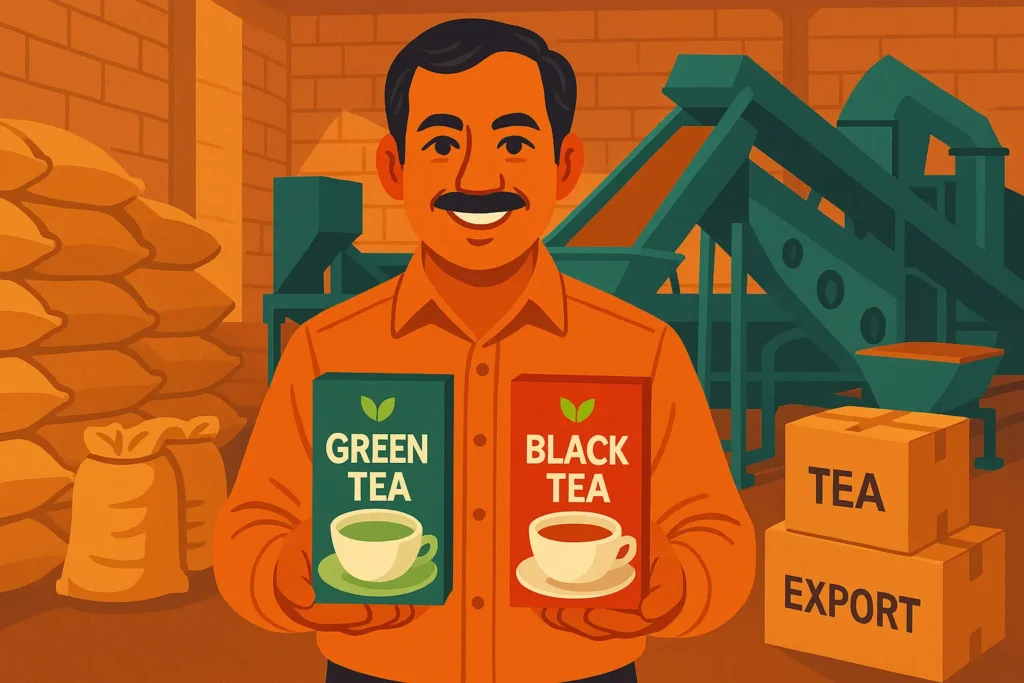
India is the world’s second-largest tea producer and one of the oldest tea exporters. From Assam black CTC tea to Darjeeling orthodox, Indian tea has a huge global market with rising demand every year.
In this guide, I’ll share:
✔ How tea export from India works
✔ Why tea is one of the easiest and best products for new exporters
✔ The step-by-step export process
✔ Mandatory documents for different countries
✔ Best markets + growing markets
✔ My personal story: How I built my tea export business without money
How to Start Tea Export From India: How I Started Tea Export From India without my investment.
I grew up with a simple dream—to build a business of my own. I didn’t have money, contacts, or a business background. But I had strong determination.
My journey started with a small tea packaging unit. Slowly, I learned about tea export from India, global demand, and how small exporters were earning good income with low investment.
I researched markets, studied regulations, attended DGFT and Tea Board webinars, and connected with overseas buyers through online platforms.
My first export order was small—only a LCL shipment. But that order changed everything.
the difference between LCL and FCL shipments
Today, I export different varieties of Indian tea, including:
- Assam CTC
- Darjeeling Orthodox
- Masala Chai blends
- Green tea
I want to tell you this clearly:
💬 “If I could start tea export from India with almost no capital, anyone can.”
You don’t need a factory, warehouse, or big money.
You need knowledge, consistency, and the right strategy.
Why Tea Is One of the Best Products to Export From India
1. Huge Global Demand
Tea is consumed heavily in 100 + countries. India’s tea quality and variety give it a natural edge.Especially the Assam and darjeeling tea varieties.
2. Easy to Start
Low investment, easy procurement, simple packaging options.
3. Stable, Repeat Orders
Tea is a consumable product → buyers reorder every month.
4. High Profit Margins
Margins can go from 20% to 30% depending on branding and grade.
5. Government Support
The Tea Board of India actively promotes exporters.
Link: https://tea-board.gov.in
6. Easiest Product to Export as a Beginner
Unlike food items like meat or dairy, tea faces fewer restrictions.
❗ When NOT to Enter the Tea Export (Very Important)
Many newcomers enter tea export without understanding the challenges. Here are solid, practical reasons when you should avoid this business:
1. If You Don’t Have Patience for Long Sales Cycles
Finding genuine international buyers can take 3–6 months or more.
If you expect quick money, tea export is NOT for you.
2. If You Don’t Understand Quality Variations in Tea
Tea is not a standardized product.
CTC, Orthodox, Dust, Fanning, Leaf grades—all vary in:
- taste
- color
- aroma
- moisture
- density
If you cannot handle quality complaints, disputes, and sampling process, avoid this business.
3. If You Don’t Want to Invest in Sample Shipments
Buyers demand samples before placing orders.
You must pay for:
- courier charges
- lab reports
- packaging samples
If you are not ready to spend a little upfront, tea export will disappoint you.
4. If You Cannot Maintain Consistent Quality
Tea bought today may not taste 100% same next month.
If a buyer’s repeat order quality differs, you may lose the client forever.
5. If You Are Afraid of International Compliance
Some markets have strict rules:
- EU demands extremely low pesticide residue
- USA requires FDA registration
- Japan requires rigorous testing
- Saudi Arabia has strict labeling rules
If you cannot handle documentation pressure, avoid these markets or avoid exporting altogether.
6. If You Want Fast Returns Without Building Relationships
Tea buyers stay loyal. But only after trust is built.
If you prefer one-time deals instead of long-term partnerships, this sector may not suit you.
7. If You Expect Every Inquiry to Convert Into Orders
Export business has:
- time-wasters
- brokers
- low-price seekers
- fake inquiries
Only 5–10% inquiries convert into serious orders.
If that frustrates you, tea export may not be ideal.
8. If You Cannot Handle Price Fluctuations
Tea auction prices change weekly.
If price fluctuations scare you, avoid this business.
9. If You Want a Zero-Risk Business
Currency fluctuation, shipment delays, customs issues—everything carries risk.
Tea export is profitable, but not risk-free.
Country-Wise Requirements
1. Middle East (UAE, Saudi Arabia, Qatar, Bahrain)
✔ Very high demand
✔ Easiest for beginners
✔ Documents required:
- Halal certificate (sometimes needed)
- Lab test report
- Certificate of Origin
Growing demand for Masala tea, CTC tea.
2. Russia, CIS, Kazakhstan
✔ Large volume buyers
✔ Prefer Assam CTC and Orthodox tea
✔ Requires:
- Phytosanitary certificate
- Lab analysis
- Invoice & COO
Market size is stable, long-term.
3. USA & Canada
Moderately strict regulations.
Documents required:
- FDA Registration (for exporters shipping to USA)
https://www.fda.gov - FSSAI
- Tea quality report
- Ingredient list (for flavored teas)
Demand growing for green tea, herbal blends, and organic tea.
4. Europe (Germany, UK, France, Italy)
Highly regulated markets.
Requirements:
- Strict pesticide residue reports
- Organic certification (if claiming organic)
- Phytosanitary certificate
- CE certificate not required for tea
- Compliant packaging & labeling
High demand for Darjeeling tea.
5. Africa (Egypt, Morocco, South Africa)
Price-sensitive markets.
Prefer:
- Bulk tea
- Low-cost blends
Growing market for India’s CTC tea.
Where Indian Tea Has Huge Market
- UAE
- Russia
- USA
- UK
- Germany
- Iran
- Kazakhstan
- Egypt
- Saudi Arabia
Where Indian Tea Has Limited Market
- China (self-producing country)
- Japan (strict quality norms, traditional tea culture)
Where The Market Is Rapidly Growing
- Middle East
- East Africa
- Eastern Europe
- South East Asia (Vietnam, Malaysia, Indonesia)
These markets are increasing their imports every year.
Government portal:
https://www.indiantradeportal.in
🌍How to Start Tea Export From India by finding Genuine Tea Buyers through import data?
Finding reliable buyers is often more challenging than completing export documentation. Instead of sending thousands of random emails, successful exporters focus on identifying companies that are already importing tea and then approach them with targeted samples and competitive offers.
Here are some of the most effective ways to find genuine international tea buyers:
- Participate in international food and beverage trade fairs.
- Connect with importers through LinkedIn and B2B marketplaces.
- Join Tea Board India buyer–seller meets and export promotion events.
- Build a professional website showcasing your products and certifications.
- Network with freight forwarders, customs brokers, and overseas distributors.
- Ask satisfied buyers for referrals—one happy customer can often lead to several new opportunities.
how Use Import–Export Trade Data to find genuine tea buyers?
One of the smartest ways to find genuine buyers is by analysing actual import shipment data rather than relying on generic business directories.
Platforms like Volza allow exporters to search import records, identify companies that are actively importing tea, discover destination countries, estimate shipment frequency, and understand sourcing patterns. This helps you approach businesses that are already buying tea instead of contacting random prospects. According to Volza’s trade database, tea shipments continue to move through hundreds of verified exporters and buyers across major importing markets, providing valuable insights for market research and lead generation.
🔍 Save Hours of Buyer Research
Instead of guessing who might import tea, use verified import–export intelligence to identify companies that are already purchasing tea in your target market. Check out Volza Import Export Data and start building a qualified buyer list with confidence. (Affiliate Link)
💼 Exporter’s Insight
One lesson I learned from my own export journey is that finding the right buyer is more important than finding many buyers. A long-term customer who places repeat orders is far more valuable than dozens of one-time enquiries. Invest time in understanding your buyer’s quality expectations, packaging preferences, payment terms, and market requirements before negotiating on price.
📢 Affiliate Disclosure
Affiliate Disclosure: Some links in this article may be affiliate links. This means BusinessZindagi may earn a small commission if you purchase a product or service through those links, at no extra cost to you. We only recommend tools, software, and services that we believe can genuinely help tea exporters, MSMEs, and entrepreneurs based on our research, practical experience, and industry relevance. Your support helps us continue creating free, high-quality business guides and export resources.
Can You Start Tea Export From India Without Big Investment?
YES.
Many exporters start:
- without a factory
- without machinery
- without employees
You can begin as a merchant exporter—buy tea from trusted suppliers in Assam, Siliguri, Kolkata auctions, or private factories ,pack it and export it at your unit or at a rented unit.
This is exactly how I started.
📢 Tea Export from India: Latest Update (2026)
2026 Update: India’s tea export sector continues to show strong momentum despite global economic uncertainties. According to official government data, India exported 262.98 million kg of tea worth ₹7,817.58 crore (US$923.89 million) during FY 2024–25, reflecting healthy global demand for premium Indian tea. During April–December FY 2025–26, exports had already reached 223.53 million kg valued at ₹6,880.53 crore, indicating another encouraging year for Indian tea exporters. Rising demand for value-added teas, specialty Assam and Darjeeling teas, and private-label packaging is creating new opportunities for exporters targeting international markets.
BusinessZindagi Tip: If you’re planning to enter the tea export business, don’t focus only on bulk tea. Value-added products such as retail packs, tea bags, green tea, matcha, herbal blends, and private-label manufacturing often offer better profit margins and stronger brand recognition in overseas markets.
📚 Suggested Articles
If you’re planning to build a successful tea export business, these practical guides from BusinessZindagi will help you at every stage of your journey:
- Tea Business in India: From Assam to the World – My Journey and Opportunities for New Entrepreneurs
- 🔍 How to Find Genuine Foreign Buyers for Export Business
- Export to Russia from India: Why Now Could Be the Best Time to Start (Complete 2026 Guide)
- Work Contract Agreement: Why Exporters Must Be Cautious and Learn from My Mistakes
- 🛡️ ECGC Export Credit Insurance: How It Protects Indian Exporters
- Tea Packaging: Real Opportunities & Hidden Risks (From My Own Business Journey)
- Best Free Import Export Databases (Beginner Guide): How to Find Genuine Export Buyers Without Paying Thousands
About the Author
Tabrez — Entrepreneur, Tea Exporter & MSME Mentor
I built my tea packaging and export business from scratch with limited resources. Today, I help new entrepreneurs learn about tea export from India, MSME loans, and small business growth.
I believe anyone can become an exporter with the right guidance and persistence.
Disclaimer
The information provided in this article is for educational and general informational purposes only. Although every effort has been made to ensure accuracy, export regulations, documentation requirements, government policies, and market conditions change frequently and may vary from country to country.
Readers are advised to:
- Verify all regulatory requirements with official authorities (DGFT, Tea Board of India, FSSAI, Customs, etc.)
- Consult certified export professionals, customs brokers, or legal advisors before making business decisions
- Conduct independent market research before entering any export market
The author and the website businesszindagi.com are not responsible for any losses, delays, compliance issues, rejections, or financial impacts arising from actions taken based on this content.
Exporting involves financial and regulatory risks. Proceed with due diligence.