
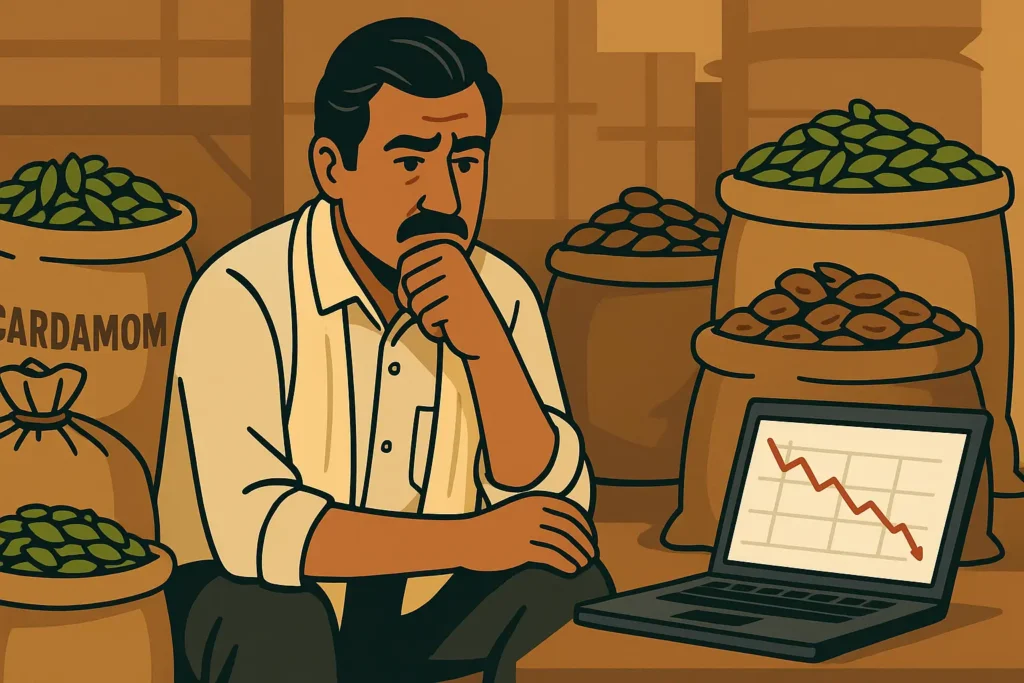
(Lessons I Learned After Heavy Losses, Bad Quality & Price Crashes)
The cardamom business often looks attractive from the outside—high value, strong demand, and the impression that margins are “naturally good.” That’s what I believed when I entered this trade.
I have been doing cardamom trading for nearly two years, buying from South India and selling in North Indian markets. Even today, after all this time, I must say this very honestly:
👉 I still cannot confidently predict how cardamom prices will move tomorrow.
Six months ago, a sudden price decline forced me to sell my stock at a heavy loss. Since then, restarting the business has not been easy—financially or mentally.

What made it worse was this:
my last consignment also had quality issues, and prices fell at the same time.
This article is not theory.
It is about real mistakes in cardamom business, including my own.
related post: Inside the green Cardamom Auction Power System: How South India Built the Most Transparent Spice Marketplace”
Why Mistakes in Cardamom Business Hurt More Than Other Trades
Cardamom is not a forgiving commodity.
It is:
- Highly price volatile
- Extremely quality sensitive
- Dependent on trust-based supply chains
When even one factor goes wrong, losses multiply.
When two factors go wrong together—quality and price—you are trapped.
you may also like to read: Green Cardamom Business in India: Profit, Peril, and the Price Roller-Coaster
Mistake #1: Believing Experience Alone Can Predict Cardamom Prices
After two years of trading, I expected clarity.
But the truth is:
- Prices move due to too many variables
- Many of them are outside a trader’s control
Weather, auctions, export demand, hoarding, sudden arrivals—everything plays a role.
Assuming that experience alone guarantees price prediction is one of the most dangerous mistakes in cardamom business.
Mistake #2: Underestimating How Sudden Price Declines Can Be
My biggest financial setback came from a sharp, unexpected price fall.
There was:
- No gradual warning
- No time to plan an exit
- No chance to recover cost
I sold at a loss not because I wanted to—but because holding longer felt even riskier.
Cardamom prices don’t always correct slowly.
Sometimes, they collapse brutally.
Mistake #3: Trying to Sustain Cardamom Business Without a Strong Supplier
This is a very underrated but critical issue.
The harsh reality:
Without a reliable, quality-conscious supplier, sustaining a cardamom business is extremely difficult.
In my last consignment:
- The quality was not as expected
- Grading issues reduced buyer confidence
- And at the same time, market prices dropped suddenly
This combination is deadly.
Why supplier quality matters:
- Poor quality reduces negotiation power
- Buyers push prices down faster
- You lose flexibility during market falls
A bad supplier can turn a normal price correction into a major loss.
Mistake #4: Getting Hit by Bad Quality and Price Fall Together
Individually:
- Bad quality is manageable
- Price fall is manageable
Together:
- They become destructive
When quality is weak:
- You cannot wait
- You cannot hold
- You cannot negotiate
I was forced to sell faster—and cheaper.
This is one of the most painful cardamom trading mistakes, especially for small traders.
Mistake #5: Overconfidence in Holding Decisions
Another hard lesson:
The market does not care about your buying price.
Holding stock with hope—without a downside plan—is dangerous.
Common errors:
- Emotional attachment to stock
- Waiting for “just a small recovery”
- Ignoring liquidity pressure
Risk management matters more than market intelligence.
Mistake #6: Ignoring the Emotional Impact of Losses
After my loss:
- Confidence dropped
- Decision-making slowed
- Restarting felt mentally heavy
This part of trading is rarely discussed.
Many traders don’t quit because the cardamom business is bad—but because one bad cycle breaks their confidence.
Mistake #7: Treating Cardamom Like a Regular Commodity
Cardamom is not like grains or pulses.
It is:
- High-value
- Low-volume
- Emotion-driven
Even a small mistake can cause disproportionate losses.
This is why capital protection is more important than profit chasing.
The Real Truth About Cardamom Business (From Ground Reality)
After all these experiences, one truth stands out:
👉 The cardamom business is not about prediction.
👉 It is about survival, supplier strength, quality control, and risk discipline.
Even knowledgeable traders:
- Cannot control prices
- Cannot control weather
- Cannot control sentiment
But they can control how much they risk and who they buy from.
Frequently Asked Questions (FAQ)
❓ What are the biggest mistakes in cardamom business?
Overconfidence, ignoring price volatility, poor supplier selection, bad quality control, and weak risk management.
❓ How important is a good supplier in cardamom trading?
Extremely important. Without a reliable supplier, sustaining the cardamom business long-term is very difficult.
❓ What happens if quality is bad and prices fall together?
Losses increase sharply because buyers negotiate harder and holding stock becomes risky.
❓ Is cardamom business risky for beginners?
Yes. Beginners should start small, focus on quality, and avoid aggressive holding strategies.
About the Author
Tabrez Khan is a first-generation entrepreneur and commodity trader with real-world experience in the cardamom trading business, sourcing from South India and selling in North India. Through BusinessZindagi.com, he shares honest, experience-based insights on MSME businesses, trading risks, exports, and entrepreneurship—focusing on reality, not hype.
Disclaimer
This article reflects the author’s personal trading experience and is for educational purposes only. Commodity trading involves risk, and results may vary based on market conditions, quality, and individual decisions. Readers should conduct their own due diligence before investing.