
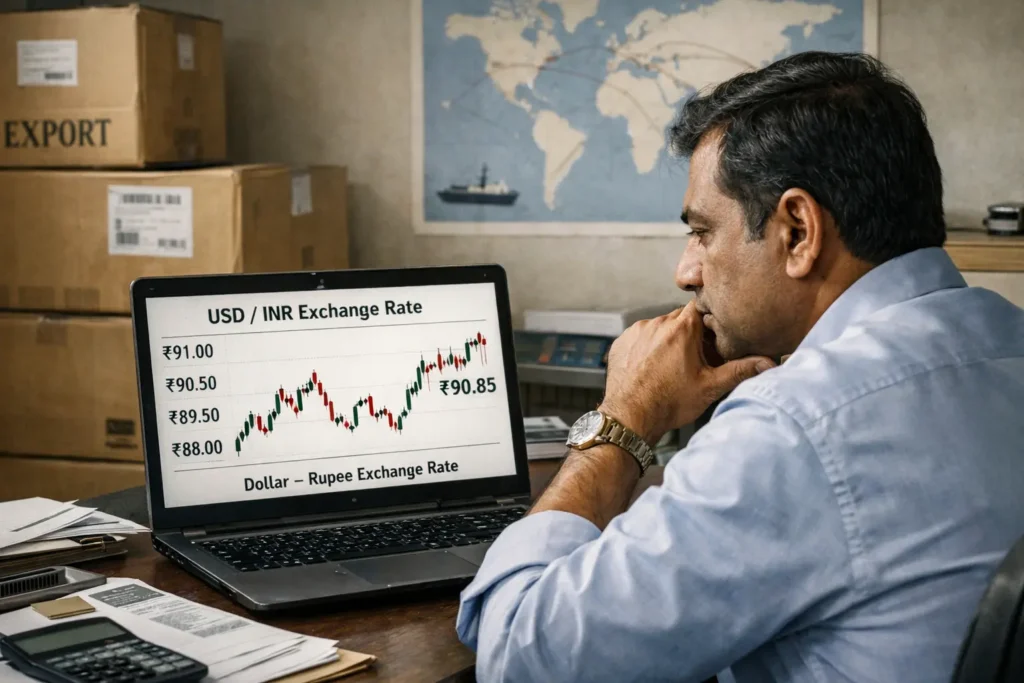
(From Real Trade Experience)
Why the Dollar–Rupee Exchange Rate Is a Daily Reality for Exporters
For many people, the Dollar–Rupee Exchange Rate is just a headline on business news channels.
For an exporter, it is something far more serious — it decides profit, loss, and sometimes survival.
When I was actively exporting, tracking the dollar–rupee rate became a daily habit. Some days, a stronger dollar meant instant relief and better margins. On other days, sudden movements wiped out expected profits even before the shipment reached the buyer.
This article explains — from real trade experience — how the Dollar–Rupee Exchange Rate impacts Indian exporters’ profit, what mistakes many MSMEs make, and how small exporters should think about currency movements in a practical way.
you may also like to read: Dollar Rupee at ₹91: Why this record Fall Matters for Indian Businesses and Consumers
Why the Dollar–Rupee Exchange Rate Matters So Much in Export Business
Most Indian exporters are paid in US dollars (or currencies linked to it).
But almost all costs — raw material, labour, transport, electricity, bank charges — are in Indian rupees.
That gap is where the Dollar–Rupee Exchange Rate becomes critical.
Simple logic:
- You earn in dollars
- You spend in rupees
- The exchange rate decides how much rupees your dollar income converts into
A small movement in the exchange rate can change:
- Net profit per shipment
- Pricing competitiveness
- Cash flow timing
- Ability to accept or reject future orders
Dollar–Rupee Exchange Rate and Exporters’ Profit: A Simple Example
Let’s break this down in a very practical way.
Scenario:
- Export order value: $10,000
Case 1: Dollar at ₹80
$10,000 × 80 = ₹8,00,000
Case 2: Dollar at ₹90
$10,000 × 90 = ₹9,00,000
👉 ₹1,00,000 difference on the same export order, without selling even 1 extra unit.
This is why exporters often say:
“Price didn’t change, buyer didn’t change — but profit changed.”
My Real Trade Experience with the Dollar–Rupee Exchange Rate
During my export shipments, I used to track the Dollar–Rupee Exchange Rate almost every day.
There was a simple reason:
- A stronger dollar meant more rupees credited when the bank converted export proceeds.
- It directly improved working capital comfort and profit margins.
I clearly remember being happy when the dollar strengthened — not because of speculation, but because:
- My export pricing was already fixed
- My costs were locked in rupees
- The exchange rate movement alone improved profitability
However, I also learned the hard way that:
- Sudden reversals can hurt
- Ignoring currency risk is dangerous
- Blindly depending on a weak rupee is not a business strategy
When a Weak Rupee Helps Exporters — and When It Doesn’t
How a Weak Rupee Helps
- Higher rupee realization for the same dollar invoice
- Better price competitiveness in global markets
- Temporary cushion against rising domestic costs
When a Weak Rupee Does NOT Help
- If raw materials are imported
- If freight and insurance costs rise
- If buyers demand price renegotiation
- If exchange rate volatility delays payment decisions
👉 The Dollar–Rupee Exchange Rate is helpful only when cost structure is well understood.
Dollar–Rupee Exchange Rate Volatility: The Hidden Risk for MSME Exporters
Many small exporters think:
“If the rupee falls, exporters always benefit.”
That is only half the truth.
Real risks exporters face:
- Rate falling after order confirmation but before shipment
- Rate strengthening before payment realization
- Bank conversion charges eating into gains
- Delay in buyer payment during volatile periods
Without planning, volatility can turn expected profit into uncertainty.
Available Hedging Options for Managing Dollar–Rupee Exchange Rate Risk
For Indian exporters, hedging is often misunderstood. Many think hedging is only for large corporates or involves complicated financial instruments.
In reality, basic hedging tools are easily accessible to MSME exporters through banks.
Hedging does not mean trying to make extra profit — it means protecting existing profit from adverse movement in the Dollar–Rupee Exchange Rate.
1. Forward Contracts (Most Common Hedging Tool)
A forward contract allows exporters to lock a fixed Dollar–Rupee Exchange Rate for a future date.
How it works:
- You have a confirmed export order
- Payment is expected after 30, 60, or 90 days
- You lock today’s exchange rate with your bank
- On payment date, the bank converts dollars at the agreed rate — regardless of market movement
Example:
If today’s rate is ₹88 and you fear the rupee may strengthen:
- You lock ₹88 via a forward contract
- Even if the rate becomes ₹85 later, your realization remains protected
✔ Best for exporters with thin margins
✔ Reduces uncertainty
✖ You lose upside benefit if the dollar strengthens further
2. Option Contracts (Flexible but Costly)
Currency options give exporters the right, but not the obligation, to convert dollars at a specific rate.
Why exporters use options:
- Protection from downside risk
- Ability to benefit if the dollar strengthens
Drawback:
- Options involve a premium cost
- Not always suitable for small shipments
✔ Suitable for experienced exporters
✖ Not very popular among small MSMEs due to cost
3. Natural Hedging (Often Ignored but Powerful)
Many exporters unknowingly hedge naturally.
Examples:
- Importing raw material in dollars
- Paying overseas freight or insurance in dollars
- Holding dollar expenses against dollar income
This balances inflow and outflow, reducing exposure to Dollar–Rupee Exchange Rate volatility.
✔ No extra cost
✔ Simple and practical
✖ Works only if dollar expenses exist
4. Invoicing Strategy as a Partial Hedge
Exporters can manage risk by:
- Negotiating shorter payment cycles
- Using advance payments
- Avoiding long credit periods during volatile phases
While not a formal hedge, smart invoicing reduces exposure to sudden exchange rate shocks.
Why Many MSME Exporters Avoid Hedging (And Why That’s Risky)
From ground reality, many small exporters avoid hedging because:
- They feel it is “too complex”
- Banks do not proactively explain it
- They believe rupee will always weaken
- They had one good cycle and became overconfident
But the truth is:
Ignoring hedging is also a decision — and often a costly one.
My Practical View on Hedging as an Exporter
From my experience:
- Hedging is not about maximizing gains
- It is about sleeping peacefully after shipment
- It brings discipline to export business
- It protects profits already earned
For MSME exporters, partial hedging is better than no hedging.
When Should Exporters Consider Hedging Dollar–Rupee Exchange Rate Risk?
You should seriously consider hedging if:
- Profit margins are tight
- Payment cycles are long
- Shipment value is large
- Market volatility is high
- Cash flow predictability is important
Hedging is not compulsory — but risk awareness is.
Pricing Export Orders with Dollar–Rupee Exchange Rate in Mind
One mistake I see many new exporters make is:
- Pricing exports assuming the current exchange rate will remain unchanged
Smarter pricing approach:
- Keep a buffer margin
- Avoid ultra-thin margins
- Understand breakeven exchange rate
- Never price only to “beat competitors”
Export business rewards discipline, not optimism.
Should Small Exporters Track Dollar–Rupee Exchange Rate Daily?
Yes — but not emotionally.
Track it to:
- Understand trends
- Plan cash flows
- Time conversion wisely (within limits)
- Improve business awareness
Don’t track it to:
- Panic daily
- Speculate
- Make impulsive pricing decisions
The Dollar–Rupee Exchange Rate is a business variable, not a gambling tool.
Common Mistakes Exporters Make Related to Dollar–Rupee Exchange Rate
- Assuming rupee will always weaken
- Ignoring currency risk in pricing
- Not understanding bank conversion mechanisms
- Confusing export profit with exchange gains
- Overconfidence after one good currency cycle
These mistakes are common — and expensive.
Key Lessons for Indian Exporters
- The Dollar–Rupee Exchange Rate directly impacts profit
- Currency movement can boost or destroy margins
- Real exporters plan for volatility, not hope against it
- Sustainable export businesses focus on product + pricing + discipline
Frequently Asked Questions (FAQ)
Is a weak rupee always good for Indian exporters?
No. It helps only if costs are rupee-based and pricing is managed properly.
Should exporters wait for a better dollar rate before converting?
Timing helps, but waiting too long increases risk. Discipline matters more.
Do small exporters need hedging?
Basic awareness is important, but hedging should match business scale and understanding.
How often should exporters track Dollar–Rupee Exchange Rate?
Regularly, but without emotional decision-making.
Final Thoughts: Dollar–Rupee Exchange Rate Is a Silent Business Partner
For Indian exporters, the Dollar–Rupee Exchange Rate works silently in the background — sometimes helping, sometimes hurting.
Those who respect it, understand it, and plan around it survive longer than those who ignore it.
Export success is not only about finding buyers —
it is about managing realities that don’t appear on invoices.
About the Author
Tabrez is an entrepreneur and exporter with hands-on experience in Indian trade and MSME business realities. Through BusinessZindagi.com, he shares practical lessons from real successes, failures, and ground-level business experience to help small business owners make informed decisions.
Disclaimer
This article is based on personal trade experience and general business understanding. It does not constitute financial or investment advice. Exporters should consult professionals before making major currency or pricing decisions.
Sources & References
- Reserve Bank of India (RBI) – Exchange Rate & Forex Data
👉 https://www.rbi.org.in
(Authoritative source for Dollar–Rupee Exchange Rate trends and RBI policy) - CCIL – USD/INR Reference Rates
👉 https://www.ccilindia.com
(Official clearing corporation for forex markets in India) - EXIM Bank of India – Export Finance & Risk Insights
👉 https://www.eximbankindia.in