
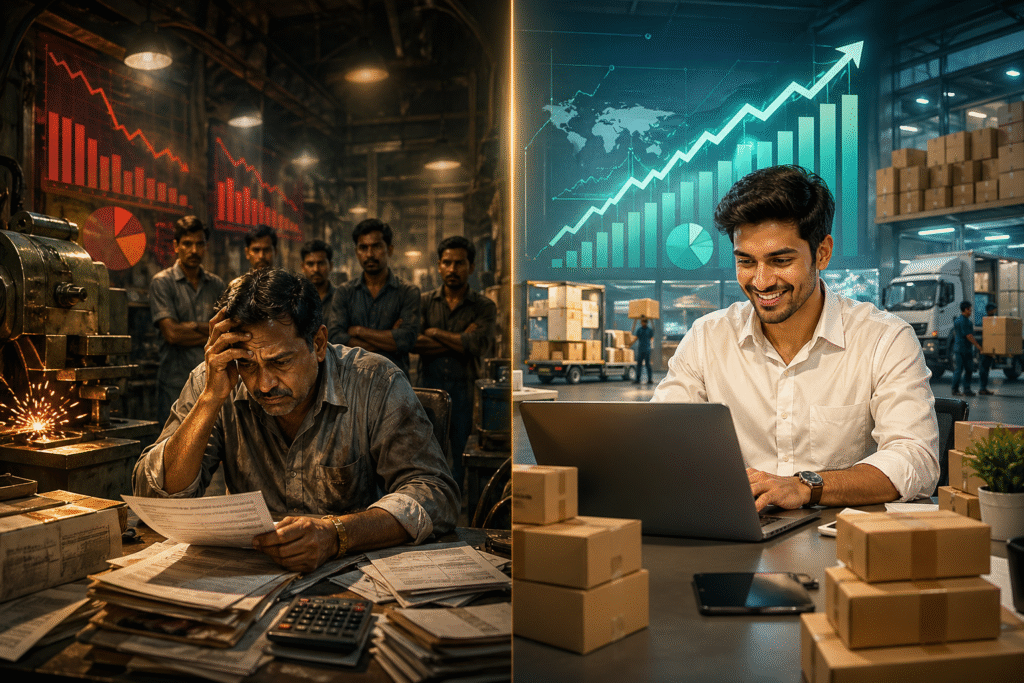
Choosing between trading and manufacturing is one of the most important decisions for any entrepreneur in India. While manufacturing is often seen as the backbone of the economy, the reality on the ground tells a different story.
👉 A large number of Indian MSMEs prefer trading or importing goods, especially from China.
So, which business actually has higher margins? And why is trading dominating?
Let’s break it down logically.
Trading vs Manufacturing : Profit Margin Comparison
Trading Business Margin
- Average Margin: 10% – 40%
- In some niches: even 50%+
Why margins are attractive:
- No production cost
- No factory setup
- Faster buying and selling cycle
- Easy scalability
👉 Traders earn by price difference + volume
Manufacturing Business Margin
- Average Margin: 5% – 25%
Why margins are lower:
- Raw material costs (volatile)
- Labour expenses
- Electricity & maintenance
- Machinery investment
- Compliance costs
👉 Profit depends on efficiency, scale, and cost control
Trading vs Manufacturing Ground Reality: Margin vs Effort
| Factor | Trading | Manufacturing |
|---|---|---|
| Investment | Low–Medium | High |
| Risk | Low | High |
| Complexity | Simple | Complex |
| Cash Flow | Fast | Slow |
| Profit Consistency | High | Uncertain |
👉 Conclusion:
Trading offers faster and easier profits, which is why it attracts more small business owners.
Trading vs Manufacturing:Why Indian Businesses Prefer Trading Over Manufacturing
Faster Cash Flow = Survival
In India, cash flow is everything.
- Traders rotate money quickly
- Manufacturers often wait months for payments
👉 This makes trading more practical for small businesses
Price Volatility Kills Manufacturing Margins
Industries like aluminium, steel, and plastic face constant price changes.
👉 If raw material prices increase suddenly:
- Manufacturer’s cost rises
- Selling price may not increase immediately
➡️ Result: Profit gets squeezed or turns into loss
Trading vs Manufacturing: Compliance & Regulatory Burden
Manufacturers deal with:
- GST filings
- Pollution control rules
- Factory inspections
- Labour regulations
Entities like Ministry of Micro, Small and Medium Enterprises and Goods and Services Tax Council aim to support MSMEs, but:
👉 On-ground compliance is still time-consuming and costly
China has a massive advantage:
- Large-scale production
- Lower cost per unit
- Government support
- Strong supply chains
👉 Example:
- Indian manufacturing cost = ₹100
- Chinese import cost = ₹60–₹70
➡️ Traders can earn more without producing anything
Lack of Scale in Indian MSMEs
Most small manufacturers:
- Produce in low quantities
- Face higher per-unit cost
- Cannot compete with bulk imports
👉 This makes trading more profitable in many cases
Credit Pressure on Manufacturers
- Manufacturers sell on credit (30–90 days)
- Expenses are immediate
👉 Traders often maintain faster payment cycles
Skill & Technology Gap
Manufacturing requires:
- Skilled labour
- Process control
- Technical knowledge
👉 Many MSMEs lack access to:
- Automation
- Advanced machinery
- Efficient systems
Trading vs Manufacturing: Which Business Should You Choose?
👉 Choose Trading If:
- You have low capital
- You want quick returns
- You want less risk
👉 Choose Manufacturing If:
- You have long-term vision
- You can invest capital
- You want to build a brand
Trading vs Manufacturing: Smart Strategy Used by Successful Entrepreneurs
Most smart business owners follow this path:
- Start with trading
- Understand demand
- Build customer network
- Move into manufacturing
👉 This reduces risk and increases success rate
📉 Future Outlook: Will Manufacturing Grow in India?
India is pushing manufacturing through initiatives like:
- Make in India
- PLI Schemes
But for manufacturing to compete with imports:
- Costs must reduce
- Infrastructure must improve
- Compliance must simplify
👉 Until then, trading will remain dominant in MSMEs
❓ FAQ
Q1. Which business is more profitable in India?
Trading is generally more profitable for small businesses due to lower cost and faster cash flow.
Q2. Why do Indian businesses import from China?
Because products are cheaper due to large-scale production and lower costs.
Q3. Is manufacturing a bad business?
No. It’s powerful for long-term growth, but requires capital, patience, and efficiency.
👤 About Author
Tabrez Khan is the author on BusinessZindagi.com .He is focused on explaining real-world business challenges, MSME insights, and practical strategies for Indian entrepreneurs.
⚠️ AI Disclaimer
This article is created with the help of AI and real-world business insights for educational purposes. Readers are advised to verify details before making financial decisions.
Sources and references🔗 1. India vs China Manufacturing Reality
👉 India vs China Manufacturing Analysis
- India’s manufacturing contributes only 16–17% of GDP vs China’s ~27%
- Shows clearly that China is still far ahead in scale and efficiency