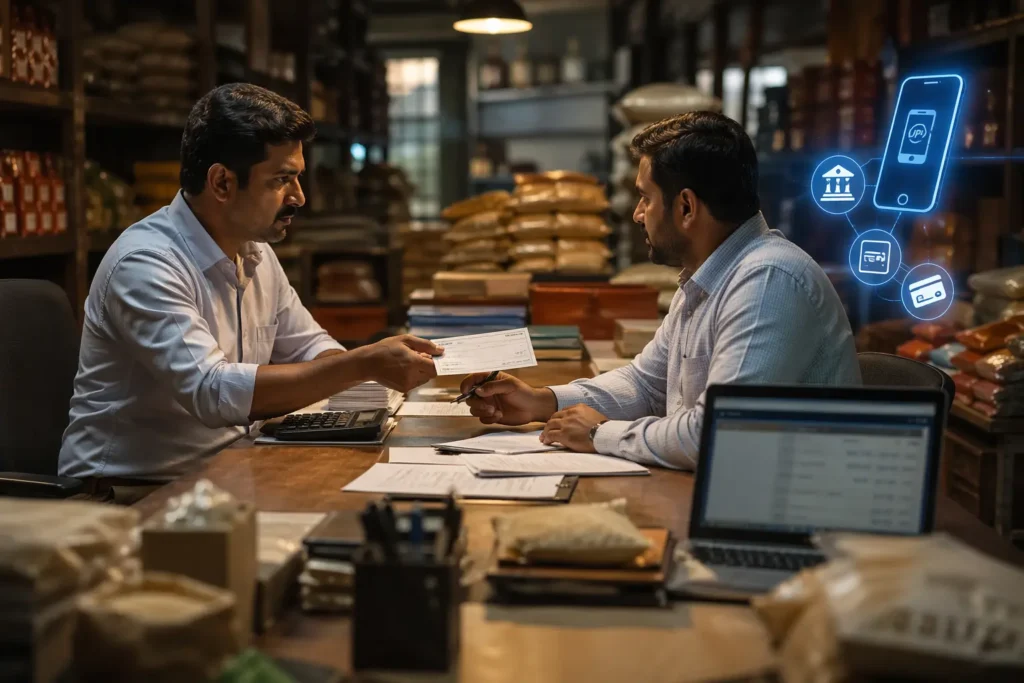
In a country where UPI processes billions of instant transactions every month, it’s easy to assume that cheques are outdated.
But step inside real business environments—wholesale markets, construction sites, manufacturing units—and you’ll see a different reality:
👉 Cheques are still very much alive.
Not because they are faster or more convenient—but because they offer something digital payments often don’t:
👉 Control, leverage, and strategic flexibility.
This article breaks down why smart business owners still prefer cheques—and how they use them as a powerful negotiation tool in business deals.
related article: Cheque Bounced Despite Sufficient Balance? My Real Experience with Positive Pay System
The Big Myth: Cheques Are Obsolete
Digital payments are growing rapidly. But cheques haven’t disappeared—they’ve simply evolved into a strategic instrument.
👉 Today:
- Digital = speed and convenience
- Cheque = control and negotiation power
And smart businesses know when to use which.
1. Cheques Give You Payment Control (Not Just Payment Speed)
With digital transfers:
- Money is gone instantly
- No reversal window
- No flexibility
With cheques:
- You control when the payment is deposited
- You can align payments with your cash flow
👉 This is critical for businesses with:
- Irregular revenue cycles
- Seasonal demand
- Working capital pressure
💡 Insight:
Cheques allow timing strategy, not just payment execution.
2. Post-Dated Cheques = Built-In Credit System
One of the biggest advantages of cheques is post-dating.
👉 Example:
- You issue a cheque dated 45 days later
- Supplier agrees to deposit it later
This acts like:
👉 Interest-free short-term credit
Used heavily in:
- Real estate
- Wholesale trade
- Manufacturing supply chains
💡 This is something digital payments cannot replicate naturally.
3. Legal Strength Creates Payment Discipline
Cheque transactions are backed by strong legal provisions in India.
👉 If a cheque bounces:
- Legal action can be initiated
- It creates serious consequences for the issuer
This gives:
👉 Confidence to the receiver
👉 Accountability to the payer
💡 Digital transfers don’t offer the same level of enforceable commitment.
4. Trusted in High-Value & Formal Deals
For large or sensitive transactions, businesses often prefer cheques because:
- They create a documented trail
- They are widely accepted in contracts
- They signal seriousness
👉 Common use cases:
- Security deposits
- Vendor agreements
- Partnership deals
5. Cash Flow Management Advantage
Smart businesses don’t just focus on profit—they manage cash flow timing.
Cheques allow:
- Delayed outflow
- Planned liquidity
- Better working capital control
👉 This is especially important for MSMEs.
6. Cheques as a Powerful Negotiation Tool
Now comes the most underrated advantage.
👉 Cheques are not just payment instruments—they are negotiation tools.
Let’s break this down.
A. Negotiating Better Credit Terms
Instead of immediate payment, businesses offer:
👉 Post-dated cheques in exchange for:
- Longer credit periods
- Bulk purchase discounts
- Flexible payment terms
💡 Supplier perspective:
- They get a commitment
- They reduce default risk
👉 Result: Win-win deal
B. Securing Better Pricing
Cash is king—but commitment is powerful too.
👉 Businesses often say:
“I’ll give you post-dated cheques—give me a better rate.”
This works because:
- Supplier gets payment assurance
- Buyer gets price advantage
C. Locking in Deals Without Immediate Cash
In many industries, deals happen before funds are available.
👉 Cheques help:
- Lock inventory
- Secure contracts
- Reserve supplies
👉 Without immediate payment
D. Building Trust Without Full Upfront Payment
Cheques act as a middle ground between trust and security.
👉 For new business relationships:
- Full advance may feel risky
- Credit may not be available
👉 Solution:
Post-dated cheque
💡 It signals:
“I am committed—but I need time.”
E. Risk Management in Negotiations
From a supplier’s point of view:
👉 Cheque = legal backing + payment assurance
So they are more willing to:
- Extend credit
- Offer better terms
- Prioritize your orders
But Why Not Just Use Digital Payments?
Digital systems like UPI are excellent for:
- Instant payments
- Small transactions
- Convenience
But they lack:
- Payment timing flexibility
- Negotiation leverage
- Legal enforcement strength
📊 Cheque vs Digital Transfer (Real Business View)
| Factor | Cheque | Digital Payment |
|---|---|---|
| Speed | Slow | Instant |
| Control | High | Low |
| Negotiation power | Strong | Weak |
| Legal backing | Strong | Limited |
| Flexibility | High | Low |
🔮 The Real Trend
Cheques are not disappearing.
👉 They are becoming specialized tools for strategic transactions.
Future:
- Daily payments → Digital
- Strategic payments → Cheques
Final Insight
Smart business owners don’t choose between cheque and digital.
👉 They use both—strategically.
- Use digital for speed
- Use cheques for control and negotiation
💡 In business, how you pay is as important as how much you pay.
And that’s exactly why cheques still matter in 2026.
❓ FAQ
Why do businesses still use cheques
Because they offer control, legal security, and negotiation flexibility.
Are cheques better than digital payments
Not better—different. Each serves a specific purpose.
Can cheques be used as credit
Yes, post-dated cheques act as short-term credit tools.
Are cheques still relevant in India
Yes, especially in B2B transactions and large deals.
✍️ About the Author
BusinessZindagi Editorial Team
Helping MSMEs and entrepreneurs understand real-world business strategies.
⚠️ AI Disclaimer
This article is created with the assistance of AI for informational purposes only. Always consult financial or legal experts before making business decisions.
🔗 Sources & References
- Reserve Bank of India – Cheque Truncation System (CTS) & Payment Systems
https://www.rbi.org.in/Scripts/FAQView.aspx?Id=17 - National Payments Corporation of India – UPI System & Digital Payments Data
https://www.npci.org.in/what-we-do/upi/product-overview - Ministry of Finance – Digital Payments & Financial Inclusion Initiatives
https://financialservices.gov.in