
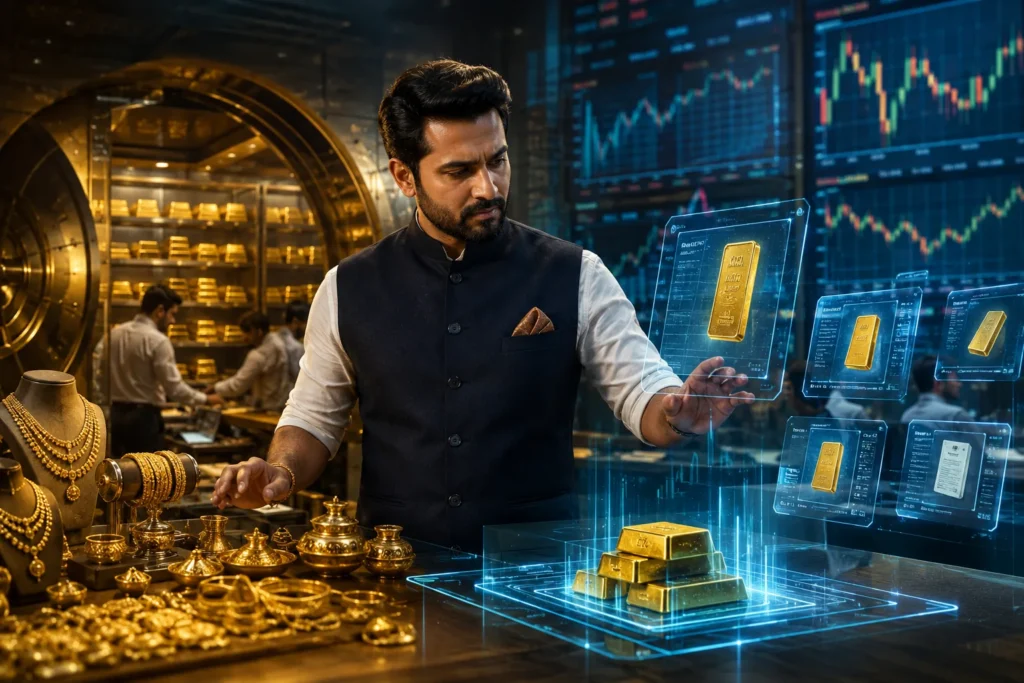
India’s relationship with gold is emotional, cultural, and financial. From weddings and festivals to business investments and savings, physical gold has dominated the Indian economy for generations. But now, a new digital system called Electronic Gold Receipts is slowly changing the way gold can be bought, stored, and traded.
After the success of digital payments and demat investing, India is now moving toward exchange-based gold trading through Electronic Gold Receipts. The recent launch of the Electronic Gold Receipts on may 4th 2026 , by the National Stock Exchange has brought fresh attention to the future of gold trading in India.
This raises an important question for investors, jewellers, MSMEs, bullion traders, and small businesses:
Can Electronic Gold Receipts eventually replace traditional physical gold trading in India?
The answer is complex, but the transformation has already begun.
related article:The Hidden Risk in Gold Loans: What Margin Calls Mean for Small Business Borrowers
What is a Electronic Gold Receipt?
Electronic Gold Receipts, commonly called EGRs, are digital securities representing ownership of physical gold stored in SEBI-approved vaults.
Instead of holding physical gold bars or coins yourself, the gold is securely stored in accredited vaults, and ownership is reflected electronically in your demat account. These receipts can then be traded on stock exchanges just like shares.
In simple words:
Physical gold is converted into a digital tradable asset.
The Securities and Exchange Board of India (SEBI) introduced the framework for Electronic Gold Receipts to modernise India’s highly fragmented gold market.
you may also like to read: Electronic Gold Receipts for Jewellery Businesses: How MSMEs Can Benefit in India
Why India Is Pushing Electronic Gold Receipts
India is one of the world’s largest gold consumers. However, most gold transactions still happen in the unorganised sector.
This creates several challenges:
- inconsistent pricing,
- purity concerns,
- storage risks,
- tax leakage,
- lack of transparency,
- informal cash transactions.
Electronic Gold Receipts are designed to solve many of these problems by bringing gold trading into a regulated digital ecosystem.
The recent NSE launch aims to:
- improve transparency,
- standardise gold trading,
- create efficient price discovery,
- increase investor confidence,
- formalise India’s gold economy.
artcile you may like to read: Falling Gold Prices Shake MSME Finances: What Gold-Loan Borrowers Must Know
How Electronic Gold Receipts Work
The system works through multiple regulated entities:
- SEBI,
- stock exchanges,
- vault managers,
- depositories like NSDL and CDSL,
- clearing corporations.
Here is the basic process:
- Physical gold is deposited into a SEBI-approved vault.
- The gold is verified for purity and quality.
- Electronic Gold Receipts are issued against that gold.
- These EGRs are credited to a demat account.
- Investors can buy, sell, or trade them electronically.
The system also allows conversion back into physical gold if needed.
Can Electronic Gold Receipts Replace Physical Gold Trading?
Electronic Gold Receipts have strong potential to reduce dependence on traditional physical gold trading, especially in organised investment and business transactions.
However, completely replacing physical gold in India may take many years because gold in India is not only an investment but also an emotional and cultural asset.
Still, Electronic Gold Receipts can significantly transform how gold is traded, stored, financed, and invested.
Why Electronic Gold Receipts Could Become Popular
1. Safer Than Storing Physical Gold
One of the biggest problems with physical gold is storage risk.
Jewellers, traders, and investors often spend heavily on:
- lockers,
- insurance,
- transportation,
- security.
Electronic Gold Receipts eliminate many of these risks because the gold remains stored in regulated vaults.
2. Better Transparency
Traditional gold trading often suffers from:
- varying purity,
- inconsistent pricing,
- hidden charges.
Electronic Gold Receipts create a more transparent exchange-based trading system with standardised quality and pricing.
3. Easier Trading and Liquidity
Physical gold transactions can be slow and inconvenient.
Electronic Gold Receipts allow investors and traders to:
- buy instantly,
- sell quickly,
- trade online,
- hold gold digitally.
This improves liquidity and efficiency in the gold market.
4. Strong Potential for MSMEs and Small Businesses
Electronic Gold Receipts could become especially useful for:
- jewellers,
- bullion traders,
- exporters,
- small gold businesses,
- rural traders.
Possible benefits include:
- digital ownership proof,
- easier inventory management,
- improved financing opportunities under gold loan schemes
- transparent valuation.
Over time, banks and financial institutions may become more comfortable accepting digital gold-backed assets for lending.
5. One Nation One Gold Price
A major issue in India’s physical gold market is price inconsistency across regions.
Electronic Gold Receipts support a more standardised national pricing mechanism. NSE itself highlights unified pricing as a major benefit of EGR trading.
Why Physical Gold Still Dominates India
Despite the advantages of Electronic Gold Receipts, physical gold remains deeply rooted in Indian society.
Emotional and Cultural Value
Indian families buy gold for:
- weddings,
- festivals,
- traditions,
- gifting,
- inheritance.
Physical jewellery has emotional value that digital receipts cannot replace.
Rural India Still Prefers Physical Ownership
A large section of rural India still prefers tangible gold ownership.
Many people trust:
- gold jewellery,
- coins,
- bars,
more than digital assets.
Internet awareness and demat adoption are also lower in many regions.
Jewellery Demand Will Continue
Even if Electronic Gold Receipts grow rapidly, physical jewellery demand is unlikely to disappear because wearable gold serves a completely different purpose.
Challenges Facing Electronic Gold Receipts
Low Public Awareness
Most retail investors and MSMEs still do not fully understand how Electronic Gold Receipts work.
Awareness remains one of the biggest barriers.
Limited Liquidity
Electronic Gold Receipts are still new in India.
Large-scale participation from traders, investors, and institutions will be needed for deep liquidity.
Dependence on Vault Infrastructure
The EGR ecosystem depends heavily on:
- vault managers,
- logistics,
- purity testing,
- digital systems.
Building nationwide infrastructure will take time.
Competition From Gold ETFs and Digital Gold Apps
Electronic Gold Receipts will also compete with:
- Gold ETFs,
- digital gold apps,
- sovereign gold bonds,
- traditional bullion trading.
Each format serves different investor needs.
Electronic Gold Receipts vs Physical Gold
| Feature | Electronic Gold Receipts | Physical Gold |
|---|---|---|
| Storage | Vault-based | Self-storage |
| Security | High | Theft risk |
| Trading | Online exchange | Offline market |
| Transparency | High | Varies |
| Liquidity | Faster | Slower |
| Emotional value | Low | Very high |
| Purity standardisation | Strong | Depends on seller |
| Suitable for jewellery use | No | Yes |
Electronic Gold Receipts vs Gold ETFs
| Feature | Electronic Gold Receipts | Gold ETF |
|---|---|---|
| Backed by physical gold | Yes | Indirectly |
| Exchange traded | Yes | Yes |
| Demat required | Yes | Yes |
| Physical conversion possible | Yes | Limited |
| SEBI regulated | Yes | Yes |
What Experts Believe About the Future
Experts believe Electronic Gold Receipts could become an important part of India’s evolving financial ecosystem.
The system may help:
- formalise gold trading,
- improve transparency,
- reduce unorganised transactions,
- strengthen investor trust,
- modernise India’s gold economy.
The recent launch by NSE and SEBI’s regulatory framework indicate that India is serious about building a structured gold exchange ecosystem.
Final Verdict
Electronic Gold Receipts may not completely replace physical gold trading in India anytime soon, but they can definitely transform a large portion of the organised gold market.
For investors, traders, MSMEs, and jewellers, Electronic Gold Receipts offer:
- better transparency,
- safer storage,
- digital convenience,
- exchange-based liquidity,
- regulated trading.
Physical gold will continue to dominate cultural and jewellery demand, but Electronic Gold Receipts could become the preferred choice for investment-grade gold trading in the future.
India’s gold economy is slowly moving from lockers to digital platforms — and Electronic Gold Receipts may become one of the biggest drivers of that transformation.
Frequently Asked Questions (FAQ)
What are Electronic Gold Receipts?
Electronic Gold Receipts are digital securities representing physical gold stored in SEBI-approved vaults and traded electronically on stock exchanges.
Are Electronic Gold Receipts safe?
Yes. Electronic Gold Receipts operate under SEBI regulations and involve accredited vault managers and regulated exchanges.
Can Electronic Gold Receipts be converted into physical gold?
Yes. Investors can convert Electronic Gold Receipts back into physical gold under the prescribed process.
Who can invest in Electronic Gold Receipts?
Retail investors, jewellers, bullion traders, MSMEs, institutional investors, and gold market participants can invest in EGRs.
Are Electronic Gold Receipts better than physical gold?
Electronic Gold Receipts offer better transparency, security, and liquidity, while physical gold continues to hold emotional and cultural importance.
About Author
Tabrez is a entrepreneur, exporter, trader focused on MSMEs, startups, digital business trends, exports, fintech, and emerging opportunities shaping India’s entrepreneurial ecosystem. Through BusinessZindagi.com, he simplifies complex business topics into practical insights for traders, entrepreneurs, and small business owners.
AI Disclaimer
This article was created with the assistance of AI for research, structuring, and language enhancement purposes. All efforts have been made to ensure accuracy using publicly available information and authentic sources. Readers are advised to verify financial and investment-related information independently before making decision.