
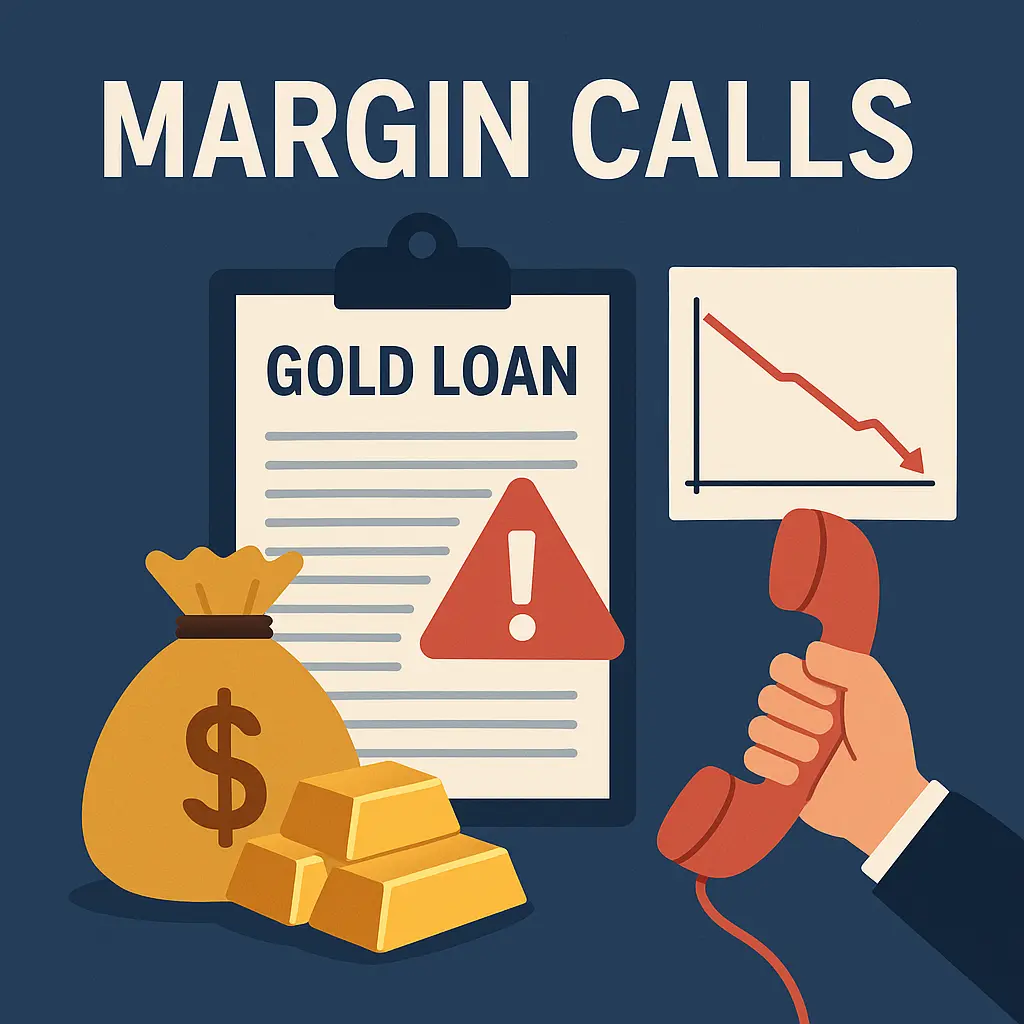
November 2026: Falling Gold Prices Increase Gold Loan Risks
Gold’s sharp correction in November 2026 has raised fresh concerns for India’s gold-loan borrowers and lenders.
According to Financial Express (23 November 2026), domestic gold prices have fallen approximately 26% from their January peak, weakening the collateral coverage of existing gold loans.
The impact is significant because the outstanding loan amount does not automatically decrease when gold prices fall. Consequently, the loan-to-value (LTV) ratio can rise, potentially creating collateral shortfalls.
Moneycontrol also reported on 23 November that the RBI has increased its monitoring of gold-loan portfolios amid concerns about rising LTV ratios, with some loans reportedly exceeding 100% LTV.
For borrowers, this is a reminder that gold loans carry market-linked collateral risks even when repayments are regular.
Sources: Financial Express | Moneycontrol
If gold prices fall significantly, the value of your collateral can decline and your effective LTV can increase. Depending on your lender’s terms, this could increase repayment or margin pressure.
Can Lenders Auction Gold When Prices Fall?
A decline in gold prices alone does not automatically allow a lender to auction pledged jewellery.
However, if a borrower fails to meet repayment obligations or resolve a contractual shortfall, the lender may initiate recovery proceedings under applicable rules.
RBI directions require lenders to provide adequate notice before auctioning pledged gold. They also prescribe a transparent auction process and minimum reserve-price requirements.
Borrowers should contact their lender promptly if they receive a margin-call or repayment notice instead of ignoring the communication.
Source: RBI Gold and Silver Collateral Directions.
📊 Check Your Gold Loan Margin Call Risk
Use our Gold Loan Margin Call Calculator to estimate how changes in gold prices could affect your loan position and potential margin requirement.
👉 Check Gold Loan Margin Call Calculator
Source: RBI data and recent disclosures/reports from Bajaj Finance, Piramal Finance and Shriram Finance. Gold-loan terms and margin requirements vary by lender.
When I First Heard the Term “Margin Call”
Recently, while visiting my bank to renew my gold loan, I heard a term that instantly caught my attention — “margin call.”
As someone who has taken gold-backed loans for business working capital before, I thought I understood how these loans worked. But this time, since gold prices had been falling sharply, I casually asked the banker, “What happens if gold prices fall too much after I take a loan?”
The banker smiled and said, “That’s when we issue a margin call.”
That short conversation stayed with me — because like most Indian entrepreneurs and MSME owners, I had never even heard of margin calls before. And yet, this single concept can affect thousands of small borrowers, traders, and business owners who rely on gold loans for short-term liquidity.
You may also like to read: Can Electronic Gold Receipts Replace Physical Gold Trading?
What Exactly Is a Margin Call?
A margin call is a request from your lender to restore the value of your collateral when its market value drops below the agreed safety margin.
In simple words — when you take a gold loan, the bank lends you only a percentage (usually 75% of the gold’s value). That gap acts as a buffer for the lender.
But if gold prices fall by, say, 10%, the value of your pledged gold automatically declines — meaning your loan is now under-secured. To balance this risk, the bank may:
- Ask you to add more gold as collateral,
- Ask you to partly repay the loan, or
- Reduce your credit limit on renewal.
This process of adjusting the loan due to falling collateral value is what’s called a margin call.
Gold and Silver Prices in 2026: How Rising and Falling Rates Impact Small Businesses
Why Margin Calls Matter for MSMEs and Entrepreneurs
For many small business owners in India, gold loans are the easiest and fastest way to raise short-term funds. Whether it’s restocking inventory, managing working capital, or handling a sudden payment crunch — gold loans have been a financial lifeline.
But what most borrowers don’t realize is that their loan security depends entirely on gold’s market price. When prices drop steeply, even without missing a single EMI, your lender can still demand extra security — that’s a margin call.
Imagine you pledged gold worth ₹10 lakh and borrowed ₹7.5 lakh. If gold prices fall 10%, your collateral’s value drops to ₹9 lakh. Suddenly, your loan is worth more than the safe limit, and the bank may call you to either repay ₹75,000 or pledge additional gold.
For an MSME owner with tight cash flow, this can come as a shock — especially if you’ve never been told about this mechanism.
Check Your Own Gold Loan Margin Call Risk
Understanding margin calls is useful—but the most important question is:
Could your own gold loan be at risk if gold prices fall?
Every gold loan is different. Your risk depends on factors such as your outstanding loan amount, the current value of your pledged gold and the Loan-to-Value (LTV) limit applicable to your loan.
Use our free Gold Loan Risk & Margin Call Calculator below to estimate:
- Your current Loan-to-Value (LTV) ratio
- Your available safety buffer
- Whether your selected LTV limit may be exceeded
- Your potential loan shortfall
- The critical gold price level to watch
- How your position could change if gold prices fall by 5%, 10%, 15% or 20%
🟡 Gold Loan Risk & Margin Call Calculator
[bz_gold_loan_risk_calculator]
Important: This calculator provides an estimated risk analysis based on the information you enter. Your lender’s actual gold valuation, loan agreement, interest dues and internal policies may differ.
Major Gold Loan Companies and How They Handle Margin Calls
India’s gold loan industry is dominated by leading NBFCs and banks such as Muthoot Finance, Manappuram Finance, IIFL Finance, HDFC Bank, Axis Bank, and Federal Bank. Together, they manage a massive share of India’s ₹5-lakh-crore gold loan market.
While all lenders follow RBI’s 75% LTV guideline, their response to falling gold prices varies slightly.
- NBFCs like Muthoot and Manappuram often issue margin call alerts via SMS or phone, giving borrowers a short window (typically a few days) to add more gold or make partial repayment.
- Banks such as HDFC and Axis may instead adjust loan renewal amounts or reduce sanctioned limits to maintain collateral coverage.
- IIFL Finance and Federal Bank tend to revalue pledged gold more frequently in volatile markets.
So, even though the process differs, the rule is universal — when gold prices drop, expect a margin call. Knowing this in advance helps borrowers prepare and avoid unpleasant surprises.
A fall in gold prices does not automatically mean that every borrower will receive a margin call. However, if the lender’s collateral valuation falls sufficiently and your loan exceeds the applicable safety level or LTV requirement, the lender may ask you to restore the required collateral coverage according to the loan terms.
Received a Margin Call? Here’s What You Should Do
Do not ignore a margin call notice. Contact your lender immediately to understand the revised Loan-to-Value ratio and the repayment required. If possible, repay part of the loan or pledge additional eligible gold. Acting quickly can help you avoid penalties and reduce the risk of auctioning your pledged jewellery.
Why Gold Prices Affect Your Loan Security
Gold is traded globally, and prices depend on international markets, inflation, interest rates, and even geopolitical tensions.
When prices rise, your gold’s value increases — but when they fall sharply (as seen recently), borrowers feel the pinch. Lenders continuously monitor gold prices and portfolio risk. When volatility increases, they act fast to protect themselves.
For the borrower, that “margin call” isn’t personal — it’s math.
What You Should Do?
Here’s what every MSME owner or entrepreneur should understand and act on:
- Know Your LTV (Loan-to-Value Ratio):
Most banks lend up to 75% of gold’s value. Borrow less if you want a cushion against price swings. - Track Gold Prices Regularly:
Use apps or financial sites to track gold price trends. If you see a fall, plan for possible margin calls before your lender does. - Keep an Emergency Buffer:
Always keep a small portion of your gold or cash aside to top up collateral quickly if needed. - Ask Questions at the Bank:
Don’t hesitate to ask your lender, “What is your policy if gold prices fall?” Understanding the margin call clause before signing can save stress later. - Use Gold Loans Wisely:
Treat gold loans as short-term liquidity tools, not long-term debt. The faster you repay, the lower the risk of being hit by a margin call.
Why This Awareness Matters
Thousands of small borrowers take gold loans without realizing that falling gold prices can directly affect their loan security. When lenders issue margin calls, borrowers often panic or misunderstand the notice — thinking it’s a penalty.
But in reality, it’s just a protective measure. Awareness helps you stay prepared, confident, and financially disciplined.
As I learned firsthand from that banker — a single conversation can change how you view risk.
RBI Gold Loan LTV Rules 2026: How Much Can You Borrow Against Gold?
The Reserve Bank of India (RBI) introduced revised Lending Against Gold and Silver Collateral Directions, 2025, with compliance required by 1 April 2026.
Under the revised framework, the maximum Loan-to-Value (LTV) ratios for consumption loans are:
| Total consumption loan per borrower | Maximum LTV |
|---|---|
| Up to ₹2.5 lakh | 85% |
| Above ₹2.5 lakh to ₹5 lakh | 80% |
| Above ₹5 lakh | 75% |
What does this mean for borrowers?
Suppose you pledge eligible gold jewellery valued at ₹10 lakh.
- If your loan falls in the up-to-₹2.5 lakh category, the maximum permitted LTV is 85%.
- If your loan falls in the above-₹2.5 lakh to ₹5 lakh category, the maximum is 80%.
- If your loan exceeds ₹5 lakh, the maximum is 75%.
Important RBI requirements:
- The prescribed LTV must be maintained throughout the loan tenure.
- For bullet repayment loans, the total amount payable at maturity, including interest, is considered for calculating LTV.
- Lenders must establish procedures for addressing LTV breaches.
- Gold valuation must follow RBI-prescribed purity and pricing methodology.
These limits apply to consumption loans. Income-generating loans, including eligible business-purpose gold loans, are subject to the lender’s applicable regulatory and credit-policy requirements rather than automatically following the above three-tier
FAQ: Margin Calls and Gold Loans
1. What is a margin call in a gold loan?
A margin call happens when the value of pledged gold falls below the lender’s required safety margin, prompting the bank to ask for more collateral or repayment.
2. Why do gold prices affect my loan?
Gold loan amounts are linked to market value. When prices fall, the same gold secures a smaller value, reducing your loan’s security ratio.
3. Can my bank force me to repay early due to a margin call?
Yes, if your collateral value falls below safe limits. The bank may ask for partial repayment or additional gold.
4. How can MSME borrowers avoid margin calls?
Borrow below the 75% LTV limit, track gold price trends, and maintain extra gold or funds as a safety buffer.
5. Is a margin call the same as loan default?
No. A margin call is a precaution, not a penalty. It ensures your loan remains adequately secured even if gold prices drop.
About Author
Tabrez is a entrepreneur, exporter who is focused on MSMEs, startups, digital business trends, exports, fintech, and emerging opportunities shaping India’s entrepreneurial ecosystem. Through BusinessZindagi.com, he simplifies complex business topics into practical insights for traders, entrepreneurs, and small business owners.
AI Disclaimer
This article was created with the assistance of AI for research, structuring, and language enhancement purposes. All efforts have been made to ensure accuracy using publicly available information and authentic sources. Readers are advised to verify financial and investment-related information independently before making decisions.
References and Further Reading
- RBI Guidelines on Gold Loan LTV Ratios
- Economic Times – What Happens When Gold Prices Fall for Borrowers
- Mint – Why NBFCs Issue Margin Calls in Falling Gold Prices
- Business Standard – Gold Loan Lenders Monitor Collateral Risks Closely