
Indian MSME exporters may be missing an important opportunity to make their products more competitive in international markets.
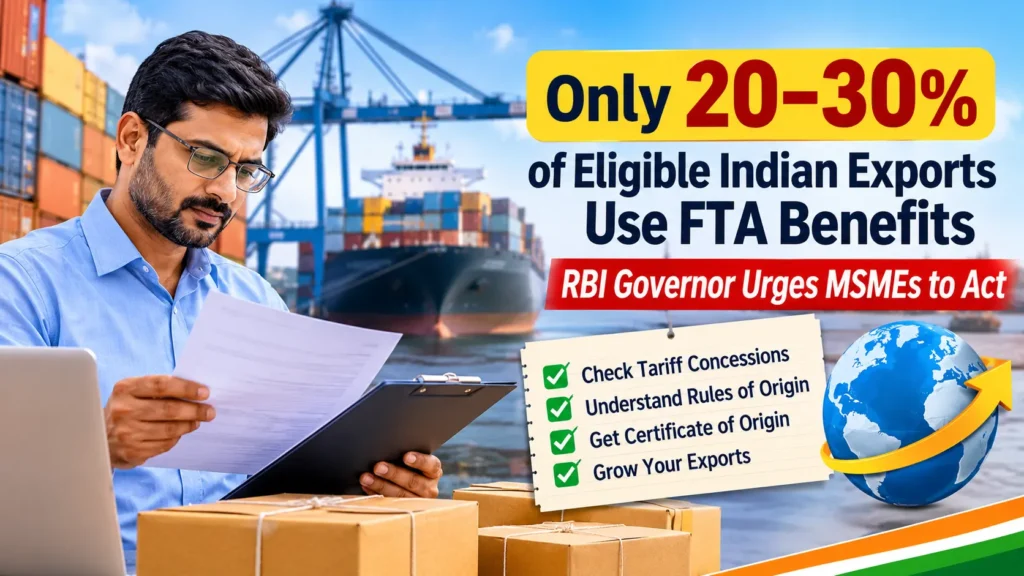
Reserve Bank of India (RBI) Governor Sanjay Malhotra has highlighted a significant gap in India’s utilisation of Free Trade Agreement (FTA) benefits. According to his November 27, 2026 address, only around 20–30% of eligible Indian exports take advantage of lower tariffs available under India’s trade agreements.
In comparison, around 60–70% of eligible exports from India’s FTA partner countries to India utilise these benefits.
The Governor urged MSMEs, particularly labour-intensive businesses, to explore overseas markets, understand the trade agreements relevant to their products and invest in quality, standards and certification.
For India’s small manufacturers, traders and exporters, this is an important reminder: having access to an international market is not enough. Businesses must also understand how to use the benefits available to them.
What are FTA benefits, and why should MSMEs care?
A Free Trade Agreement is a trade arrangement between countries that can reduce or eliminate customs duties on eligible products traded between them.
For example, an Indian manufacturer exporting a qualifying product to an FTA partner country may be able to offer it at a lower landed cost because the overseas importer pays a reduced customs duty.
This can help Indian MSMEs:
- Offer more competitive prices to international buyers.
- Improve their chances of securing export orders.
- Enter new international markets.
- Participate in global supply chains.
- Source certain inputs more competitively, where the agreement permits.
However, FTA benefits are not automatic. The product must qualify under the relevant agreement and satisfy its Rules of Origin and documentation requirements.
How can an Indian MSME check whether its product qualifies?
An exporter should follow these practical steps before quoting an overseas buyer.
1. Identify your product’s HS code
The Harmonised System (HS) code classifies products for international trade. The correct code is essential because preferential tariffs are generally specified product by product.
Do not rely on a generic product description alone. Confirm the applicable classification with a qualified customs or export professional where necessary.
2. Check whether India has an applicable trade agreement
Find out whether India has an operational FTA or preferential trade agreement with your buyer’s country.
India has agreements with several trading partners and regions, including the UAE, Australia, ASEAN countries, Japan, South Korea and EFTA countries, among others.
The agreement and its operational date matter. A signed agreement does not necessarily mean its tariff concessions are already available.
3. Check the preferential tariff rate
A product may receive a reduced or zero customs duty under an agreement, while another product may receive only a partial concession or no concession at all.
Use the official Trade Connect platform to explore tariff information and export opportunities:
Explore Trade Connect – Government of India
4. Understand Rules of Origin
Rules of Origin determine whether a product qualifies as originating from India for the purpose of claiming preferential tariff treatment.
Depending on the agreement and product, requirements may include:
- Minimum domestic value addition.
- Change in tariff classification.
- Specific manufacturing or processing requirements.
- Wholly obtained criteria for certain products.
Simply packing, labelling or carrying out minor processing in India may not be sufficient to establish Indian origin.
5. Arrange the required proof of origin
A preferential Certificate of Origin (CoO), or another form of proof of origin permitted under the relevant agreement, helps establish that the product qualifies for the tariff concession.
The certificate or declaration requirements differ between agreements. Exporters should check the applicable procedure before dispatching their goods.
Official application platform: DGFT Trade Connect – Certificate of Origin
Important development: DGFT introduces Open API for Certificates of Origin
There is also a useful digital development for exporters.
In September 2026, the Directorate General of Foreign Trade (DGFT) introduced an Open API facility for Certificates of Origin through the Trade Connect platform.
Eligible exporters can integrate their ERP, accounting or other business software with the DGFT system to transfer application information electronically.
The facility supports both preferential and non-preferential Certificates of Origin. It can reduce repetitive data entry and help businesses track applications.
This could be particularly useful for exporters handling regular shipments and documentation.
Read the official PIB announcement about the DGFT Open API facility
Which MSME businesses should explore FTA opportunities?
The opportunity is not limited to large manufacturers. Depending on product eligibility and destination-market requirements, several small-business sectors can explore international markets.
| MSME sector | Potential export opportunities |
|---|---|
| Tea and spices | Packaged tea, bulk tea and processed spices |
| Textiles | Garments, fabrics and made-ups |
| Food processing | Processed foods and selected agricultural products |
| Handicrafts | Decorative products and traditional crafts |
| Engineering | Components, tools and selected machinery |
| Leather and footwear | Finished leather products and footwear |
For example, an Indian tea exporter should check the destination country’s tariff schedule, food safety requirements, labelling rules and origin criteria before offering a preferential-duty price to a buyer.
The same principle applies to every product category.
Finding international buyers is another important challenge
Understanding FTA benefits is only one part of exporting successfully. MSMEs must also identify genuine overseas buyers, understand market demand and evaluate competing suppliers.
This is where international trade intelligence can help.
Explore Volza for global trade data and buyer research
If you are planning to expand your export business, you can explore Volza’s trade intelligence platform to research international buyers, suppliers and shipment activity.
Explore Volza – Global Trade Intelligence
Affiliate disclosure: This is an affiliate link. BusinessZindagi may earn a commission if you sign up or purchase through the link, at no additional cost to you. Please review Volza’s features, pricing and terms before subscribing.
RBI also highlights strong growth in MSME bank credit
The RBI Governor’s address also highlighted growth in financing to the MSME sector.
According to the reported figures, outstanding bank credit to MSMEs increased by 27% year-on-year to ₹42.89 lakh crore in September 2026, compared with 19.4% growth in overall bank credit.
While this indicates stronger lending to the sector, access to finance remains an important issue, particularly for first-time borrowers, micro enterprises, women-led businesses and enterprises in smaller towns and rural areas.
For an MSME planning to enter export markets, adequate working capital is essential. Businesses need funds for raw materials, packaging, production, transportation, documentation and the waiting period before receiving payment from overseas buyers.
FTA Utilisation in India: What Do the Latest Government Figures Show?
The government has published data showing a significant increase in Certificates of Origin issued under several Indian trade agreements. These certificates are important because they help eligible exporters establish the origin of their products and claim preferential customs duties in partner countries.
The following figures, published by the Ministry of Commerce and Industry through the Press Information Bureau (PIB) on July 28, 2026, provide a useful picture of FTA-related activity.
Certificates of Origin issued under selected Indian FTAs
| Trade agreement | Certificates issued |
|---|---|
| India–UAE CEPA | 4.45 lakh |
| India–Australia ECTA | 2.73 lakh |
| India–EFTA TEPA | 7,885 |
| India–Mauritius CECPA | 1,956 |
| India–Oman CEPA | 783 |
Source: Ministry of Commerce and Industry, Government of India, PIB, July 28, 2026. Figures are cumulative as reported in the release; the agreements have different implementation dates.
India’s merchandise exports to selected FTA partners
The government also reported the following merchandise export values for FY 2025–26.
| FTA partner / agreement | Indian merchandise exports |
|---|---|
| ASEAN | US$ 38.42 billion |
| UAE | US$ 37.36 billion |
| SAFTA | US$ 25.77 billion |
| United Kingdom | US$ 13.44 billion |
| Singapore | US$ 11.86 billion |
| Australia | US$ 7.28 billion |
| Malaysia | US$ 6.83 billion |
| Japan | US$ 6.04 billion |
| South Korea | US$ 6.01 billion |
Source: PIB, Ministry of Commerce and Industry, July 28, 2026. Values are total merchandise exports to the listed partners, not necessarily exports that claimed preferential FTA tariffs. Some agreements cover overlapping partner groupings, so these figures should not be added together as a unique total.
Overall Certificate of Origin trend
A separate government statement reported that Certificates of Origin issued to Indian exporters increased from approximately 3.6 lakh in FY 2021–22 to over 7.8 lakh in FY 2026–27 so far, indicating a substantial increase in certificate issuance.
The government also reported that merchandise exports to FTA partner countries increased by 25% during April–June 2026, from US$34.65 billion to US$43.14 billion compared with the corresponding period a year earlier. Their share in India’s total merchandise exports increased from 31.1% to 33.4%.
What does this mean for MSMEs?
These figures show that FTA-related documentation and trade with partner countries are expanding. However, they do not establish how many individual MSMEs are using the concessions or what proportion of eligible export value is actually receiving reduced duties.
That distinction matters. One exporter can obtain several Certificates of Origin, and total exports to an FTA partner can include shipments that do not claim preferential tariff treatment.
The RBI Governor’s 20–30% utilisation estimate therefore highlights a continuing opportunity: more Indian MSMEs need to understand product eligibility, preferential tariffs, Rules of Origin and the documentation required to claim available benefits.
A practical checklist for Indian MSME exporters
Before accepting your next international order, check the following:
- Have you identified the correct HS code?
- Does India have an operational trade agreement with the destination country?
- Does your product qualify for a preferential tariff?
- Do you satisfy the applicable Rules of Origin?
- Have you checked the Certificate of Origin or alternative proof requirements?
- Have you verified destination-country quality, safety and certification requirements?
- Has your overseas buyer confirmed how the preferential tariff will be claimed?
A little preparation before quoting can help avoid costly documentation errors and pricing mistakes.
Useful government resources for exporters
- DGFT – Foreign Trade Policy and Export Information
- Trade Connect – Government of India
- Certificate of Origin – Trade Connect
- Indian Trade Portal
- Export Inspection Council of India
How BusinessZindagi can help your export journey
Exporting involves much more than finding an overseas buyer. Businesses must calculate shipment costs, understand documentation, manage working capital and protect their profit margins.
Explore these BusinessZindagi resources:
- Export Profit Calculator & Shipment Cost Tracker – Plan shipment expenses and estimate export profitability.
- MSME Business Tools – Explore practical tools for finance, exports, business planning and MSME management.
Our objective is to make international trade and business planning easier for small entrepreneurs.
Frequently Asked Questions
1. What percentage of eligible Indian exports use FTA benefits?
RBI Governor Sanjay Malhotra stated on November 27, 2026, that around 20–30% of eligible Indian exports utilise lower tariffs available under India’s FTAs.
2. Does every Indian exporter qualify for FTA benefits?
No. Eligibility depends on the destination country, product-specific tariff concessions and applicable Rules of Origin.
3. What is a preferential Certificate of Origin?
It is a document or proof that establishes that goods meet the relevant origin requirements under a trade agreement, allowing the importer to claim applicable preferential customs duties.
4. Where can MSMEs apply for a Certificate of Origin?
Exporters can use the DGFT’s Trade Connect e-Platform for applicable Certificate of Origin services. The specific procedure depends on the agreement and proof-of-origin rules.
5. Can small Indian businesses export under FTAs?
Yes. MSMEs can use applicable FTA concessions if their products meet the agreement’s eligibility and origin requirements and they complete the necessary procedures.
Disclaimer: This article is for general informational and educational purposes only. FTA benefits, tariff rates, Rules of Origin and certification requirements vary by product, agreement and destination country. Exporters should verify current requirements with DGFT, the relevant authorities, customs professionals or authorised issuing agencies before making commercial decisions.
Editorial disclaimer: BusinessZindagi publishes independent business and MSME information based on publicly available reports and official sources. This article is an explanatory editorial and is not an official RBI or government publication.
AI disclosure: AI tools may have been used to assist with research organisation and content preparation. The article is intended to provide practical information; readers should verify applicable trade and regulatory requirements through official sources before acting.
Author: Tabrez Khan | BusinessZindagi.com